
It’s one of the first things business owners ask me when we set up their Google Business Profile: “What happens if someone leaves a fake review?”
It’s a fair question. Google removed over 240 million policy-violating reviews in 2024 — up from 170 million the year before. And in late 2025, a wave of review extortion scams hit Australian businesses directly. In one case reported by Search Scope, a Melbourne contractor lost three contracts worth $45,000 after fake one-star reviews dropped their rating from 5.0 to 3.6 overnight.
So yes, it happens. Here’s what to actually do about it.
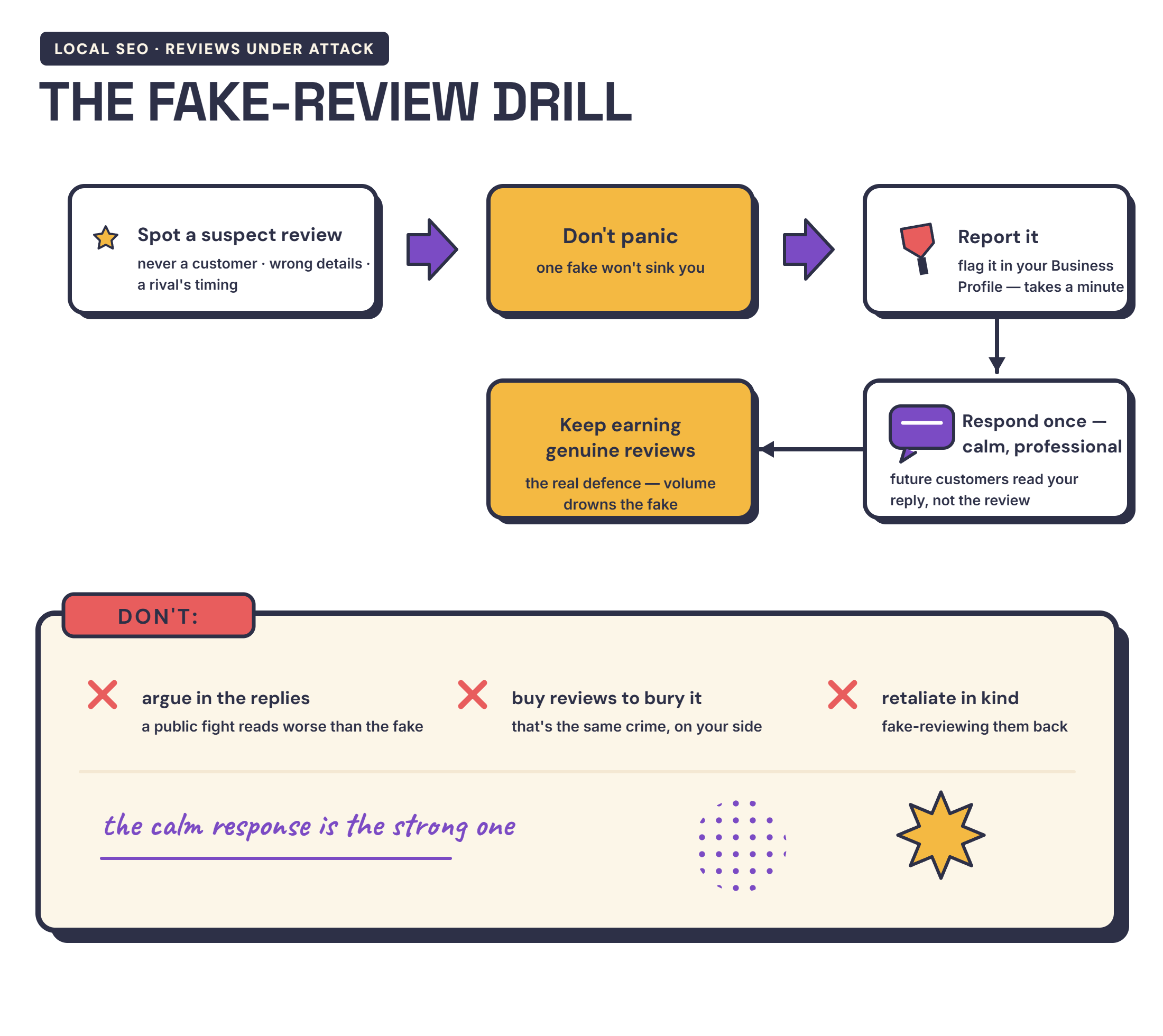
Should I panic about a fake review?
No. A single fake review among a healthy collection of genuine ones won’t destroy your business. Most people can spot an obvious fake — vague language, no specific details, a reviewer with no other activity. And Google’s AI systems are catching more of them than ever.
The worst thing you can do is react emotionally. The second worst thing is ignore it entirely.
How do I report a fake review to Google?
In your Google Business Profile, find the review, click the three dots, and select “Report review.” Google will assess whether it violates their content policies — things like spam, fake content, off-topic reviews, or reviews meant for a different business.
For straightforward violations, Google typically acts within a few days. More contested reviews can take one to four weeks. If your initial report is rejected, you get one appeal through Google’s Reviews Management Tool.
If you’re being targeted by a coordinated attack — multiple fake one-star reviews appearing within hours — there’s a specific tool for that. Google launched a dedicated extortion report form in late 2025. Local SEO professionals report that submissions through this form get fake reviews removed within days rather than weeks.
Should I respond to fake reviews?
Yes. This is the part most people skip, and it matters more than you’d think.
Leave a calm, brief response: “We don’t have a record of this interaction — please contact us directly so we can look into it.”
That does two things. It signals to anyone reading that the review may not be genuine. And it shows future customers that you take feedback seriously and handle it like a professional.
Don’t argue. Don’t accuse the reviewer of being fake — even if it’s obvious. Just respond and move on.
What should I avoid doing?
Don’t buy positive reviews to push the fake ones down. Google calls this “review jail.” Businesses caught soliciting fake five-star reviews have been blocked from receiving any new reviews at all — for up to eight months. That’s worse than the fake one-star you were trying to bury.
Don’t get friends or family to post reviews. Google detects review patterns — same device, same location, same network. Getting caught manipulating reviews can result in your entire review profile being penalised.
Don’t pay the extortionist. Review extortion scams follow a predictable pattern: a flood of fake one-star reviews, then a message offering to remove them for a fee. It’s a scam, and paying only guarantees more demands. Report it to Google using the extortion form, and report it to the ACCC as well.
What’s the best long-term defence against fake reviews?
Volume. A steady flow of genuine reviews makes the occasional fake one irrelevant.
If you’ve got 60 real reviews and one suspicious one-star, nobody’s paying attention to the outlier. But if you’ve got 4 reviews and someone leaves a fake one-star, it tanks your average and there’s nothing to counterbalance it.
That’s why having a review process matters so much — and why having templates ready to go makes it easier to actually run that process. It’s not just about your star rating or your SEO — it’s insurance against the day a fake review shows up.
Here’s something else worth knowing: a perfect 5.0 rating actually hurts you. Research from Northwestern University found that purchase likelihood peaks somewhere in the 4.0 to 4.7 range. Consumers see a perfect score and assume it’s too good to be true. A few honest three and four-star reviews mixed in with your fives makes you look more credible, not less.
So the goal isn’t perfection. It’s consistency. Keep asking, keep responding, and let the quality of your work speak through the reviews of people who actually hired you.
If you need help setting up a review process that runs in the background, book a free 15-minute chat. Or if you’re dealing with fake reviews right now and want a hand, same link — I’ll walk you through what to do.
Frequently asked questions
How do I report a fake Google review?
In your Google Business Profile, find the review, click the three dots, and select 'Report review.' Google will assess whether it violates their content policies. For straightforward violations, Google typically acts within a few days. If your report is rejected, you get one appeal through Google's Reviews Management Tool.
Should I respond to a fake Google review?
Yes. Leave a calm, brief response like 'We don't have a record of this interaction — please contact us directly so we can look into it.' This signals to anyone reading that the review may not be genuine, and it shows future customers that you handle feedback professionally.
What is Google review jail?
Review jail is when Google blocks a business from receiving any new reviews after catching them soliciting fake five-star reviews. This block can last up to eight months. During that time, customers can still write reviews, but they simply won't publish. It's far worse than the fake review you were trying to bury.
Got a question? Need some advice?
Book a free 15-minute call. No pitch — just straight answers. Most people walk away with a clear next step or a blocker sorted.
Book a Free Call →