
Coaches and consultants have the strangest calendar maths in small business: you sell your presence by the hour, and the admin quietly eats the hours. Every scheduling email, every no-show, every “just following up” you meant to send — that’s inventory leaking out of the warehouse.
My position is simple: your time is best spent strategising or with clients. Automate the repetitive, keep the personal touches. But in your industry, that second half carries more weight than anywhere else — so let’s do this properly.
The rule that’s different for coaches
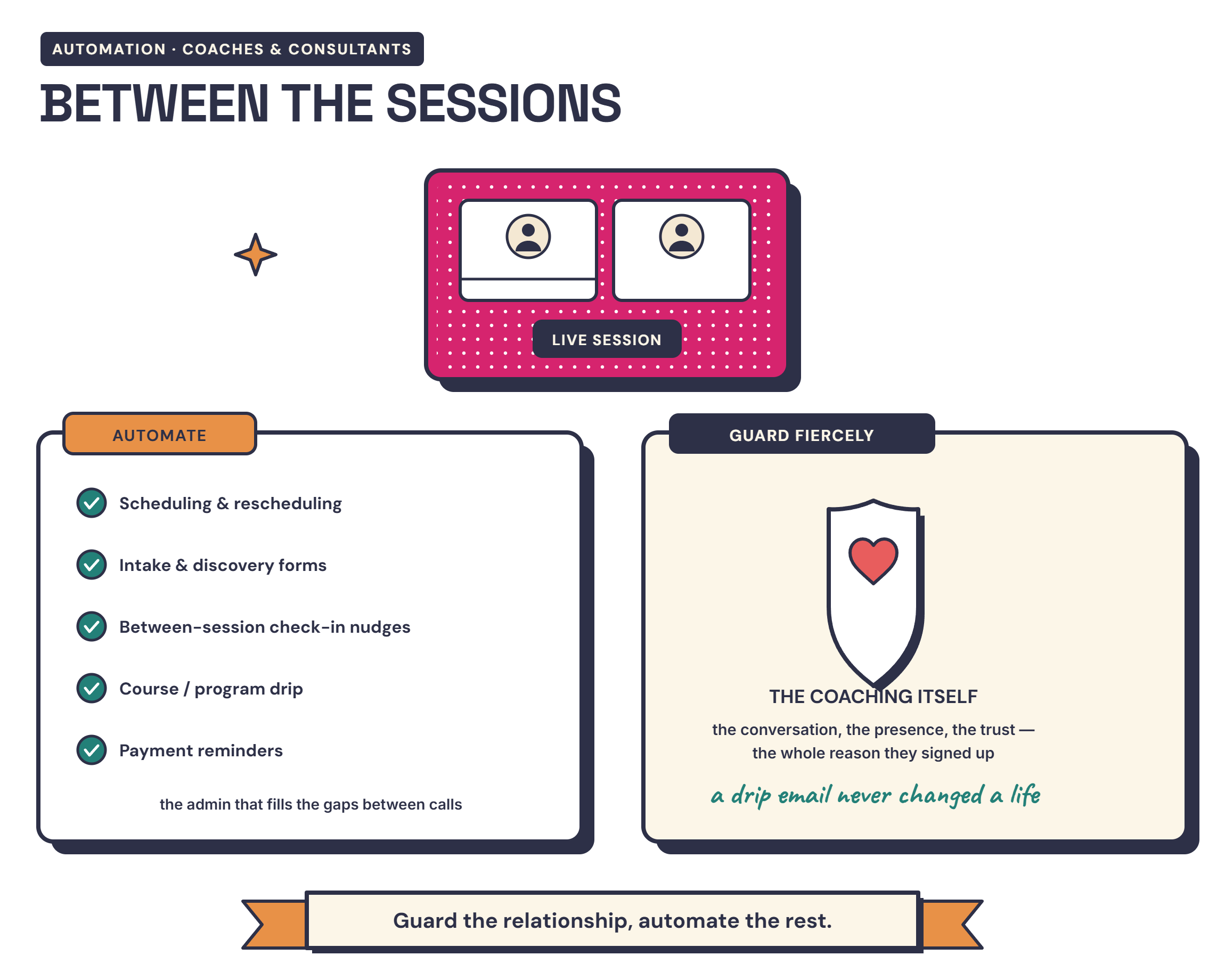
I’ve written about why I won’t let AI answer my own phone: my whole business is about me, and the people calling want the person, not a proxy. Coaches and consultants sit closer to my side of that rule than any other industry. Your clients are buying you: your judgment, your attention, your presence.
Which means the automation strategy flips. For a salon, automation can stand between the business and the phone. For a coach, automation goes around the relationship, never inside it. It handles everything that isn’t you, so more of you reaches the client. Get that distinction right and everything below is safe. Get it wrong and you’ve automated away the product.
What to automate first
Discovery-call booking and reminders. Your sales motion probably runs on discovery calls, and a no-show there costs more than a missed appointment — it costs the whole client. A booking link with automatic reminders is the single cheapest fix in your business, and it means prospects book at 9pm when the motivation struck, not three email round-trips later.
The post-call follow-up. Here’s where most coaching sales actually die: not in rejection, but in silence. Someone has a great discovery call, isn’t ready to commit, and falls into the void — because manually chasing feels needy and busy weeks swallow good intentions. A gentle follow-up sequence in your own words keeps the door open without you chasing: a thank-you, a useful resource, a no-pressure check-in weeks later. Written once, by you, sounding like you — working forever.
Client onboarding. The moment someone signs: welcome email, intake questionnaire, session prep, calendar links — the whole pack, fired automatically. New clients feel looked after in minute one, and you didn’t touch a thing. This is the same chase-and-deliver pattern I build everywhere, wearing a coaching uniform.
The between-session question
This is where coaches get tempted, and where the line matters. Scheduled resources, homework nudges, session reminders — all excellent, all clearly systems doing system jobs. But a mid-week “just thinking of you, how’s the progress?” that pretends to be personal and isn’t? That’s trust spent to save minutes, and in a business built entirely on trust, it’s never worth the trade.
So run everything through the trust test: if your client discovered this message was automated, would they mind? Homework reminder — nobody minds. Fake-personal check-in — everybody minds. When in doubt, either make it genuinely you, or make it honestly a system. The dishonest middle is the only wrong answer.
Group programs and courses
Running cohorts or thinking about a course? The same system that handles your one-on-one admin runs cohort onboarding, scheduled module releases, and group session reminders — which is why so many coaching businesses end up on all-in-one platforms. Selling digital products properly deserves its own honest treatment, and it’s coming in a future post.
Getting it built
The setup follows the same rules as everything I build: one thing first, the easiest thing, tested properly — then the next. And a pattern worth naming: coach-land is full of half-finished funnel builds abandoned at eighty percent. Finishing one is almost always cheaper than restarting — bring it as-is, unfinished is fine.
If your follow-up currently depends on memory and good intentions, that’s the leak. Fifteen minutes, your discovery-call no-show rate, and an honest look at what happens to your “maybes” — and I’ll tell you exactly what to automate first, what it’d cost, and which parts of your business should never touch a workflow.
Frequently asked questions
What should a coach automate first?
Discovery-call booking with automatic reminders — it protects your sales motion from no-shows. Then the post-call follow-up sequence, because most 'maybe' prospects are lost to silence, not rejection. Then client onboarding: welcome, intake and session prep, fired the moment someone signs.
Should coaching check-ins be automated?
Run the trust test: if your client discovered the message was automated, would they mind? Homework nudges and scheduled resources pass easily. A check-in that pretends to be personal and isn't — that's trust spent to save minutes, and it's never worth the trade.
Can group programs and courses run on the same system?
Yes — cohort onboarding, scheduled module releases and session reminders all run on the same platform as your one-on-one admin. Selling digital products properly is its own topic, and it's coming in a future post.
Got a question? Need some advice?
Book a free 15-minute call. No pitch — just straight answers. Most people walk away with a clear next step or a blocker sorted.
Book a Free Call →