
Would I let AI answer my phone? No. And I build this stuff for a living.
Stay with me, because the reason I won’t is exactly the reason it might be brilliant for you — and understanding the difference will save you from both the hype and the knee-jerk “never.”
Why I won’t use one myself
My whole business is about me. When someone calls Plain Speak, they’re calling to talk to Danny — the same person who’ll build their site, answer their questions, and pick up when something breaks. Putting an AI between us would undermine the exact thing they’re paying for: direct access to the person accountable.
So here’s the rule I’d extract from that: if you are the product, guard your phone. Consultants, advisors, anyone whose customers are buying a relationship with a specific human — the receptionist question answers itself, and the answer is no.
When the same logic flips completely
Now picture a solo salon operator. Her product isn’t her voice on the phone — it’s her hands and her attention on the client in the chair. And every time the phone rings mid-appointment, it steals from exactly that.
For her, an AI receptionist taking booking calls doesn’t make the business less personal. It makes it more personal — because she can be more present with the client in front of her. And that’s something every client appreciates when it’s their turn in the chair and she’s not answering the phone every five minutes.
Same rule, inverted: if calls interrupt the thing customers are actually paying for, the AI protects the personal touch rather than replacing it.
What do customers actually think?
Better things than the sceptics assume. Eliciting Insights’ US healthcare research on booking behaviour found consumers making around 60% of their appointments online versus 33% by phone, with demand for self-service booking exceeding 90% across every generation — including 92% of Baby Boomers. (It’s US healthcare data from a few years back, so treat the exact numbers as directional — but the direction is unmissable.)
The honest truth is a lot more people would rather book online or through an agent than talk to a person. I know I would. The “my customers will hate it” objection is increasingly a story owners tell themselves — usually the owners who’d hate it, projecting.
How to do it without putting anyone off
Three rules, non-negotiable.
Never make it the only option. Build in a “press 1 to go through to the salon” escape hatch from day one. The AI should be a convenience people choose, not a wall they hit.
Educate, don’t ambush. Tell your regulars why: “booking through the agent means I’m fully with you when you’re in the chair.” Framed that way, the AI becomes part of the service promise. Give it time — adoption is an arc, not a switch.
Keep the sensitive stuff human. Same as all my automation: handle the ninety-odd percent, and route anything delicate or complicated to a person, always.
Then do the quiet maths: you don’t need everyone to use it. Even if half your regular clients book through the agent, that’s a fifty percent reduction in interruptions — for a business whose product is uninterrupted attention, that’s not a gadget, that’s margin.
What does it cost?
Voice AI is usage-based — the platforms charge per minute of conversation, and the going rate works out to roughly 20 to 25 cents Australian a minute once conversion is counted. A solo operator whose agent takes forty short booking calls a month is looking at a few dollars a week; a quiet month costs next to nothing. The real investment is the setup: designing the call flow, the escape hatch, and what the agent can and can’t promise on your behalf.
Are you ready for one?
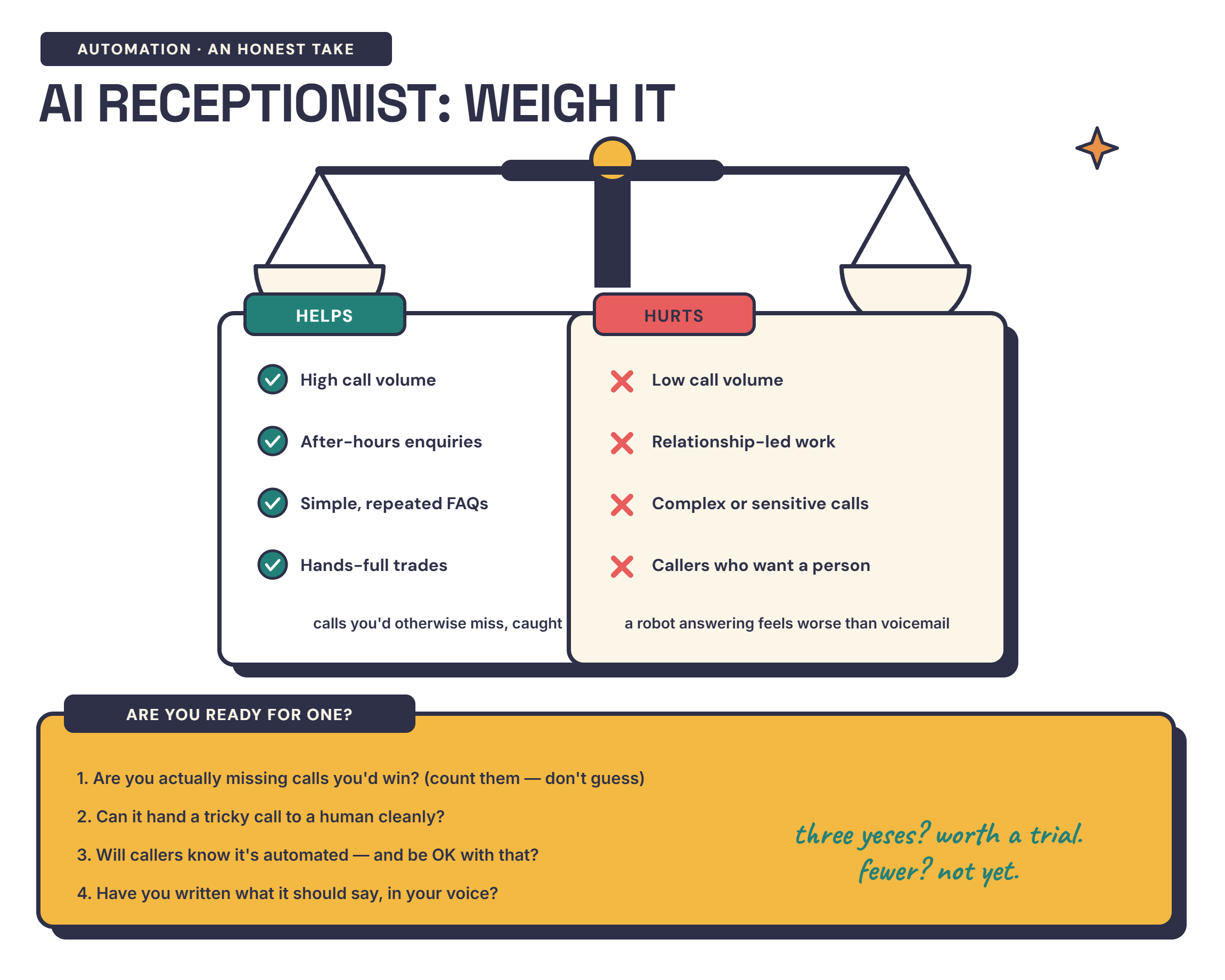
A checklist, in the spirit of the readiness check I published for automation generally. You’re probably ready if: calls regularly interrupt you mid-client; most calls are bookings or the same few questions; you already offer online booking (the agent just extends it after hours and mid-appointment); and you can honestly describe your booking process out loud in under a minute.
You’re probably not if: you are the product and callers want you specifically; your call volume is a handful a week; or every call is sensitive, complex, or high-stakes. No shame in any of those — the right answer for my own business is “no” too.
And if you’re thinking about it? That’s a pretty great first stage, and it probably means it’s worth looking into. Fifteen minutes, no pitch — I’ll walk you through what one would sound like for your business, the honest maths at your call volume, and whether the answer for you is yes, no, or not yet.
Frequently asked questions
Will customers hate talking to an AI receptionist?
Fewer than you'd think, and falling. Independent research puts demand for self-service booking above 90% across every generation — including 92% of Baby Boomers. The key is choice: keep a press-1-for-a-human option so the AI is a convenience, never a wall.
How much does an AI receptionist cost?
Voice AI is usage-based — think roughly 20 to 25 cents Australian a minute once conversion is counted. At solo-operator volumes, that's often a few dollars a week, and quiet weeks cost almost nothing. The setup and call-flow design is the real investment.
Should every small business get one?
No — and I'm the proof. If your customers are calling to reach you specifically, an AI in the middle damages exactly what they're buying. It earns its place where calls interrupt the paid work: salons, clinics, solo operators with their hands full.
Got a question? Need some advice?
Book a free 15-minute call. No pitch — just straight answers. Most people walk away with a clear next step or a blocker sorted.
Book a Free Call →