
What Is Automation? A Plain-English Explanation
Automation is one of those words that sounds like it belongs in a corporate IT meeting — something for big companies with dedicated tech teams and six-figure software budgets.
The reality is simpler than that, and a lot more useful.
What automation actually means
The simplest way to put it: automation is when a system does something automatically because something else happened first.
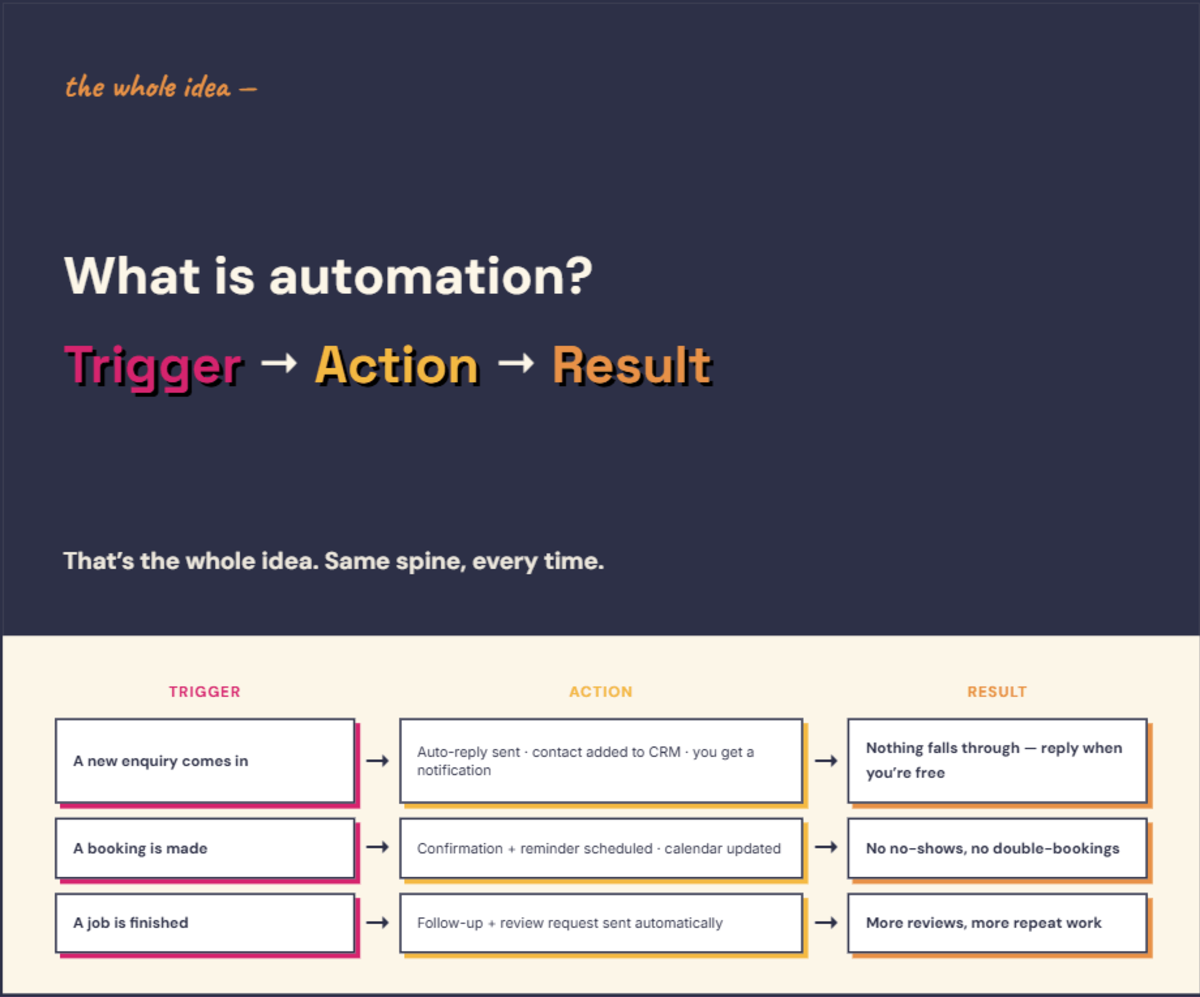
A trigger occurs, and one or more actions follow — without anyone having to manually make them happen.
You’ve already experienced this dozens of times as a customer. You’ve just probably not thought of it that way.
What it looks like in practice
Booking a doctor’s appointment online. You pick a time, confirm your details, and within seconds there’s a confirmation in your inbox. A day or two before the appointment, a reminder arrives — maybe with a link to fill in your forms in advance. None of that was a receptionist manually sending emails. The trigger was your booking. The actions were the confirmation, the intake form, and the reminder.
Signing up to a newsletter. You enter your email on a website to download a free guide. Immediately, an email arrives with the download link. A day later, a welcome message. The following week, an update. The business owner didn’t add you to a list manually or type out those emails one by one. Your sign-up was the trigger. Everything that followed was automated.
Buying something online. Order confirmation, shipping update, delivery notification, review request a week later. All automated. The trigger was the purchase. The system handled the rest.
Once you start seeing it this way, you notice it everywhere. And more importantly, you start seeing where the same logic could apply in your own business.
Why it’s particularly useful for solo operators
If you’re running a business on your own — or with a very small team — you’re already wearing every hat. Sales, marketing, client work, admin, accounting, IT. The list doesn’t stop.
The tasks that quietly drain solo operators aren’t usually the big obvious ones. It’s the time creep — the things that take three or four minutes each, but happen multiple times a day, every day. Sending a booking confirmation. Following up on an enquiry that came in yesterday. Reminding a client their appointment is tomorrow. Each one feels small. Added up across a week, they’re a significant chunk of time that has nothing to do with the actual work your business does.
A bigger business can hire someone to handle that. Automation can do the same job for a fraction of the cost — and it doesn’t forget.
How it works: triggers and actions
Every automation has two parts.
A trigger is the thing that starts it. A form submission. A booking. A payment. Someone opening an email. A specific date arriving. A contact being added to a list.
An action is what happens as a result. Send an email. Send an SMS. Add a tag to a contact. Create a task. Move someone to a different stage in your pipeline. Send you a notification.
One trigger can set off a whole chain of actions. A new enquiry comes through your website form (trigger) → a confirmation email goes out automatically (action) → the contact is added to your CRM (action) → you get a notification on your phone (action) → if you haven’t responded in 24 hours, a follow-up reminder fires (action).
That whole sequence runs while you’re doing a job, driving between clients, or not working at all.
The range of what’s possible
To give you a sense of how wide this goes, here’s a sample of triggers and actions you can work with in a typical automation platform.
Triggers — things that start an automation:
| Trigger |
|---|
| A form on your website is submitted |
| An appointment is booked |
| A payment is received or missed |
| Someone comments on a Facebook post |
| A contact is added to your CRM |
| A specific date arrives (e.g. a renewal, a follow-up deadline) |
| A customer doesn’t show up for an appointment |
| Someone clicks a link in one of your emails |
| A job or task is marked as complete |
| A new review is received on Google |
Actions — things the system does automatically:
| Action |
|---|
| Send an email or SMS |
| Update a spreadsheet or CRM record |
| Add or remove a tag on a contact |
| Create a task or reminder for you |
| Send a notification to your phone |
| Move a contact to a different pipeline stage |
| Generate and send an invoice |
| Start a multi-step follow-up sequence |
| Notify a team member |
One trigger can set off multiple actions. And actions can themselves become triggers for the next step in the sequence.
What automation isn’t
It’s not magic, and it’s not a replacement for actually running your business well.
The most common mistake I see is someone trying to automate a process before they’ve got a clear, consistent process to automate. If your intake varies wildly from client to client — if every new enquiry gets handled a bit differently depending on how busy you are — there’s nothing for a system to reliably follow.
Not every task is suitable for automation either. Anything that genuinely requires human judgement, personal context, or emotional nuance probably shouldn’t be automated. A client who’s frustrated doesn’t want a templated response. A complex quote that depends on a conversation shouldn’t be replaced with a form.
The sweet spot is the repeatable stuff — tasks that should always happen the same way, that you’re currently doing manually, that don’t actually require you to be involved. Start there.
Where to start
You don’t need a complicated system to get value from this. Pick the one task that costs you the most time each week — usually booking confirmations and reminders, or follow-ups on new enquiries — and get that working first.
For most service businesses, the sequence looks something like this:
- New enquiry comes in via website form
- Automatic confirmation sent to the customer
- Contact added to CRM with their details
- You get a notification to follow up
- If no response from you in 24 hours, a gentle follow-up goes to the customer automatically
That’s five things that currently require manual effort, running on their own. And that’s before you’ve touched bookings, reminders, review requests, or anything else.
The tools to do this aren’t expensive. Entry-level automation platforms start around $10–15 a month. All-in-one platforms that bundle everything into one place cost more, and whether that’s worth it depends on how many separate tools you’re already paying for — I’ve written a plain-English guide to consolidating your business tools to help you weigh it up. And if you want to know what a done-for-you setup looks like, check out my Automation & AI service.
What it comes down to
Automation won’t fix a broken business process, and it won’t replace genuine human connection with your clients. But for the repeatable, administrative tasks that are quietly eating your week? It’s one of the most practical things a solo operator can put in place.
Start with one thing. Get it working. Then build from there. If you want specifics, here are the five automations I set up for almost every service business — they’re where most people get the quickest return. Not sure if you’re ready? Work through the automation readiness self-assessment. Or if you want to see exactly what automation could look like in your industry — trades, beauty, allied health, coaching, hospitality, and more — the guide for 8 Australian business types walks through a typical day in each one and shows exactly which tasks to hand off.
Frequently asked questions
What is business automation?
Business automation uses software to handle repetitive tasks automatically — things like sending emails, confirming bookings, or following up with leads. It saves time and reduces the chance of things falling through the cracks.
How do you automate business processes for a small business?
Start by identifying tasks you do the same way every time — booking confirmations, follow-up emails, invoice reminders. Then use a tool like Zapier or Make to set up triggers that handle those tasks automatically.
How do I automate my business?
Begin with one simple automation, like an auto-reply to new enquiries or an automated booking confirmation. Get that working reliably, then add the next one. Trying to automate everything at once is the most common reason automation projects fail.
Got a question? Need some advice?
Book a free 15-minute call. No pitch — just straight answers. Most people walk away with a clear next step or a blocker sorted.
Book a Free Call →