
The subscription is the cost everyone knows about — it’s on the pricing page, it’s in the ads, it’s the number you budgeted for, and it’s the one I break down in what an online store actually costs in Australia. This post is about the other numbers — the ones that arrive after you’ve signed up.
If you’ve already met a few of these the hard way, you’re in good company. None of them are scams; most are perfectly reasonable. They’re just rarely mentioned up front, and a budget built on the headline price alone is a budget about to be surprised. Here are the nine I brief every client on before we build.
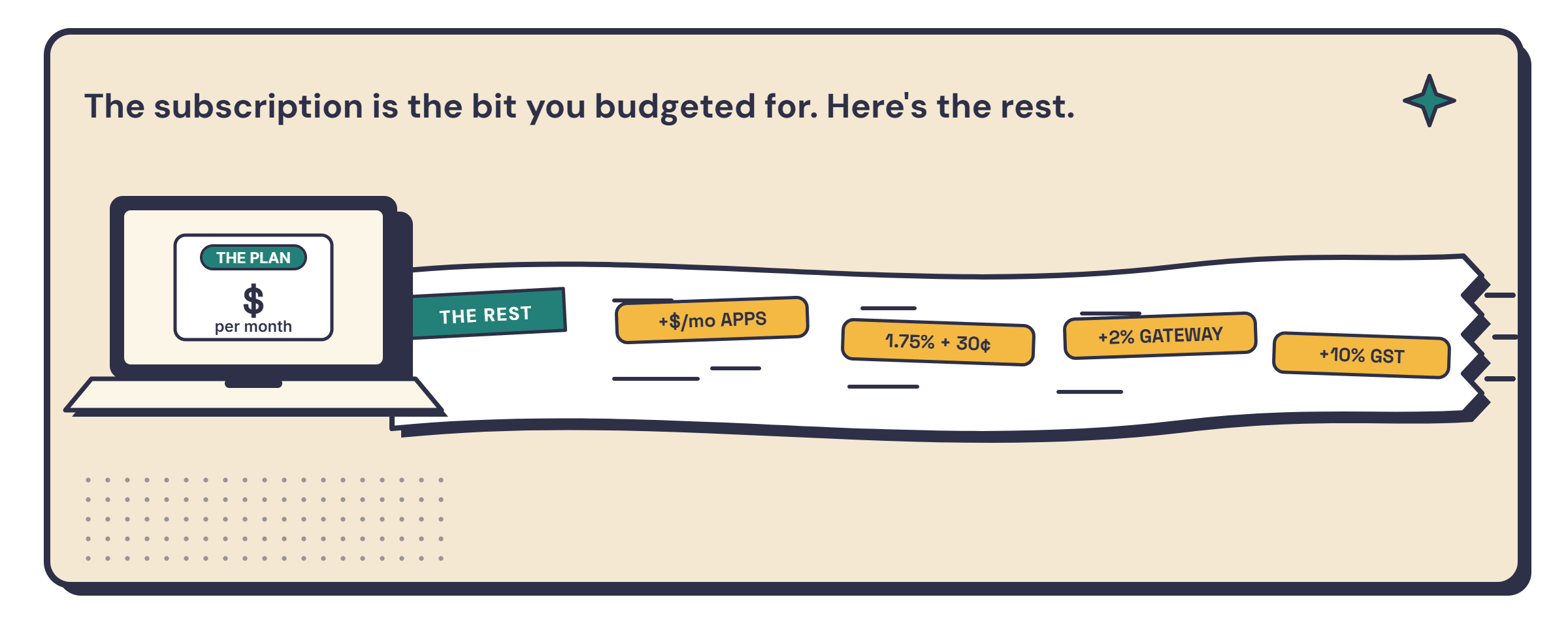
1. Apps that turn “standard” into “subscription”
Most customisation beyond the basics needs an app, a plugin, or custom code — including things you’d swear were standard. A baker I know wanted something completely reasonable: let customers pick their cake, then choose a future pickup date on a calendar. On the platform, that meant apps — plural — each with its own ongoing monthly fee. A perfectly reasonable request — that she’d now be renting forever.
Paid apps average around US$60 a month, and even a modest handful puts typical small-store app spend at US$50–200 a month. The full worked example is in my Shopify pricing breakdown.
2. Payment processing on every single sale
Roughly 1.75% + 30¢ per domestic card sale, whoever you’re with — more for international cards and Amex. It scales with success, which makes it the healthiest cost on this list, but it’s still money: on $5,000 of monthly sales, call it a hundred dollars.
And a 2026 wrinkle: from 1 October, card surcharges are banned, so you can’t hand this cost to the customer as a checkout fee. It lives in your prices now.
3. The gateway penalty
Use a payment provider other than your platform’s built-in one, and some platforms charge you extra for the privilege — on Shopify’s Basic plan it’s an additional 2% per sale on top of your gateway’s own fees. It’s the quiet reason “I’ll just use my existing provider” can be an expensive sentence.
4. Currency conversion
Selling across the ditch or beyond? Conversion typically adds around 2% on top of the card rate. Worth knowing before you cheerfully tick “sell internationally” — and worth pricing in, not discovering on your first NZ order.
5. Marketplace extras
If a marketplace is one of your channels, the headline fee isn’t the whole fee. Etsy’s offsite ads take 12–15% of the sales they bring in — read the current terms on when you can and can’t opt out. eBay’s international sales fee is now 3%. Every platform’s “small” percentages are small until they’re on every sale, forever.
6. Shipping and the packaging you forgot
Postage went up again this July — Parcel Post rose about 5% — and satchels, boxes and tape are real line items once you’re sending things weekly. Meanwhile surveys consistently put free shipping at the top of Australian shoppers’ delivery preferences, which in practice means shipping comes out of your margin, not on top of it. Budget accordingly and price with your eyes open.
7. GST on your own tools
Your subscriptions usually attract 10% GST — and on Shopify specifically, it’s added unless you’ve entered a valid ABN in your billing settings. Two-minute fix, 10% saved monthly. Check the rest of your stack while you’re at it.
8. The meter that runs while you build
The sneakiest one. The subscription starts the day you sign up — not the day you launch. I’ve watched people pay for a store for the better part of a year with nothing live but a title and a hero image. That’s rent on an empty shop, and the sunk cost makes it harder to stop each month. If that’s you right now — what you’ve built isn’t wasted yet, but it will be if it stays parked.
9. Your time — before launch and after
The learning curve is the cost nobody invoices you for. Every section of a store build is a new system to figure out, and “I’ll do it myself on weekends” is how month one becomes month six. Then after launch, the store needs running: orders packed, enquiries answered, returns handled. Someone in the business owns that job. Make sure it’s budgeted like everything else on this list.
Surprises are optional
Hidden costs are only hidden when nobody tells you. Every number above is knowable in advance — which is why my store builds have one published price, with the ongoing costs spelled out before you commit, not discovered after.
If you’d like your own no-surprises budget — the real monthly number for your product, your volumes, your channels — bring it to a free 15-minute chat. Fifteen minutes now beats twelve months of “oh, I didn’t know about that.”
Frequently asked questions
What's the biggest hidden cost of running an online store?
Honestly? Your time — first in the learning curve, then in the daily running: packing, shipping, enquiries, returns. Of the money costs, apps are the usual surprise: features that sound standard often carry their own monthly fee.
Can I avoid payment processing fees?
No — every card sale costs roughly 1.75% + 30¢ or more, whoever you're with. And from 1 October 2026 you can't pass it on as a card surcharge, so it belongs in your prices from day one.
How much should I budget beyond the platform fee?
For a small store trading steadily, the all-in monthly figure typically lands around three to four times the headline subscription once apps and processing are counted. My Shopify pricing breakdown shows a worked example.
Got a question? Need some advice?
Book a free 15-minute call. No pitch — just straight answers. Most people walk away with a clear next step or a blocker sorted.
Book a Free Call →