
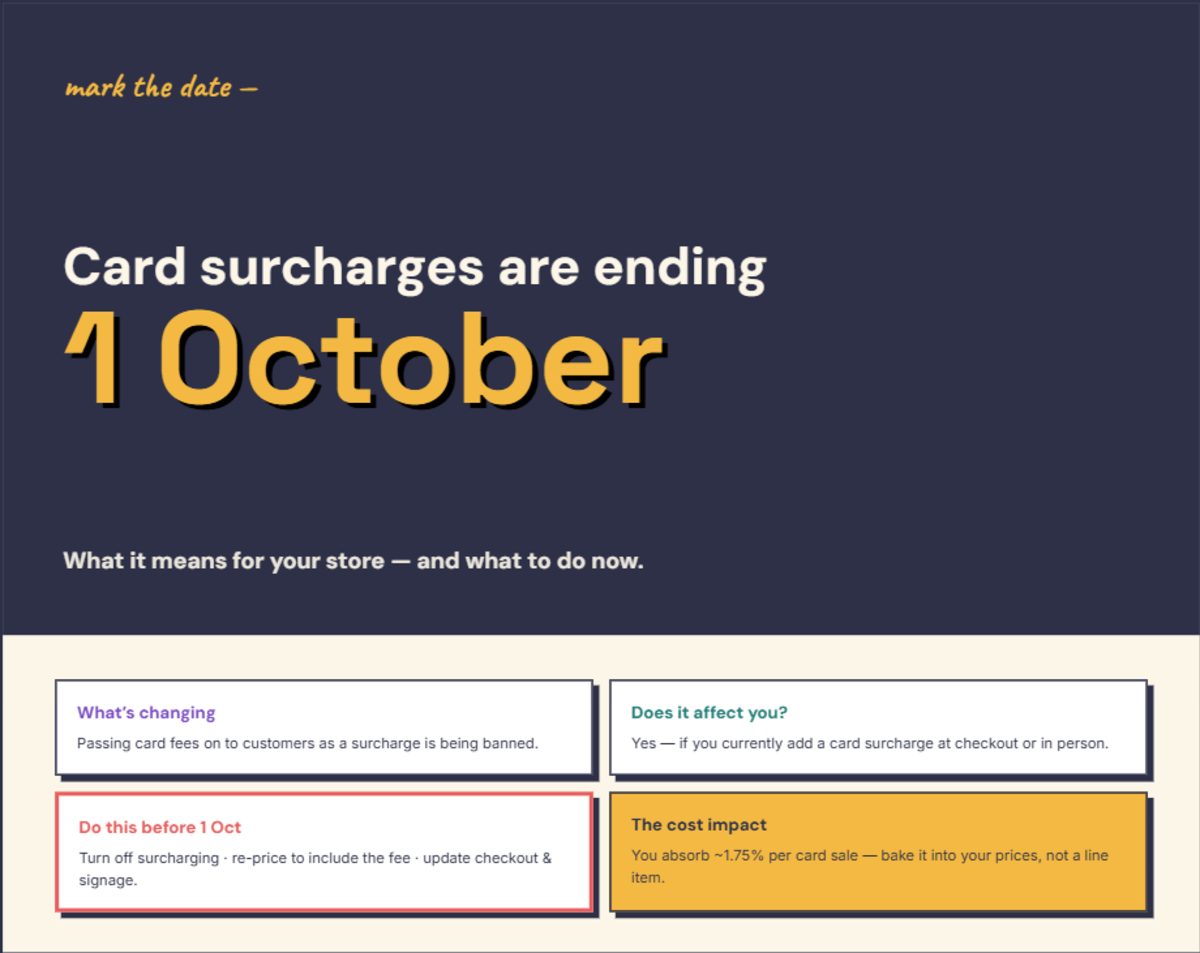
If your business adds a card surcharge — the 1.5% at the counter, the “card fee” line at your online checkout — it has an expiry date. From 1 October 2026, surcharging on eftpos, Mastercard and Visa payments is banned in Australia. Debit and credit both.
This one isn’t a maybe. The Reserve Bank confirmed it in March after a long review of card payment costs. About 16% of Australian businesses currently surcharge, and consumers pay around $1.6 billion a year in those fees. On top of removing that, the RBA expects lower interchange caps to cut what businesses pay for card acceptance by around $910 million a year.
Here’s what’s changing, and what to do about it before October.
What’s actually changing?
Two things, and they’re designed to work together.
First, the ban itself: from 1 October 2026, you can’t add a surcharge to eftpos, Mastercard or Visa payments. Not on debit cards, not on credit cards, not at the counter, not at your online checkout.
Second — and this is the part most coverage skips — the fees behind your card payments are being cut too. The caps on interchange fees (the wholesale cost that flows into what your payment provider charges you) are dropping significantly, with further changes for foreign cards from April 2027. The idea is that accepting cards gets cheaper at the same time as passing the cost on gets banned.
Will those savings fully reach every small business? That depends on your payment provider passing them through. Worth asking them directly — more on that below.
Does this affect your business?
If you never surcharge, nothing changes — you’re already doing what the rule requires.
If you do, this applies to you regardless of how you take payment. The cafe with the sign near the EFTPOS machine. The tradie whose invoice adds 1.5% for card. And yes — the online store with a “card processing fee” at checkout. A percentage added at your payment step counts the same as one added at the counter.
What should you do before October?
Four jobs, none of them huge.
Reprice. The cost of accepting cards doesn’t vanish — it moves into your prices. Work out what surcharging currently recovers for you and build it in. For most small businesses this is a small, boring adjustment, and it’s better done deliberately in August than in a panic on 30 September.
Switch the surcharge off. In your point-of-sale settings, your invoicing software, and your online checkout. If your store adds a card fee through your payment settings or an app, that’s the thing to change.
Update the words. Terms and conditions, checkout text, the laminated sign by the till. Anything that mentions a card surcharge needs to go.
Ask your provider about your rates. The same reform lowers the wholesale fees your provider pays. It’s fair to ask when — and whether — that flows through to what they charge you. If the answer’s vague, it might be time to compare providers.
For the specifics of your own pricing and tax treatment, run it past your accountant — that’s exactly what they’re for. The RBA and your payment provider both have plain-language resources on the change worth reading first.
Will this cost you money?
Honest answer: it shifts money around, and where you land depends on your setup.
If you surcharge today, you’ll recover that cost through prices instead — visible to customers in a different way, but not a new cost. Meanwhile the fee cuts underneath should make card acceptance genuinely cheaper over time. Businesses that never surcharged may quietly come out ahead. Businesses that surcharged heavily will feel the transition most, which is exactly why the repricing job is worth doing early and calmly.
What about Amex, BNPL and mobile wallets?
Outside this ban — for now. American Express, buy-now-pay-later and mobile wallets are under a separate review, so don’t change anything there without checking with your payment provider first. If you offer Afterpay or Zip, the merchant fees on those work differently anyway — that’s a whole post of its own.
The short version
If you add a card fee to eftpos, Visa or Mastercard payments, it ends on 1 October 2026. Reprice deliberately, switch the surcharge off everywhere it lives, update your wording, and ask your provider what happens to your rates.
If the checkout side of that is the bit you’re dreading — the settings buried in your store platform or payment gateway — that’s a one-hour job for me, not a one-weekend job for you. Book an hour or start with a free 15-minute chat and it’s handled before the deadline is even close.
Frequently asked questions
Does the surcharge ban apply to online stores?
Yes. A percentage 'card fee' added at your online checkout counts the same as one added at the counter. If your store adds one to eftpos, Visa or Mastercard payments, it needs to be switched off before 1 October 2026.
Do I have to drop my prices when the surcharge goes?
No. Most businesses will fold the cost of accepting cards into their prices — that's the expected outcome of the reform. The same rules also lower the fees behind the scenes, which should reduce what card acceptance costs you over time.
Can I still surcharge Amex or BNPL payments?
The 1 October ban covers eftpos, Mastercard and Visa. American Express, BNPL and mobile wallets sit outside it and are under a separate review — check with your payment provider before changing anything there.
Got a question? Need some advice?
Book a free 15-minute call. No pitch — just straight answers. Most people walk away with a clear next step or a blocker sorted.
Book a Free Call →