When someone sits down with me wanting to sell online, I don’t open a checklist. I ask about the product, and how they got to where they are now. People arrive with their story, and the good stuff — what they’re selling, who it’s for, what’s scaring them — flows out naturally. The checklist can wait ten minutes.
But once the story’s told, the same ground needs covering every single time. So here it is: the honest version of starting an online store in Australia — the one that mentions the boring parts.
First, some context worth knowing: Australians spent $82.6 billion online last year, up 14%, and about a quarter of all retail spending now happens online. The demand is real. The “live in two hours” promise in the platform ads is not.
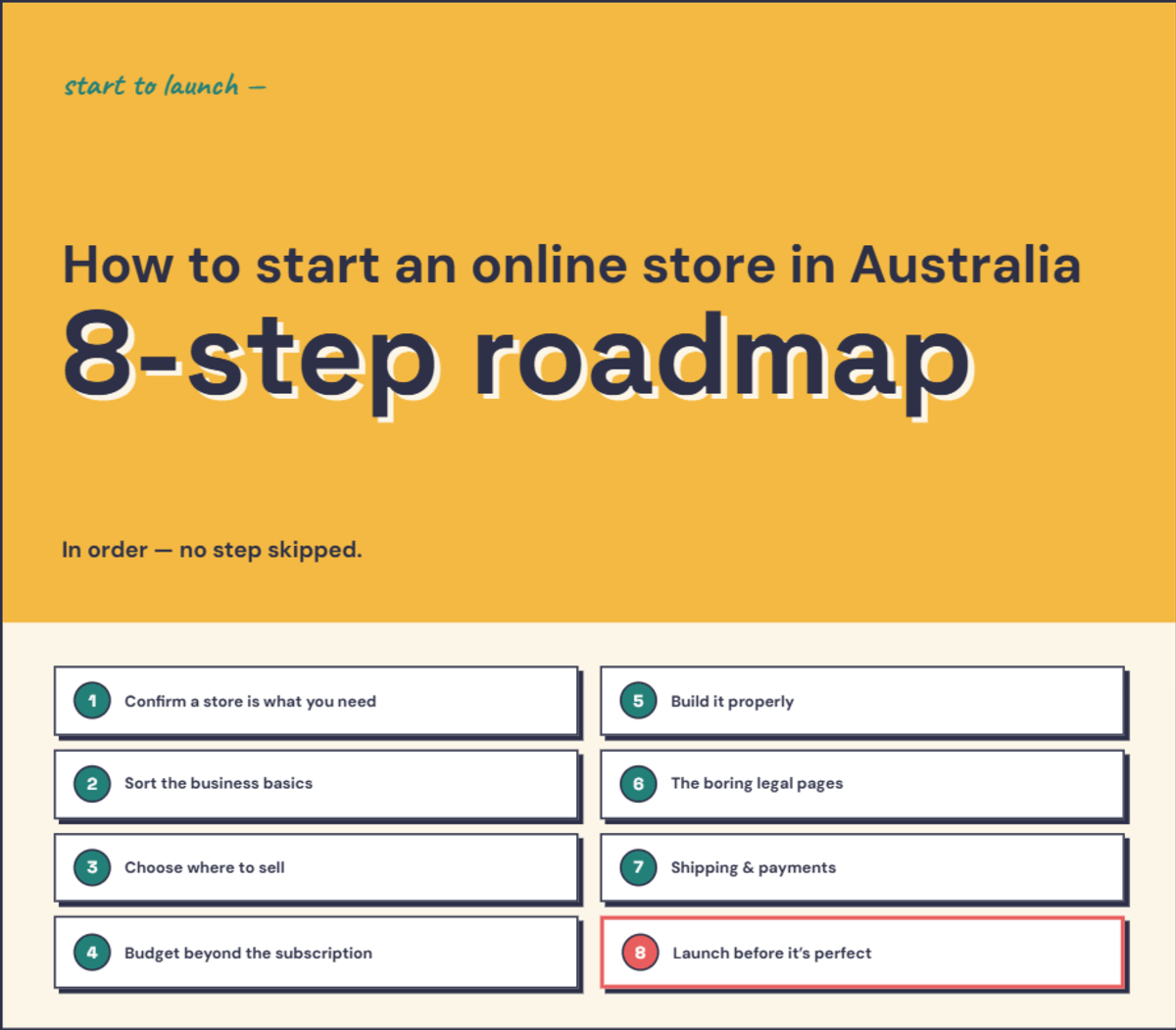
Step 1: Make sure a store is actually what you need
Selling a physical product? A store is probably right. Selling your time — treatments, sessions, consults, classes? You likely want online bookings instead, and here’s a happy secret: bookings are a lot easier to implement than a store. Cheaper, too. I’ve written up exactly this fork in the road.
And if you’re launching a single product to test the waters, you may not need a full store at all — a single-product store build gets one product selling without the platform overhead.
Step 2: Sort the business basics
The unglamorous foundation: an ABN, a registered business name if you’re trading under one, and a bank account that isn’t your personal one. On GST — registration becomes mandatory at $75,000 turnover, and you have 21 days once you get there (or expect to). Whether to register earlier is genuinely a question for your accountant. I can implement whichever way you go; I can’t tell you which way to go. That’s exactly what a licensed accountant is for.
Step 3: Choose where you’ll sell
Two decisions hiding in one step.
Your own store, a marketplace, or both? For most small businesses the answer is both, in the right order — your own store as home base, marketplaces as a secondary channel. The full reasoning (including what eBay’s new free tier does and doesn’t change) is in marketplace vs your own store. And remember Instagram and Facebook are shop windows in Australia now, not shops — purchases complete on your website, so social doesn’t replace this step.
Which platform? For most of my clients it’s Shopify — genuinely straightforward to run day to day once it’s set up (here’s what it really costs), and that day-to-day is where you’ll live. But “once it’s set up” is doing real work in that sentence, which brings us to money.
Step 4: Budget for more than the subscription
The headline price is never the whole price. The subscription is the start; customisation is where costs sneak in, because most things beyond the basics need an app, a plugin, or custom code — often with its own monthly fee. Even features that sound standard. A baker I know wanted customers to pick their cake, then choose a future pickup date on a calendar. Perfectly reasonable request. On the platform, that meant apps with ongoing monthly costs.
Typical small stores end up running a handful of apps, and it adds up quickly. Then there’s payment processing on every sale, shipping materials, and your domain. None of it is a dealbreaker — it just belongs in the budget before you start, not as a surprise in month three. I’ve broken down the full picture, dollar by dollar, in what an online store actually costs in Australia.
Step 5: Build the store properly
This is the stage where stores stall — sometimes forever. The work is real: product photos that look like the product, descriptions that read like a human wrote them (descriptive enough to sell, structured enough for Google — that balance is its own craft), a navigation that makes sense to a stranger, and a checkout you’ve tested on your own phone. Mobile isn’t the edge case; it’s most of your traffic.
A $29 template from Etsy won’t carry a business, and neither will perfectionism. Build it properly — and then, crucially, stop building and start selling.
Step 6: The boring pages that keep you out of trouble
Every Australian store should carry terms and conditions, a privacy policy, a shipping policy, and a returns policy that doesn’t fib. That last one matters: consumer guarantees under Australian law can’t be signed away, and the classic “no refunds” sign is famously illegal. Display prices GST-inclusive, and only email people who’ve actually opted in. The plain-English rundown of all of it is in the legal requirements post — for specifics on your situation, a proper legal template service or advisor beats copying a competitor’s page you found at midnight.
Step 7: Shipping and getting paid
Shipping: most small sellers start with Australia Post — a MyPost Business account gets you discounted bands from your first parcel — with Sendle worth comparing on many routes. Postage went up about 5% this July, so price your shipping from current rates, not memory. And know what you’re up against: surveys consistently put free shipping at the top of Australian shoppers’ delivery preferences, which usually means building shipping into your prices rather than pretending it doesn’t exist.
Payments: once products are live, claim your free Google Shopping listings too. Your platform’s built-in payments or Stripe covers almost everyone — roughly 1.75% plus 30 cents per domestic card sale, only when you actually sell. One deadline to know: card surcharges end on 1 October, so don’t build a “card fee” into your checkout plans.
Step 8: Launch before it’s perfect
I’ve watched stores sit at ninety percent finished for months — waiting for better photos, one more product, the perfect about page. Meanwhile the subscription ticks along and nobody can buy anything. Launch, then improve with real customer feedback instead of imagined objections. A live store earning its first awkward sale beats a perfect store earning nothing.
The part nobody budgets for: after launch
Here’s the honest bit that belongs in every guide and appears in almost none. Once the store is live, someone in your business has to run it. Orders need responding to, packing, and shipping. Enquiries need answers. Returns need handling. A store isn’t a set-and-forget asset — it’s a counter someone has to stand behind, even if the counter is your kitchen table.
Plan for whose job that is before launch day. (Some of it can be automated well — order updates, review requests, abandoned-cart nudges done politely. The packing tape, sadly, cannot.)
Where to start this week
Bring me the story and the product — I’ll bring the checklist. A free 15-minute chat is usually enough to tell whether you need a $1,000 single-product build, a full store, or just a booking button. Published pricing for all of it is on the online stores page, so you’ll know the numbers before we ever speak.
Frequently asked questions
How much does it cost to start an online store in Australia?
Realistically from about $1,000 for a professionally built single-product store up to $2,500+ for a full catalogue build, plus ongoing costs like payment processing and any apps. DIY is cheaper up-front and dearer in time. The full breakdown is in my online store cost guide.
How long does it take to launch an online store?
Done properly, a few weeks — product photos, descriptions, shipping settings, legal pages and testing all take real time. The 'live in two hours' promise in platform ads refers to an empty template, not a working store.
Do I need an ABN or GST registration to sell online?
You'll generally need an ABN to run a business in Australia, and GST registration becomes mandatory once turnover hits $75,000. Whether and when to register earlier is a conversation for your accountant — that's exactly what they're for.
Got a question? Need some advice?
Book a free 15-minute call. No pitch — just straight answers. Most people walk away with a clear next step or a blocker sorted.
Book a Free Call →