
Walk through any shopping strip and you’ll still spot one: the “no refunds” sign. It’s on websites too, usually in the footer, sometimes in bold. And it’s illegal — has been for years.
I’m not writing this to scare you. I’m writing it because the rules for selling online in Australia are genuinely simpler than they look, the regulator has started checking, and knowing the map costs you fifteen minutes. Here’s the plain-English version — the map, not legal advice.
What the law guarantees your customers — whether you like it or not
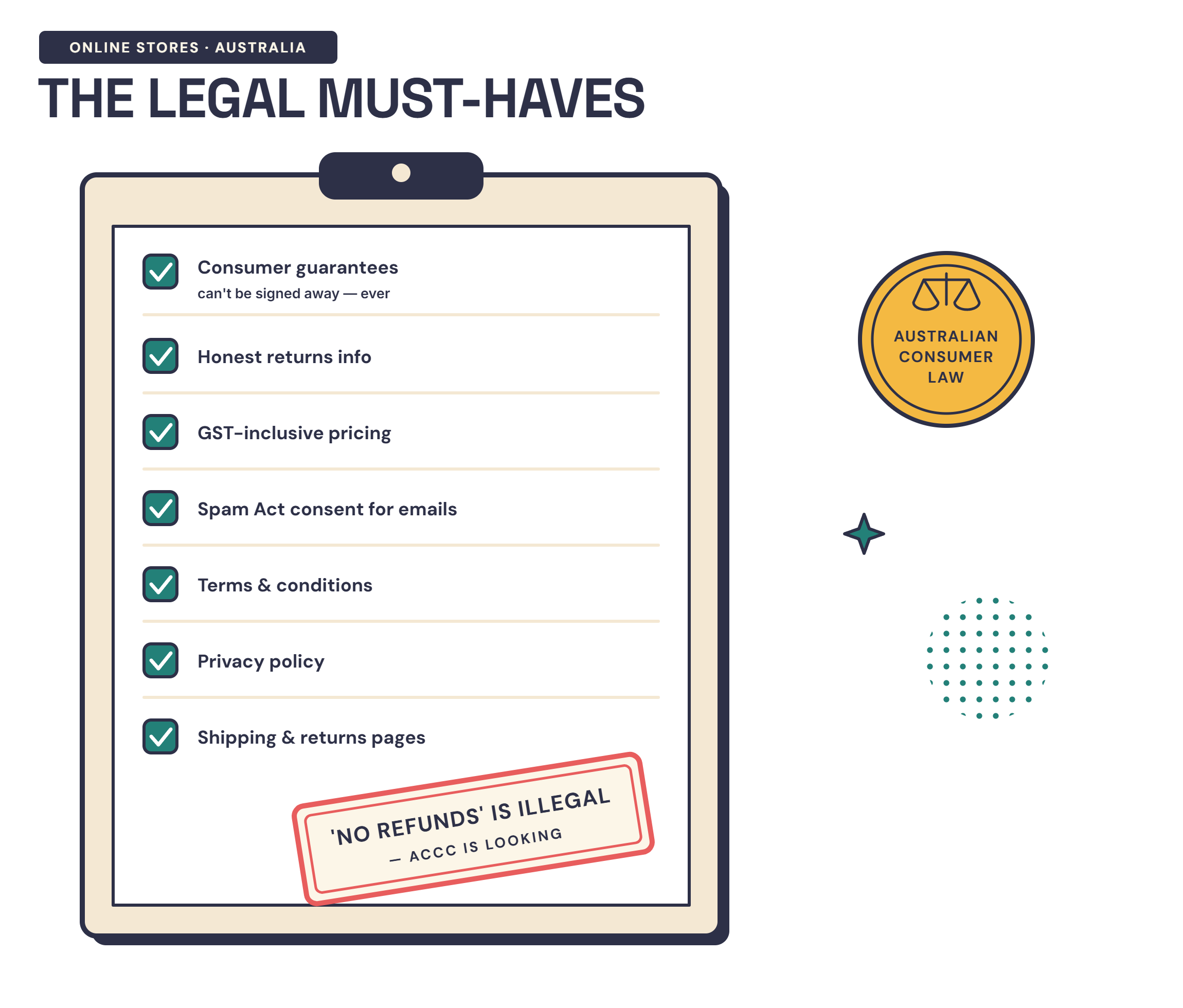
Australian Consumer Law builds guarantees into every sale automatically. Products must be of acceptable quality, fit for their purpose, and match their description. Services must be delivered with due care and skill. No terms and conditions, checkout tick-box or footer sign can switch these off — they’re not your policy to set.
When something’s genuinely faulty, the remedy depends on how bad it is: minor faults can be repaired; major ones give the customer the choice of replacement or refund. Change-of-mind is different — you’re allowed to say no to that. The trouble starts when stores blur the two.
The mistakes the ACCC is actively hunting
In early 2025 the ACCC swept more than two thousand Australian retail websites and reported numerous practices that could mislead people about their exchange, refund and return rights. The hit list is worth reading twice, because every item on it looks reasonable at first glance:
Blanket “no refunds” on sale or made-to-order items. Arbitrary deadlines like “faults must be reported within 30 days” — the law doesn’t work on your calendar. Pointing customers at the manufacturer’s warranty as their only option, when the guarantee sits with you, the seller. And charging restocking or keeping delivery fees on faulty goods.
Thousands of Australians report being denied remedies they were entitled to every year. This isn’t theoretical enforcement either — Mazda copped an $11.5 million penalty over how it handled consumer guarantee claims, and a furniture retailer was fined over misleading refund representations. There’s also a live government proposal to attach civil penalties directly to refusing a required remedy. In my words: there are plenty of stories out there for those who don’t play by the rules — at best through negligence, at worst through deliberately bending them. Don’t be either story.
The pages every store should have
None of this is exotic. Every Australian online store should carry: terms and conditions covering how you sell, a privacy policy covering what you collect and why, a shipping policy with honest timeframes, and a returns policy that tells the truth — one that explains your change-of-mind stance without pretending the consumer guarantees away.
Add your ABN (required on tax invoices, sensible on the site itself), real contact details, and GST-inclusive pricing everywhere a consumer sees a number.
Where to get these? A proper legal template service or a lawyer — not a competitor’s policy lifted at midnight with the business name swapped. Their mistakes become yours, and you won’t know which parts were mistakes.
Privacy, email, and the exemption everyone misquotes
Here’s the current honest state of privacy law for small stores, because there’s a lot of confident misinformation about. If your turnover is under $3 million, you’re presently outside most of the Privacy Act. The government has agreed in principle to remove that exemption — but as I write this, no date is legislated, so treat any confident “it changes in [month]” claim as speculation.
That’s the technical position. The practical one: have a privacy policy anyway. Payment providers and marketplaces expect it, customers trust stores that have one, and since mid-2025 individuals can sue directly over serious invasions of privacy — a door that didn’t exist before. Being technically exempt is a thin place to stand.
Marketing emails are their own set of rules — consent, identification, unsubscribe, no pre-ticked boxes — and I’ve covered the practical side in the abandoned carts post.
Dropshipping? Still your problem
Quick word for the dropshippers: consumer guarantees sit with the business that made the sale. That’s you — whether or not the product ever passed through your hands. Your supplier being slow, overseas or uncontactable is your logistics problem, never your customer’s refund problem. Price that reality in before you build the business.
Where I stand in all this
My lane is clear, and I’ll tell it like it is. I build the store with the right pages in place, the honest returns wording, GST-inclusive pricing, a checkout that collects consent properly. I implement it. What I don’t do is advise on your specific legal or tax position — your lawyer and your accountant exist for exactly that, and they’re worth their fees at setup time far more than at trouble time.
And a quiet truth about how I work: the businesses I take on want at least the basics done right. If cutting these corners is the plan, we’re probably not a fit — and honestly, the corners are cheaper than the consequences anyway.
Setting up a store and want the boring pages done properly from day one? It’s built into every store I deliver — or bring your current site to a free 15-minute chat and I’ll tell you plainly what’s missing. For the official word, the ACCC’s small business resources are genuinely readable.
Frequently asked questions
Is a 'no refunds' policy legal in Australia?
No. Consumer guarantees apply automatically and can't be excluded by a sign or a checkbox — blanket no-refund policies, even on sale items, are exactly what the ACCC's website sweep was hunting. You can decline refunds for change of mind; you can't decline them for faulty goods.
Do I legally need a privacy policy for my online store?
If your turnover is under $3 million you're currently outside most of the Privacy Act — but the exemption's removal has been agreed in principle, payment providers and marketplaces expect a policy anyway, and since mid-2025 individuals can sue over serious privacy invasions. Practically: have one, and mean it.
If I dropship, is the supplier responsible for refunds?
No — you are. Consumer guarantees sit with the business that sold the product, whether or not you ever touched the stock. Your supplier problems are not your customer's problem.
Got a question? Need some advice?
Book a free 15-minute call. No pitch — just straight answers. Most people walk away with a clear next step or a blocker sorted.
Book a Free Call →