
There are around 2.7 million actively trading businesses in Australia, and nearly all of them are small. A surprising share have no Google Business Profile at all. Of the ones that do, plenty are making mistakes that actively hurt their visibility — meaning they show up less, or not at all, when someone nearby searches for what they do.
The frustrating part is that most of these mistakes are easy to fix. They’re not technical. They don’t cost anything. They just need someone to point them out.
How much does your GBP actually matter?
According to Whitespark’s 2026 Local Search Ranking Factors report — built on input from 47 local SEO experts — GBP signals account for roughly 32% of what determines whether you appear in Google’s local map results. That makes it the single biggest factor — bigger than your website, your backlinks, or your reviews on their own.
If your profile is incomplete, miscategorised, or dormant, you’re giving up the largest chunk of local ranking power you have. For free.
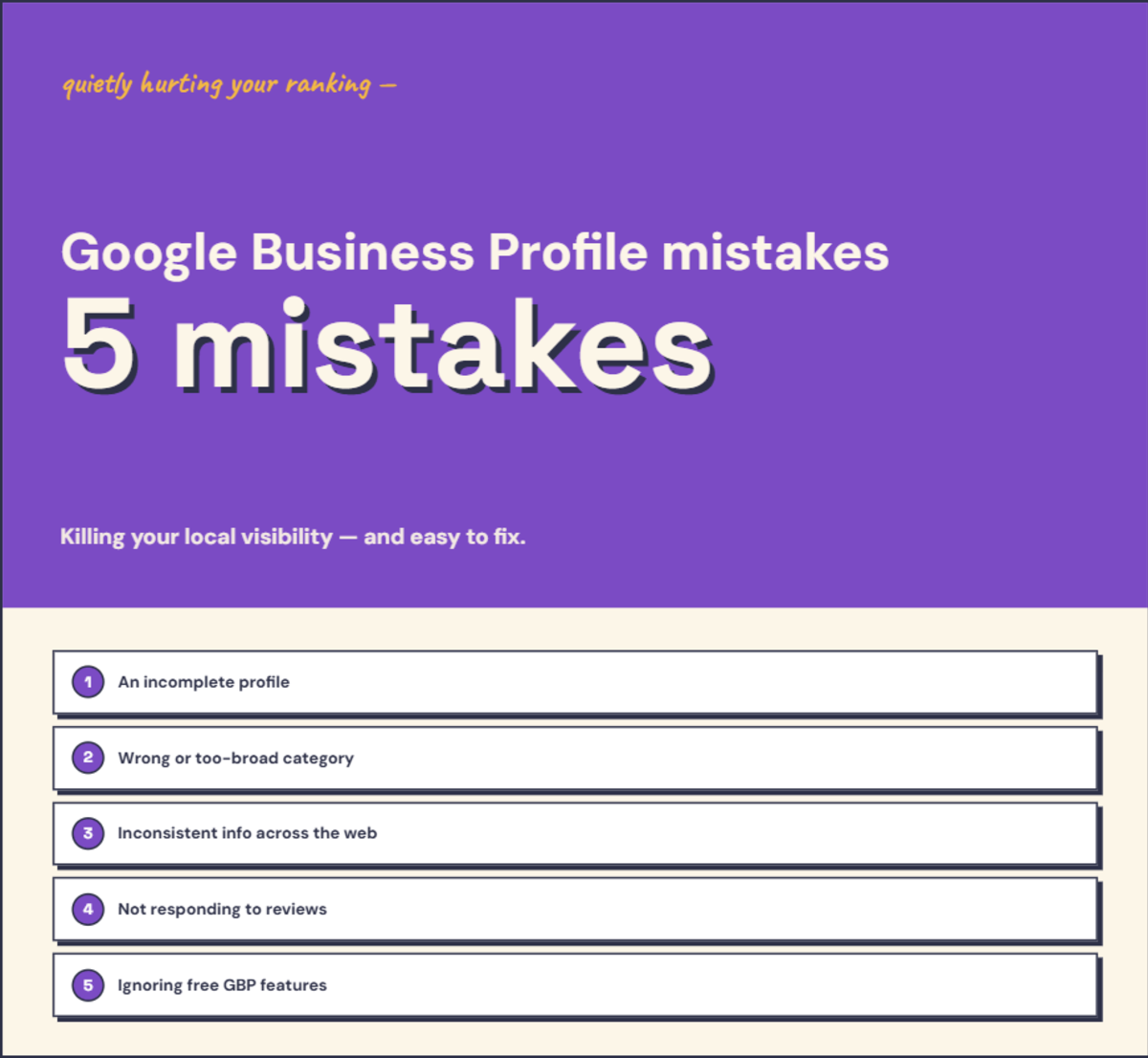
1. Your profile is incomplete
Google has said it directly: businesses with complete profiles are easier to match with relevant searches. Google’s Profile Strength meter makes this explicit — it literally tells you whether your profile is in the green zone or not.
An incomplete profile means Google has less information to work with. Less information means fewer searches where you’ll appear.
Check these specifically — they’re the most commonly missed:
- Business description (750 characters — use all of it)
- Service area or address (whichever applies to your business)
- Services list with descriptions
- Products (even service businesses can list packages here)
- Business hours including public holiday hours
- Attributes (wheelchair accessible, LGBTQ±friendly, women-owned — whatever applies)
- Photos — at least 10 real photos, not stock images
If you haven’t set up your profile yet, I’ve written a step-by-step guide to getting it done.
2. Your primary category is wrong — or too broad
Your primary business category is the single most important individual ranking factor for the Local Pack. That’s not an opinion — it’s the top-ranked individual factor in Whitespark’s 2026 survey of local SEO experts.
The mistake I see most often: choosing a broad category when a specific one exists. “Restaurant” when you should be “Italian Restaurant.” “Consultant” when “Business Management Consultant” is an option. “Health” when “Physiotherapist” is right there.
Google uses your primary category to decide which searches you’re relevant for. The more specific you are, the better your chances of appearing for the searches that actually matter.
You get one primary category and several additional categories. Local SEO studies consistently find that well-ranked businesses use several additional categories, not just one. But don’t add categories that don’t genuinely describe your business — Google can penalise you for that.
To check your current categories: sign in to your profile, click “Edit profile,” and look under “Business category.” Compare yours against what your top-ranking competitors in your area are using.
3. Your business information is inconsistent across the web
Your business name, address, and phone number — what the SEO world calls NAP — needs to be identical everywhere it appears online. Your website, your GBP, your Facebook page, Yellow Pages, True Local, any directory listing.
Even small variations matter. “(08) 9555 1234” on your website but “+61 8 9555 1234” on your GBP. “Suite 4, 123 Main St” on one listing but “4/123 Main Street” on another. Google cross-references your information across the web. Inconsistencies reduce its confidence that your business information is reliable.
Businesses with consistent NAP data are significantly more likely to appear in local results. It sounds tedious, but it’s one of the highest-impact things you can fix.
Start by searching your business name on Google and checking every listing that comes up. Then work through the main Australian directories: Yellow Pages, True Local, LocalSearch, Hotfrog, and StartLocal. Update anything that doesn’t match your GBP exactly.
I’ve covered this in more detail in my post on what local SEO actually is and the difference between SEO and local SEO.
4. You’re not responding to reviews
BrightLocal’s Local Consumer Review Survey research has found 88% of consumers would use a business that responds to both positive and negative reviews — against 47% for a business that doesn’t respond at all. That gap is enormous.
Responding to reviews does two things. For potential customers, it shows you care and you’re paying attention. For Google, it’s an activity signal — a sign that the profile is actively managed by a real person. (Reviews also feed your local rankings directly.)
Three rules for review responses:
Positive reviews: Thank them, mention something specific about their experience, keep it genuine. Don’t paste the same response on every review — people notice.
Negative reviews: Acknowledge their experience, don’t get defensive, offer to resolve it offline. A thoughtful response to a negative review often builds more trust than the review itself damages.
Timeliness: Respond within 48 hours if you can. BrightLocal’s 2026 survey found review recency now weighs heavily — consumers increasingly discount anything more than a few months old. Freshness matters for both reviews and responses.
I’ve written full guides on how to get more Google reviews and how to ask clients for reviews if you want to build a proper review strategy.
5. You’re ignoring free GBP features
Google gives you features that most businesses never touch. Posts, products, services, Q&A, and photo updates — all free, all visible to people searching for your business.
GBP Posts let you share updates, offers, and events directly in your listing. They expire after seven days (offers have custom dates), but the activity signal persists. Weekly posts are ideal.
Services and Products sections let you describe what you offer in detail — including descriptions and pricing. These help Google understand what searches you’re relevant for and give potential customers information without needing to click through to your website.
Q&A — Google has been rolling an AI-powered “Ask” experience into profiles, auto-generating answers from your business data. You should monitor what it’s saying about you and make sure it’s accurate.
Photos — Google’s own research has long found listings with photos get roughly 35% more click-throughs. Upload real photos of your work, your team, and your location. Not stock images — people can tell.
The underlying principle is simple: Google rewards profiles that look alive. A profile that hasn’t been updated in six months looks abandoned. One that has fresh photos, recent posts, and review responses looks like a business that’s open and active.
If you can only fix three things this week
Start with your primary category (mistake #2), your NAP consistency (mistake #3), and your review responses (mistake #4). These three have the most direct impact on whether you appear in local search results — and they’re all free to fix.
Want to know how your online presence looks to Google right now? Get a free website audit — it includes a GBP review alongside the site check.
Frequently asked questions
Does Google Business Profile actually affect my ranking?
Yes — significantly. GBP signals account for roughly 32% of what determines whether you appear in Google's Local Pack (the map results). Your primary business category is the single most important individual ranking factor for local search. A complete, active profile with recent reviews consistently outranks an incomplete one.
How often should I update my Google Business Profile?
At minimum, once a month — upload fresh photos, publish a GBP post, and respond to any new reviews. Weekly updates are better. Google rewards profiles that show signs of active management. Set a recurring 15-minute task and treat it like any other business admin.
Want to know how your current website stacks up?
Get a free, plain-English audit.
Get Your Free Audit →