Most people hire a web designer the same way they’d pick a restaurant they’ve never been to — they look at the photos, read a few reviews, and hope for the best.
The problem is, a web designer’s portfolio tells you what their work looks like. It doesn’t tell you what they’re like to work with, who owns what when it’s done, or what happens six months later when you need to change your phone number and can’t log in.
I’ve spoken to enough business owners who’ve been burned by a web designer to know the pattern. The questions below are the ones I wish they’d asked before signing anything.
Why these questions matter more than the portfolio
A beautiful portfolio doesn’t guarantee a good experience. The most common complaints Australian small business owners have about web designers aren’t about design quality — they’re about communication, ownership, and what happens after the project ends. Disappearing designers, domains held hostage, surprise ongoing fees, and websites built on platforms the business owner can’t access without the designer’s help.
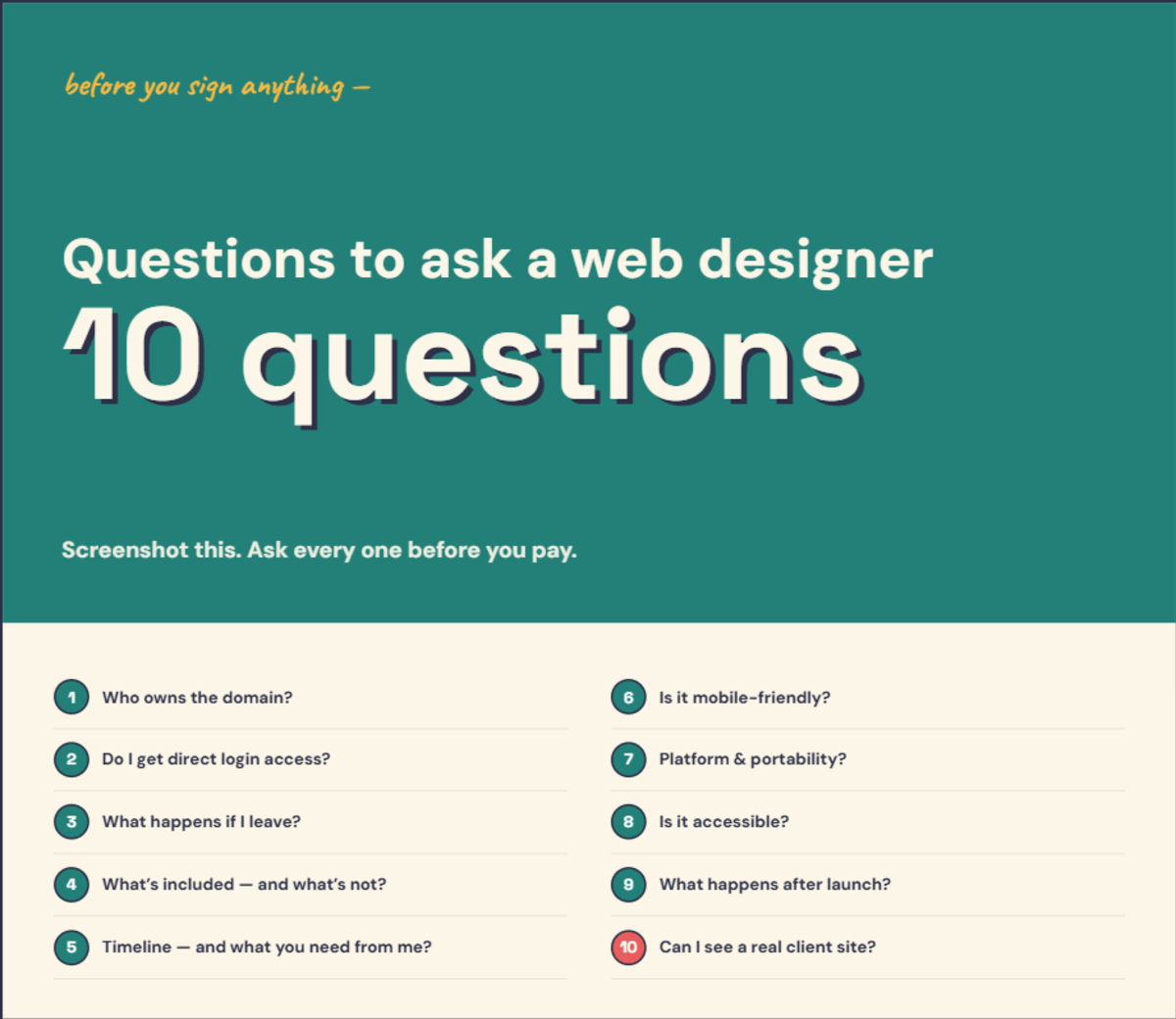
These ten questions cut through the portfolio and get to what actually matters. (My guide to choosing a web designer covers the broader process — this list is the sharp end of it.)
1. Who will own the domain name?
This is the single most important question on this list. Your domain name is your address on the internet. If your designer registers it in their name — or under their hosting account — you don’t own it. You’re renting it from them.
A good answer: “You register it yourself, or we register it in your name with your details as the registrant.”
A bad answer: “We handle all of that for you, don’t worry about it.”
Under Australian law, domain ownership sits with whoever is listed as the registrant with auDA (the .au Domain Administration). If a dispute arises, resolving it through the auDA Dispute Resolution Policy typically starts around $2,000. Easier to get it right from the start. I’ve written a full guide to domains and hosting if this is new territory.
2. Will I have direct login access to my website?
You should be able to log in to your own website and make basic changes — updating text, swapping a photo, adding a new staff member. If the designer builds your site on a system where only they can make changes, you’re dependent on them for everything.
A good answer: “Yes, you’ll have your own admin login. I’ll show you how to use it.”
A bad answer: “We handle all updates for you as part of your monthly plan.”
That second answer isn’t necessarily a scam — some businesses genuinely prefer someone else handling updates. But you should still have the option. If the only way to change your own phone number on your own website is to email someone and wait, that’s a problem.
3. What happens if I want to leave?
This is the question that separates good designers from the ones who build in dependency. Ask what happens if you want to move your website to a different host, or work with someone else in the future.
A good answer: “Your site is yours. I’ll hand over everything — files, passwords, domain access.”
A bad answer: “The website design is our intellectual property.”
Under the Australian Copyright Act, unless your contract explicitly assigns intellectual property to you, the designer may retain copyright over the work they created — even though you paid for it. That’s not a scam, it’s the legal default. But a good designer addresses this upfront. If it’s not in writing, it’s not agreed.
4. What’s included in the price — and what isn’t?
Get a written breakdown. “A website for $3,000” can mean wildly different things. Does that include copywriting? SEO setup? Mobile optimisation? Stock photos? Hosting for the first year? A training session so you can actually use the thing?
A good answer: a line-by-line quote or proposal document.
A bad answer: “We’ll sort out the details once we get started.”
The most common pricing trap I see is a low upfront cost followed by mandatory ongoing fees the business owner didn’t expect. $2,000 for the build sounds reasonable — until you find out hosting is $150/month on top and you can’t move the site elsewhere. My pricing is published for exactly this reason.
5. How long will it take — and what do you need from me?
A realistic timeline for a small business website is 2–6 weeks. If someone says they’ll have it done in two days, you’re getting a template with your logo dropped in. If they can’t give you a timeline at all, that’s a different kind of red flag.
A good answer: “About three to four weeks, depending on how quickly you get me the content and photos.”
A bad answer: “It depends on the project.”
Every designer needs things from you — photos, text, logo files, login details. Ask what they need and when. The biggest cause of project delays isn’t the designer — it’s the business owner not realising they needed to provide content.
6. Will my website be mobile-friendly?
This sounds like it should be obvious in 2026. It’s not. Statcounter puts mobile at around four in ten Australian page views — and Google indexes the mobile version of your site first regardless. If your site doesn’t work properly on a phone, you’re invisible to a huge share of your potential customers.
A good answer: “Every site I build is responsive — I test on mobile throughout the process.”
A bad answer: “We can add a mobile version as an upgrade.”
If mobile responsiveness is treated as an add-on rather than a default, walk away. That’s a fundamental requirement, not a feature. I’ve covered this in more detail in my post on how websites actually work.
7. What platform will you build it on — and can I move it later?
WordPress, Squarespace, Wix, Shopify, custom-coded, or something proprietary — you need to know what your site is built on and whether you can take it with you.
A good answer: names the specific platform and explains why it suits your needs.
A bad answer: “We use our own custom platform.” (Translation: you can never leave.)
Proprietary platforms are the biggest lock-in risk. If a designer builds your site on their own system, moving to another designer usually means starting from scratch. Open platforms like WordPress, Squarespace, or a static site generator give you options. I’ve written a comparison of custom websites versus website builders that covers the trade-offs.
8. Is accessibility included?
Your website should be usable by people with disabilities — keyboard navigation, screen reader compatibility, proper colour contrast, alt text on images. In Australia, the Disability Discrimination Act 1992 applies to websites, and the AHRC’s 2025 guidelines recommend WCAG 2.2 Level AA as the minimum standard.
A good answer: “Accessibility is built into every site I create. It’s not an add-on.”
A bad answer: “We can do an accessibility audit later as a separate project.”
If accessibility is treated as an afterthought, the site wasn’t built properly. Retrofitting accessibility is significantly more expensive than building it in from the start. It’s 2026 — this should be standard. I’ve written a full plain-English guide to web accessibility if you want to understand what’s actually involved.
9. What happens after launch?
Websites need ongoing attention — security updates, software patches, content changes, hosting renewals. Ask what support looks like after the site goes live. Is there a warranty period? A monthly plan? Hourly rates for changes?
A good answer: specific details about post-launch support, pricing for ongoing work, and a clear process for getting help.
A bad answer: “We’ll be here if you need us.” (With no specifics about response times, costs, or what’s included.)
I include a 90-day settle-in period with every site I build — any tweaks, adjustments, or “actually, can we change this?” requests during that time are included. After that, ongoing support is $59/month. My post on ongoing website costs in Australia covers what to budget for long-term.
10. Can I see a real website you’ve built — and contact that client?
A portfolio of screenshots proves design skill. A reference from an actual client proves reliability, communication, and follow-through.
A good answer: “Here are three live sites I’ve built. Happy to connect you with any of them.”
A bad answer: “We can’t share client details due to confidentiality.”
If a designer can’t put you in touch with a single past client, ask yourself why. Even one genuine reference is worth more than a portfolio of twenty screenshots.
If you can only remember three of these
Start with questions 1, 2, and 3 — domain ownership, website access, and what happens if you leave. These are the questions that protect you. Everything else is important, but these three determine whether you’re building on solid ground or renting someone else’s.
One more thing
I publish my answers to every question on this list on my services page and my working with me page. You own your domain. You own your site. You get full access. No lock-in contracts. If you leave, everything goes with you.
Not because I’m special — because that’s how it should work.
Want to know how your current website stacks up? Get a free, plain-English audit — I’ll tell you what’s working, what isn’t, and whether it’s worth fixing or starting fresh.
Frequently asked questions
What should I look for in a web designer?
Look for published pricing (or at least a clear range), a portfolio of real sites you can visit, a clear explanation of what's included, and straight answers about who owns the domain, hosting, and files. If they dodge ownership questions or won't give you a ballpark price without a 'discovery call,' that's a red flag.
How much should a web designer charge in Australia?
A professional small business website in Australia typically costs $1,500–$10,000 depending on complexity. Be cautious of quotes under $500 (often offshore template work) and over $15,000 for a simple brochure site. I charge $500 for a one-page site and $1,000 for a full build — pricing is published on my website.
Should I hire a freelancer or an agency for my website?
For most small businesses, a solo web designer or small freelancer is the right fit. You get direct communication with the person doing the work, lower overheads, and more personal accountability. Agencies make sense for larger projects with multiple moving parts — but for a 5–10 page business website, you're often paying agency rates for freelancer-level work.
Want to know how your current website stacks up?
Get a free, plain-English audit.
Get Your Free Audit →