Most NDIS provider websites I come across look like they were built from the same template. Clean. Professional. Corporate. And completely interchangeable with every other provider in the search results.
That’s a problem — because the people looking at your site aren’t comparing corporate brochures. They’re trying to figure out whether you’re someone they’d trust with their care, or their child’s care, or their parent’s care. They want to see a real person with a genuine reason for doing this work. Not a stock photo and a mission statement that could belong to anyone.
I’m a web designer based in Scarborough, Perth. I build websites for small businesses across Australia — including NDIS providers and not-for-profits. I’ve worked inside large healthcare organisations, I’ve built sites for allied health practitioners, and I understand the compliance pressures that come with operating in the NDIS. So here’s the honest guide I wish existed when providers started asking me about this.
What does the NDIS actually require on your website?
Here’s the short version: there is no official NDIS website checklist.
That surprises a lot of providers. The NDIS Quality and Safeguards Commission doesn’t publish a document saying “your website must include X, Y, and Z.” If someone is telling you there’s a mandatory checklist — and charging you accordingly — I’d be asking questions.
That said, several legal obligations affect what goes on your site, even if they don’t mention the word “website” directly.
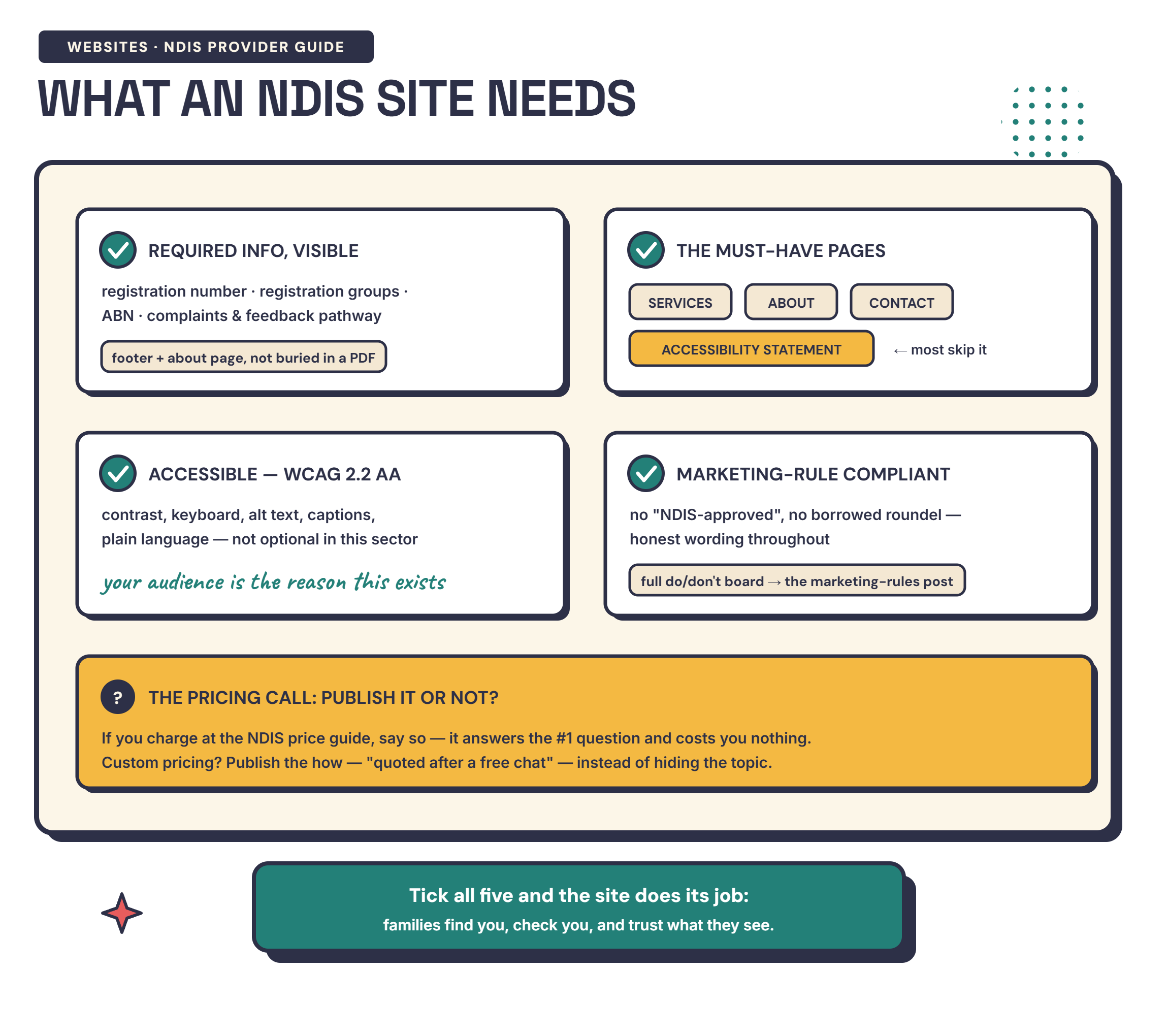
The NDIS Practice Standards require your communication with participants to be accessible and responsive to their needs. If your website is how people first find and contact you, that standard applies to it. Your complaints process needs to be findable — and for most providers, the website is where people look. You’re required to explain how you handle personal information, which means a privacy policy. And the NDIS Code of Conduct prohibits misrepresenting your registration status.
Those are the legal obligations. Everything else — the service descriptions, the team photos, the intake forms — falls into best practice. Still important. Still worth doing well. But nobody should be telling you it’s a compliance requirement and charging you a premium for it.
Does your website need to be accessible?
I’ll be straight with you — no Australian law specifically names WCAG compliance as a requirement. But this is one of those areas where the technicality doesn’t match the reality.
The Disability Discrimination Act 1992 says you can’t discriminate in how you provide services. An inaccessible website is, by definition, discriminatory. The Australian Human Rights Commission’s April 2025 guidelines recommend WCAG 2.2 Level AA as the minimum standard — a significant update from the WCAG 2.0 recommendation that had been in place since 2014.
There’s case law reinforcing this too. The Maguire v SOCOG case in 2000 established that an inaccessible website constitutes disability discrimination. In 2014, Mesnage v Coles became the first web accessibility case to reach the Federal Circuit Court — a blind customer couldn’t select delivery times or navigate the Coles online shopping site with a screen reader. The case was settled out of court, with Coles agreeing to make accessibility improvements.
For NDIS providers specifically, the situation is even more clear-cut. You’re serving people with disabilities. If your website excludes the very people you exist to support, that’s not just a legal risk — it’s the opposite of what you’re here to do.
Here’s what accessible actually means in practice. It’s not a mystery — and it’s not a reason to triple the price of a website. Alt text on your images. Decent colour contrast so people can actually read the text. Keyboard navigation that works. Form labels that screen readers can understand. Headings in a logical order. Link text that tells you where you’re going instead of “click here.”
I think of accessibility like wheels on a car. You wouldn’t pay extra for them — they’re part of what makes it a car. In 2026, accessibility should be part of what makes it a website. With modern tools and AI-assisted testing, keeping a site accessible is easier than it’s ever been. My approach is to build it in from the start — not bolt it on afterwards as a premium add-on.
What pages does an NDIS provider website actually need?
Every provider is different, but here’s what I’d recommend for a small to mid-size NDIS provider — the kind of setup that covers your bases without overbuilding.
Your homepage should make it immediately clear who you are, what you do, who you do it for, and where you’re based. Not a wall of text. Not a stock photo carousel. A clear message and a way to get in touch.
An about page with real information about you and your team. Real photos — not stock images of smiling people in scrubs. Why you do this work. Your registration status. Your registration number. People are choosing someone to provide support or care. They want to know who they’re dealing with.
Individual service pages for each type of support you provide. This matters because a participant searching for “support coordination Perth” and a plan manager searching for “SIL provider northern suburbs” are looking for different things. Generic “our services” pages that lump everything together don’t help either of them.
A referral or intake form that captures the right information without being overwhelming. Name, contact details, NDIS number, plan management type (agency-managed, plan-managed, or self-managed), what support they’re looking for, and a file upload option for plans if needed. Every extra field you add reduces the chance someone actually fills it in.
A contact page with multiple ways to reach you and realistic response time expectations. If you take 48 hours to return calls, say so — people would rather know than wonder.
A service area page with specifics. “We cover the Perth metro area” is okay. “We provide in-home support across Scarborough, Joondalup, Wanneroo, and surrounding suburbs” is better. Search engines reward specificity, and so do the support coordinators and plan managers who are scanning your site to figure out if you can actually reach their client.
And a privacy policy that explains in plain English how you handle participant information. Not a 3,000-word legal document copied from a template generator — something your clients can actually read and understand.
What are the NDIS marketing rules you need to know?
This one catches a lot of providers off guard — and the penalties are real.
You can’t use the NDIS logo without written NDIA consent. If you’re a registered provider, you can use the “I ♥ NDIS” or “We ♥ NDIS” logos — but only with the “Registered Provider” tagline, and you can’t change the colours or design.
You can’t describe yourself as “NDIS approved,” “NDIS endorsed,” or an “official NDIS provider.” The NDIS doesn’t approve or endorse individual providers. Thermomix paid $79,200 in penalties and Bedshed $39,600 over misleading NDIS claims in 2025, and the ACCC has Federal Court proceedings running against Ausnew Home Care over its pricing and ‘NDIS approved’ claims. Under the NDIS Amendment (Integrity and Safeguarding) Act 2026, which commenced in April 2026, maximum penalties for serious contraventions now reach $16.5 million.
And here’s one that’s particularly relevant to your website: the NDIS Code of Conduct now includes a fair pricing provision. You can’t charge NDIS participants more than non-NDIS customers for the same service without reasonable justification. The ACCC has had NDIS advertising and pricing squarely on its radar since late 2024.
I’m not a lawyer and this isn’t legal advice — but these are the rules as they currently stand, and they directly affect what you put on your website.
What about NDIS pricing — should you publish your rates?
The NDIS Pricing Arrangements and Price Limits (PAPL) is a public document. There’s no rule against publishing your rates. If anything, transparency supports the Code of Conduct.
If you do publish NDIS pricing on your site, keep a few things in mind. The PAPL sets maximum prices — make sure that’s clear. Keep them current when the annual update comes through (the 2025–26 PAPL took effect 1 July 2025, with updates from November 2025). And make sure your NDIS rates aren’t higher than what you charge non-NDIS clients for the same service.
My own approach to pricing is to publish everything on the site. I don’t believe someone should have to sit through a sales call just to find out how much something costs. And I don’t change my prices based on what industry you’re in. That’s the same whether you’re a beauty salon, a tradie, or an NDIS provider.
How much does an NDIS provider website actually cost?
Honestly, the range varies as much as any other industry — from a few hundred dollars for a basic setup to $6,000 or more for a full custom build with booking systems, CRM integrations, and multilingual content.
I’ve seen quotes for NDIS provider websites that feel a lot like the wedding tax. You know how a dress or a cake suddenly costs three times more the moment someone mentions the word “wedding”? The same thing happens with NDIS. Some agencies hear “NDIS provider” and assume there’s a big pot of government money behind it — and price accordingly.
The reality is most small NDIS providers are sole operators or small teams running tight margins. The NDIS pricing framework doesn’t leave much room for $5,000 website projects — especially when you’re spending your days actually delivering support.
I charge $500 for a one-page website and $1,000 for a full site. That includes design, development, mobile optimisation, SEO, accessibility compliance, copywriting assistance, and 12 months of hosting. Because accessibility and SEO aren’t premium features — they’re what a website should be.
The biggest NDIS reforms in years — and what they mean for your website
The NDIS is going through its most significant set of changes since it started. The Getting the NDIS Back on Track legislation took effect in October 2024, introducing a defined “NDIS supports” list, stricter budget controls, and stronger advertising and marketing rules.
From 1 July 2026, registration is mandatory for SIL and platform providers. That means thousands of providers who’ve been operating without registration will need to establish a professional online presence for the first time.
A new planning framework rolling out from mid-2026 introduces “Flexible Budget” and “Stated Supports” categories with longer plans and new assessment tools. If you’re a provider, you might need to update how you describe your services as the definition of “NDIS supports” narrows.
Nobody else in the Australian web design space is talking about what these reforms mean for provider websites — which is part of why I wanted to write about it. The rules are changing, and your website is one of the first places those changes need to be reflected.
The common mistakes I see on NDIS provider websites
The biggest one is what I mentioned at the start — defaulting to a corporate template when your strength is being a real person. Most providers got into this work because they genuinely care about the people they support. That passion, that personality, that “why” — it should come through on your website. Not be buried under a generic theme with stock photography.
Other common ones: using NDIS jargon instead of plain English (“we provide Capacity Building Supports” instead of “we help you build skills”), not stating your registration status or which plan types you support, relying on “email us to book” instead of an actual booking system, letting the site go stale with last year’s pricing, and — the irony of ironies — building an inaccessible website for an organisation that serves people with disabilities.
Where to from here?
If you’re still weighing up whether you need a site at all, start with do NDIS providers actually need a website? And if you know you need one — or you’ve got one that isn’t doing what it should — I’m happy to have a conversation about it. No pitch. No pressure. Just a straight chat about what you need and what it’ll cost.
I offer discounts for not-for-profits on a case-by-case basis, and I work with community organisations because I genuinely want to. I spent 11 years working inside a national not-for-profit. I contribute 1% of revenue to the Stripe Climate program. These aren’t marketing lines — they’re just part of how I want to run the business.
Book a 15-minute chat — and I’ll give you honest feedback on where you’re at.
Frequently asked questions
Do NDIS providers need a website?
Technically, no — there's no NDIS rule that says you must have a website. But most participants, support coordinators, and plan managers search online before making contact. If you're relying solely on referrals and word of mouth, you're invisible to anyone who doesn't already know you exist.
How much does an NDIS provider website cost?
Anywhere from $500 for a simple one-page site to $6,000+ for a full custom build with booking systems and CRM integration. I charge $500 for a one-pager and $1,000 for a full site — that includes accessibility compliance, mobile optimisation, and SEO. Accessibility shouldn't be an add-on that doubles the price.
Does my NDIS provider website need to be WCAG compliant?
No Australian law names WCAG specifically. But the Disability Discrimination Act 1992 prohibits discrimination in providing services — and an inaccessible website for an NDIS provider serving people with disabilities is a significant legal risk. WCAG 2.2 Level AA is the standard the Australian Human Rights Commission recommends as the minimum.
Can I use the NDIS logo on my website?
Only if you're a registered provider, and only with the correct tagline 'Registered Provider.' You cannot alter the logo's colours or design, and you cannot use phrases like 'NDIS approved,' 'NDIS endorsed,' or '100% NDIS funded' — the NDIS doesn't approve or endorse individual providers. Fines for misuse have reached $79,200.
Got a question? Need some advice?
Book a free 15-minute call. No pitch — just straight answers. Most people walk away with a clear next step or a blocker sorted.
Book a Free Call →