
If you’ve researched starting a store for more than ten minutes, you’ve met this question. It’s the most-asked platform comparison in e-commerce, and most versions of it are written by someone with an affiliate link.
So, disclosures first: I’m a Shopify Partner, and most of my store builds are Shopify or fully custom — that’s where my hands-on depth is. What follows is the numbers laid out fairly both ways, WooCommerce’s genuine strengths included, and then my honest take clearly labelled as exactly that.
What’s the actual difference?
Everything downstream flows from one structural fact.
Shopify is hosted. You rent a complete system — the software, the servers, the security, the updates all live with Shopify. You log in and run your store.
WooCommerce is self-hosted. It’s free, open-source software that turns a WordPress site into a store. Nobody sends you a bill for the software — and nobody else is responsible for it either. Hosting, backups, updates and security sit with you, or with whoever you pay to handle them.
Neither model is wrong. They’re different answers to the question “whose job is it to keep this running?”
What does each really cost in Australia?
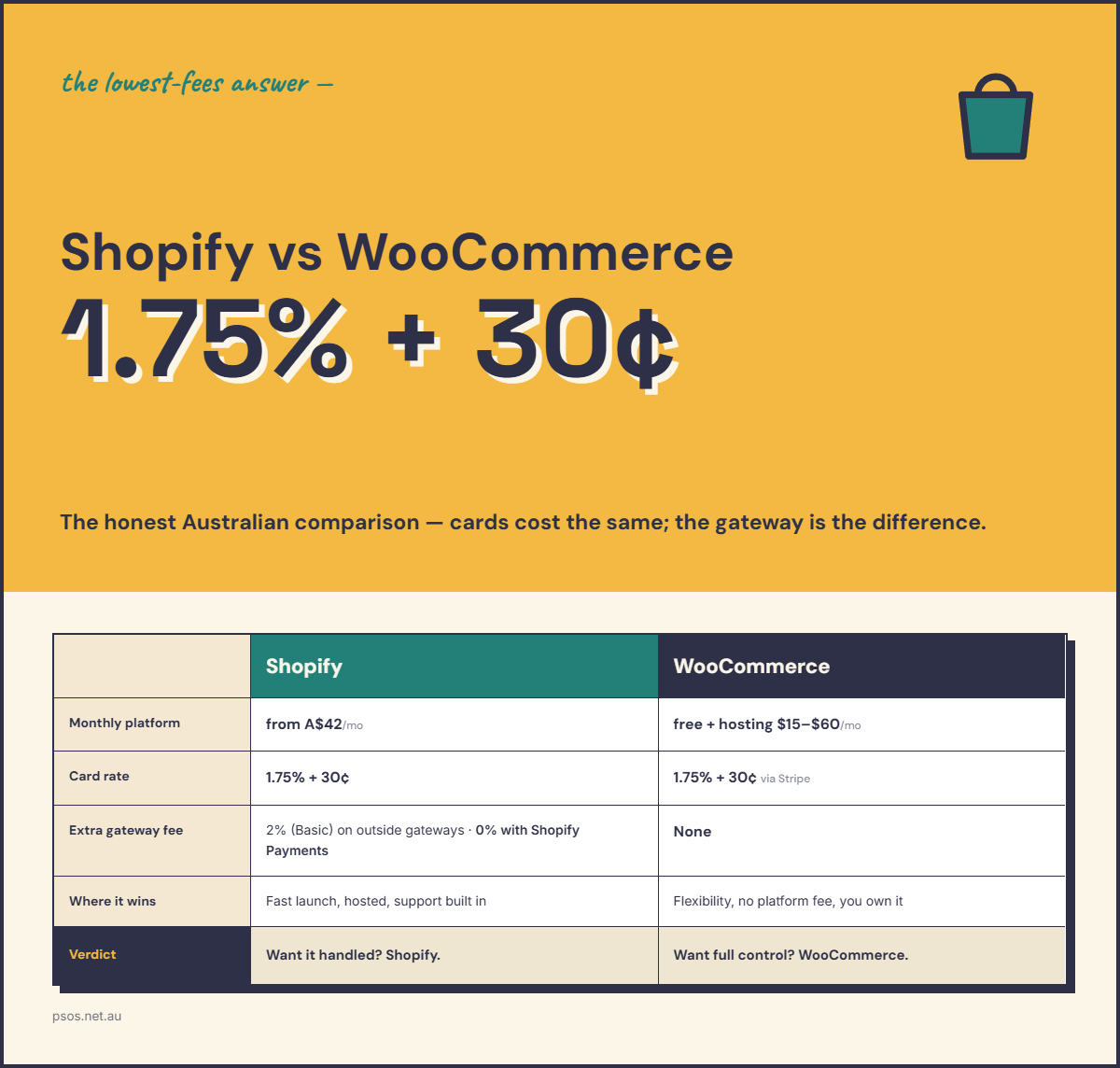
Shopify: plans from A$56/month (A$42 billed annually), payment processing from 1.75% + 30¢, and realistically some app costs on top. I’ve broken down the full real-world Shopify bill — a typical small store lands around three to four times the headline subscription once everything’s counted.
WooCommerce: the software is free; the running isn’t. Australian hosting runs from about A$60–120 a year on shared plans to A$300–600 for managed hosting worth having (look for Australian data centres, and watch the classic intro-price-then-renewal jump). A decent premium theme is roughly A$75–225. Then extensions — this is where “free” earns its quotation marks, because capability lives in paid add-ons: subscriptions functionality alone runs around US$200–280 a year, bookings similar. Payment processing via Stripe or WooPayments costs about the same as Shopify’s rates. All up, a realistic DIY WooCommerce store runs A$300–$3,000+ a year, and a professionally built one starts around A$6,000 through most agencies — my online store cost guide puts the whole market side by side.
The honest summary: for a lean setup run by someone technical, WooCommerce can be cheaper. For everyone else, the totals land closer than the word “free” suggests — the difference mostly isn’t money. It’s whose job the maintenance is.
Which platform has the lowest transaction fees?
A question worth answering wider than these two, because “transaction fee” and “total cost” are different things:
| Platform | Platform’s own transaction fee | Card processing |
|---|---|---|
| WooCommerce | None | ~1.75% + 30¢ via Stripe |
| BigCommerce | None | Gateway rates apply |
| Shopify | 0% with Shopify Payments; 2% (Basic) with outside gateways | 1.75% + 30¢ (Basic) |
| Squarespace | 2% on Business plan; 0% on Commerce plans | Processing on top |
| Square Online | None on the free plan | ~2.2% online |
So yes — WooCommerce and BigCommerce charge no platform cut, and that’s a real advantage at volume. But the platforms with the lowest transaction fees aren’t automatically the cheapest to run: subscriptions, hosting, extensions and your hours all sit outside this table. Lowest fee ≠ lowest cost.
Where WooCommerce genuinely wins
Fair’s fair. You own everything — the software, the data, the hosting relationship — with no platform able to change your rules or your rent. There’s no platform transaction fee, which compounds nicely at scale. It inherits WordPress’s content and blogging strengths, which suits stores built on publishing. And the extension ecosystem is enormous — if a feature exists in e-commerce, someone’s built it for Woo.
If you’re technically comfortable — or have a developer you trust on call — and full control matters to you, WooCommerce is a completely legitimate choice. Plenty of excellent Australian stores run on it.
Where Shopify genuinely wins
The store is Shopify’s problem to keep online, patched and secure — that’s what the subscription buys, and for a busy owner it buys a lot. Day to day it’s genuinely straightforward: orders come in, you fulfil them, the software stays out of your way. Payments are built in at fair rates. And when something breaks at 9pm before a sale, there’s a support team whose actual job that is.
My honest take — labelled as exactly that
Most of my clients aren’t technical, don’t want to be, and have precisely zero interest in maintaining software. They want to sell things. For them, I recommend Shopify — not because the Partner badge says so, but because the day-to-day running of the store is the part they’ll live with for years, and Shopify makes that part easy. When I hand over a store, I want the owner running it confidently without a developer on retainer. That’s the test I apply every single time — badge or no badge.
Two important edges to that position. If you already have a WooCommerce store that’s working — keep it. Don’t rebuild something that’s performing; I can integrate with what you’ve got. And if you’re launching a single product to test the waters, you may not need either platform yet — a single-product build is its own path.
The quick decision guide
Choose Shopify if you want the running of the store to be somebody else’s job, you value support existing, and predictable monthly costs beat theoretical savings. Choose WooCommerce if you’re technical or have developer support, you want full ownership and no platform fees, and you accept that maintenance is now a line in your calendar, not just your budget. Choose neither yet if you’re testing one product — start smaller.
And whichever way you lean: the wrong reason to choose is a stranger’s blog post. Including mine. Bring your actual situation — products, volumes, technical comfort — to a free 15-minute chat and we’ll pick the right home for it. If it’s WooCommerce, I’ll tell you that too.
Frequently asked questions
Is WooCommerce really free?
The core software is. Running it isn't — hosting, a theme, extensions and payment processing add up to roughly $300–$3,000+ a year depending on your needs, plus your time (or a developer's) for updates and maintenance.
Is Shopify or WooCommerce cheaper in Australia?
For a lean, technically confident owner, WooCommerce can run cheaper. For most small businesses, the total cost lands surprisingly close once real hosting, extensions and maintenance time are counted — which is why the better question is who you want responsible for keeping the store running.
Can I move between WooCommerce and Shopify later?
Yes, in either direction — products, customers and orders can be migrated. It's a project rather than a button-press, so choose deliberately, but no choice here locks you in forever.
Got a question? Need some advice?
Book a free 15-minute call. No pitch — just straight answers. Most people walk away with a clear next step or a blocker sorted.
Book a Free Call →