If you’re weighing up whether a website is worth the money, you’re asking the right question. Not every business needs one on day one — I’ve written about that separately. But if you’re past that stage and wondering what a website actually does for you in practical terms, here are seven benefits I see play out with my clients.
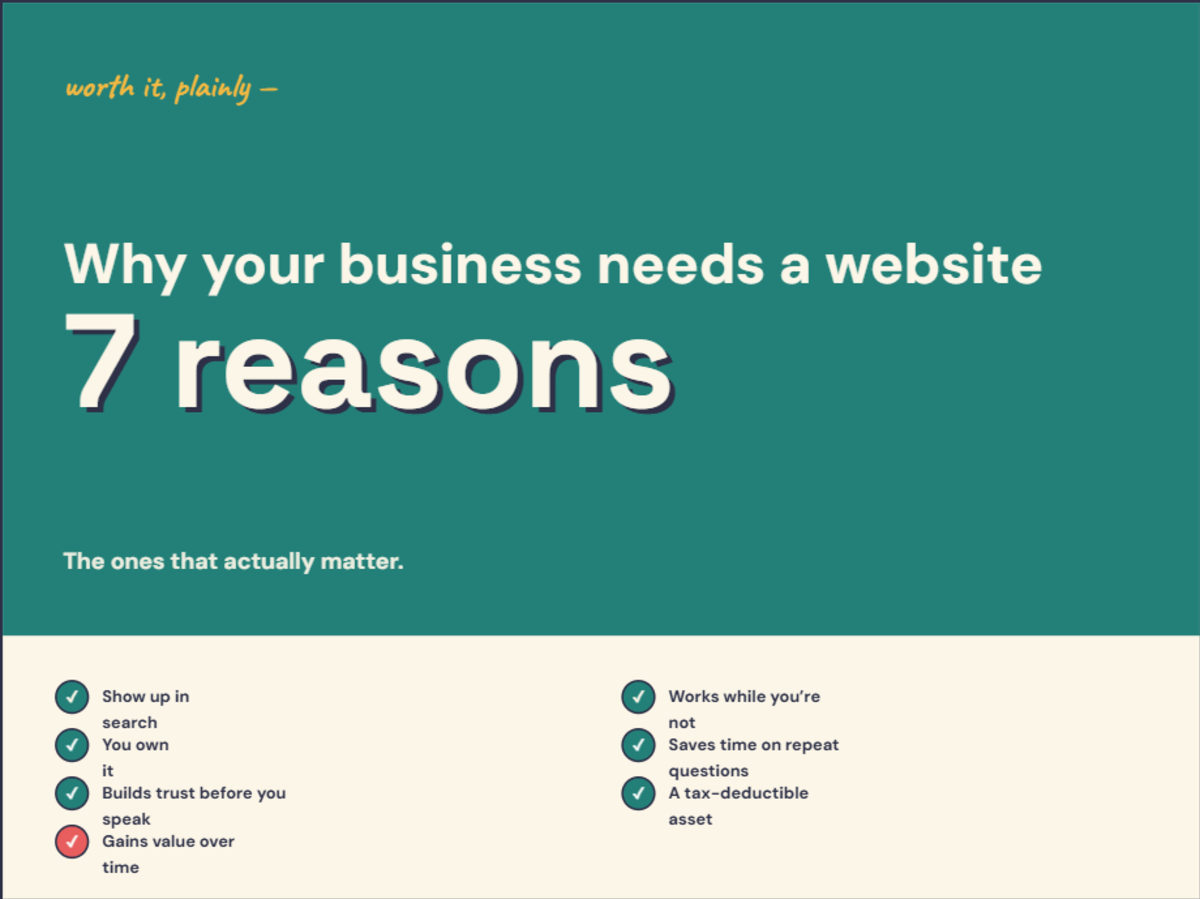
1. You show up when people search
This is the big one. When someone types “plumber near me” or “mobile vet Perth” into Google, the businesses that show up have websites. Social media profiles sometimes appear in results, but they’re almost always outranked by a proper website with basic SEO in place.
And it’s not just Google anymore. AI tools like ChatGPT, Perplexity, and Apple’s Siri are recommending businesses by name — and they’re pulling that information from websites, not Instagram stories. If you don’t have a website, you’re invisible in the places people are increasingly looking first.
2. You own it
Instagram can change its algorithm tomorrow. Facebook can throttle your reach. TikTok got banned in some countries. None of that matters if you have a website — because it’s yours.
Your website is the one place online where you control the message, the layout, the pricing, the photos, and the experience. Nobody else’s ads sit alongside your content. Nobody else decides who sees it.
3. It builds trust before you ever speak to someone
When someone hears about your business — through a friend, a Google search, a flyer on a noticeboard — the first thing they do is look you up. 81% of Australian consumers research online before making a purchase. If all they find is a Facebook page with inconsistent posts, they’re already forming an opinion.
A clean, simple website with your services, your pricing, and a way to get in touch tells people you’re legitimate. You don’t need anything fancy. You just need something that looks like you care about your business — because you do.
4. It works while you’re not
A website doesn’t clock off. Someone can find your business at 10pm, read your services, check your prices, and fill in an enquiry form — all while you’re watching TV. By the time you open your phone in the morning, the lead is sitting there.
One of my clients — a mobile vet — was missing enquiries because people would call during appointments and never call back. Now, her website captures those enquiries through a form and an automated text-back. I’ve written about setting up automations like this in more detail. She doesn’t miss leads anymore, and she didn’t have to hire anyone.
5. It saves you time answering the same questions
If you’re getting the same questions over and over — “What do you charge?”, “Do you come to my area?”, “How do I book?” — a website puts those answers in one place. Instead of replying to every DM and text individually, you can point people to a page that already has the answer.
I had a client who was answering the same five questions multiple times a week. We put a simple FAQ on a one-page website, connected it to a chatbot, and cut their repetitive enquiries by more than half. That’s hours back every week.
6. It’s a tax-deductible business asset
This one surprises people. In Australia, your website is a business expense — and depending on how your business is structured, you may be able to claim it under the instant asset write-off. A $500 one-page website or a $1,000 full site isn’t just a marketing cost. It’s an investment the ATO recognises. And most small business websites pay for themselves within a few months.
Worth talking to your accountant about, especially before EOFY.
7. It gets more valuable over time
Social media posts disappear into feeds within hours. A website does the opposite — it compounds. Every blog post, every page, every Google review you earn builds your site’s authority. Google starts trusting you more. You show up for more searches. More people find you without you doing anything.
I like the analogy of a spider’s web. Every page, every listing, every link is another strand. The bigger the web, the more Google trusts you — and the harder it is for competitors to catch up. The businesses that start building now have a real advantage over those who wait another year.
Where to start if you’re not sure
If you only take three things from this list, focus on these: show up in search (that’s local SEO and a Google Business Profile), make it easy to get in touch (a contact form or booking link), and put your prices on the page. Everything else builds from there. And if you’re ready to get a site built, here’s how to choose a web designer without getting burned.
Not sure what your business actually needs? Take my 30-second quiz — it’ll tell you where to start, no email required.