I recently searched my inbox for emails from a marketing personality I follow on YouTube. Twenty emails in three weeks. Here’s a sample of the subject lines:
- “FINAL DAY Danny! Open before it’s too late.”
- “24 hours. Then it’s gone.”
- “CANCEL YOUR PLANS Danny!!!”
- “10x bigger than CHATGPT… OPEN THIS NOW Danny”
- “NOTICE OF ADJUSTMENT: Price Reduced to $0.00”
Some had keyboard-smash subject lines designed to trick you into opening them out of confusion. Others used fake-official language to make promotional emails look like account notifications. And that “FINAL DAY” email? More emails came after it. The deadline wasn’t real.
This person clearly knows their stuff when it comes to online advertising. But every time I open my inbox and see another all-caps demand to OPEN THIS NOW, it has the opposite effect. It flags them as exactly the kind of business I don’t want to be associated with — and definitely not one I’d hand money to.
I run a web design business. I could use these tactics. Countdown timers on my proposals, pre-checked add-ons in my quotes, “only 2 spots left this month” on my Instagram. The tools exist and they’re not hard to set up. But I choose not to — because I think they erode the trust that good business is built on.
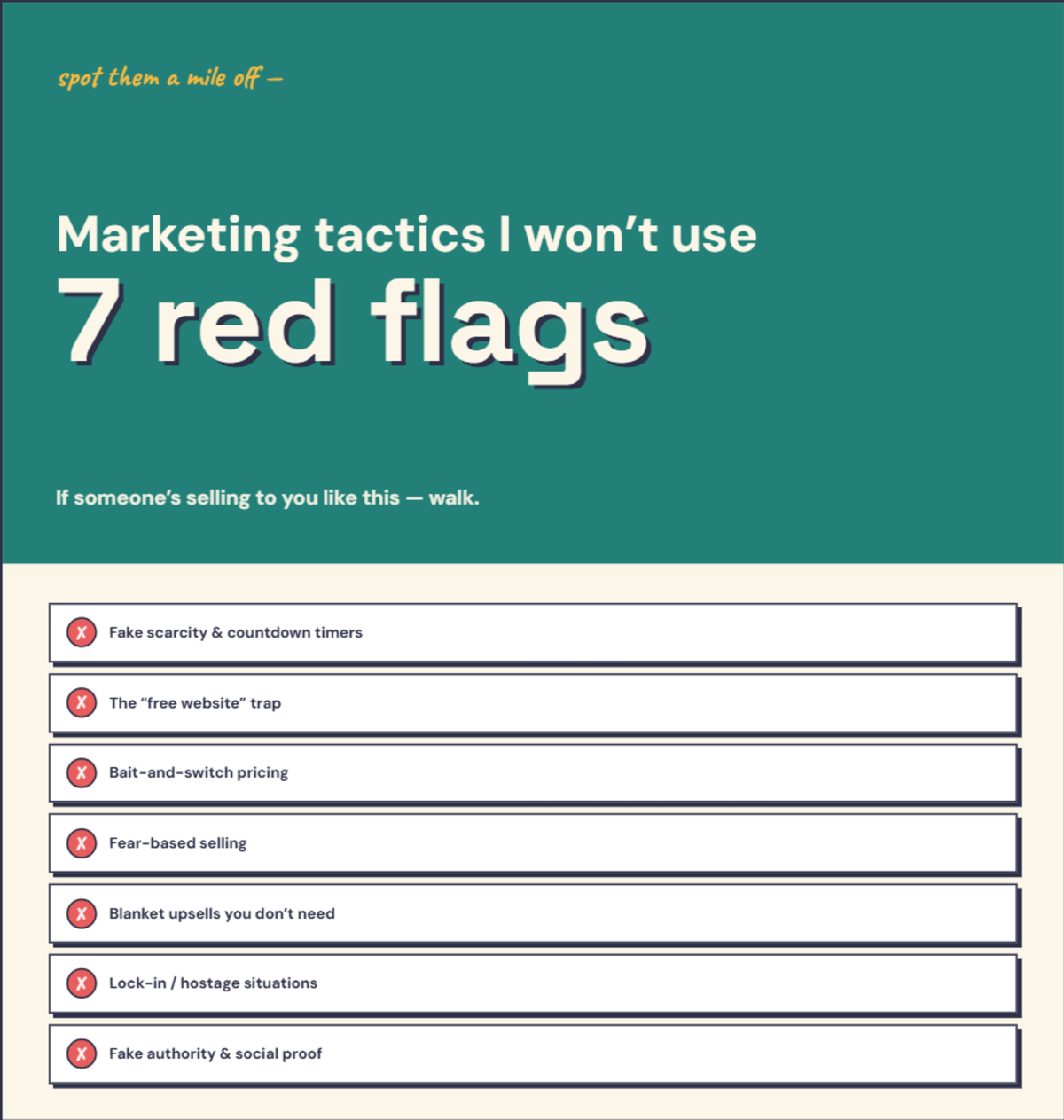
This post walks through seven marketing tactics that are common in the web design and digital services industry. For each one, I’ll explain what it looks like, why it works, and what I do instead. Not because other businesses are terrible — but because once you know what to look for, you can make better decisions about who you work with. I’ve also written a practical guide on how to choose a web designer if you’re actively looking.
What’s the scale of the problem?
Before I get into specifics — this isn’t just my opinion. The Australian Small Business and Family Enterprise Ombudsman (ASBFEO) studied the relationship between small businesses and digital service providers in 2024. The numbers were pretty confronting.
Nearly 70% of small businesses drop their digital marketing provider within 12 months. One in three of those relationships end in a dispute. And half of small businesses report being upsold services they didn’t need. Digital service disputes now make up one in four new cases to the ASBFEO — more than double what it was in 2022.
Those numbers don’t surprise me. I hear versions of these stories regularly from business owners who reach out after a bad experience with a previous provider. But the tactics that lead to these outcomes aren’t always obvious — especially when you’re busy running a business and trusting someone to handle the digital side.
1. Fake scarcity and countdown timers
What it looks like: “Only 3 spots left!” on an Instagram story. A countdown timer on a sales page that hits zero — and the offer is still there the next day. Emails warning that the price goes up at midnight, followed by more emails two days later with the same offer.
Why it works: Scarcity is a genuine psychological trigger. When something feels limited, we’re wired to act faster. Researchers at Princeton crawled over 11,000 shopping websites and found more than 1,800 instances of dark patterns — including countdown timers that reset and sales that continued after the deadline passed.
Why I don’t use it: If I’m genuinely busy and can’t take on new work for a few weeks, I’ll tell you that directly. I don’t need to manufacture urgency. My pricing is published, and I’ve written about why I think every business should publish their prices. It doesn’t change based on a fake deadline, and there’s no “price goes up at midnight” pressure. If you’re ready, great. If you need time to think, take it.
2. The “free website” trap
What it looks like: A post in a local Facebook group — “I’m a web designer building my portfolio and I’m offering a few businesses a FREE website.” Sounds generous. But once the site is built, the real costs appear. Monthly hosting fees of $99–$299. No access to your own domain. No admin login. No way to export the site. If you stop paying, the website disappears.
Why it works: A free offer removes all perceived risk upfront. Once the site exists with your business name, your content, and your branding on it, walking away feels like losing something you already own — even though you don’t actually own it.
Why I don’t use it: My website builds start at $500 for a one-page site. That’s not free — but you own the result outright. Your domain is registered in your name. You get full admin access from day one. If you decide to move on, everything comes with you. I’d rather charge a fair price for something that’s genuinely yours than give something away that comes with strings attached.
3. Bait-and-switch pricing
What it looks like: Facebook ads offering “websites from $199” or “$299 custom web design.” The price gets you in the door. Then during the quote process, you discover that mobile responsiveness is extra, SEO setup is extra, contact forms are extra, and the content is your problem. The final number looks nothing like the ad.
Why it works: The low number sets an anchor in your mind. Once you’ve started a conversation and invested time explaining your business, it feels easier to keep going than to start again with someone else.
Why I don’t use it: I’ve written about this in my Australian website pricing guide — those $199 offers and what you actually get for that money. My quotes include everything: design, development, copywriting, SEO setup, mobile responsiveness, training, and 90 days of post-launch support. The price on the proposal is the price you pay. No surprise extras three weeks in.
Under Australian Consumer Law, advertising a product at a price you can’t reasonably supply at that price is actually prohibited. It’s called bait advertising, and it falls under Section 35 of the ACL. That $199 ad might be more than just misleading — it might be unlawful.
4. Fear-based selling
What it looks like: “Your competitors are already ranking above you on Google.” “Your website has critical security vulnerabilities — act immediately.” “You’re losing customers every single day without a modern website.” Cold emails with alarming reports you didn’t ask for, warning that your traffic is crashing and your business is at risk.
Why it works: Fear bypasses rational thinking. When someone in a position of authority tells you your business is in danger, the instinct is to act first and evaluate later. That’s the whole point.
Why I don’t use it: If there’s a genuine issue with your website — a real security risk, a broken form, a Google listing problem — I’ll tell you about it factually and explain your options. I won’t invent problems to create panic. And I definitely won’t cold-email you with a scare report designed to make you feel like your business is on fire so you’ll pay me to put it out.
My free website audit exists because I think businesses should have honest information about where they stand — without the pressure.
5. Blanket upselling and bump sells
What it looks like: You enquire about a website. The proposal comes back with pre-checked add-ons — a logo refresh for $297, an SEO package for $500/month, social media management for $400/month. Or you sign up for a $1,000 website and six months later you’re getting emails pushing you toward premium hosting, monthly retainers, and services you didn’t ask about.
Why it works: When you’ve already committed to a purchase, your resistance to spending more drops. That’s why the add-ons appear at the checkout, not at the start. It’s the same reason supermarkets put chocolate at the register.
Why I don’t use it: I’m not against upselling as a concept. When an e-commerce store suggests an accessory that genuinely goes with what you’re buying, that can be helpful. What I am against is the blanket approach — where every client interaction becomes an extraction exercise.
My approach is different. If I can see that a booking system or an automation would genuinely help your business, I’ll explain why I think so and lay out the options — including the option of doing nothing. I’ll explain the pros and cons of each path. But I’m not going to pre-check add-ons on a proposal or guilt you into a monthly retainer you didn’t ask for.
I believe that if I solve the problem we agreed on, to a high standard, at the price we agreed on — you’ll come back when you need something else. Call me old school, but I’d rather earn repeat business through good work than rely on tactics to extract more from a single transaction.
6. Lock-in contracts and website hostage situations
What it looks like: A 12 or 24-month contract with hefty early termination fees. A website built on a proprietary platform that only the agency can edit or export. Your domain registered in the designer’s name — not yours. Monthly “hosting” fees of $150+ for what’s actually $10 of shared server space.
I’ve heard stories from business owners who wanted to leave their provider and discovered they couldn’t take their website with them. One Australian web designer reported that in ten years in the industry, they’d lost count of how many clients came to them only to discover their domain wasn’t in their own name. Some had even seen the previous designer remove the website entirely and replace it with spam content.
Why it works: Once your business data, your content, and your online identity are tied to a platform or provider you can’t leave, switching costs feel impossibly high. So you stay — even when the service isn’t working.
Why I don’t use it: Everything I build, you own. Your domain is in your name. You get full admin access to your site and every platform I set up on your behalf. My ongoing plans are month-to-month, cancel anytime. If you want to leave, I’ll help you transition — no exit fees, no hostage negotiations. That’s all spelled out on my Working With Me page.
Worth knowing: the Australian Government strengthened unfair contract terms laws in November 2023. Terms like automatic rollover clauses, excessive cancellation fees, and one-sided variation clauses in standard form contracts can now attract penalties. If your current web design contract has any of those — it might be worth a closer look.
7. Manufactured authority and fake social proof
What it looks like: “Award-winning web design agency” — but the award was a mass-distributed email that just required buying a plaque. “As featured in…” logos on the homepage for publications that never actually featured them. Five-star Google reviews that all appeared in the same week from accounts with no other review history. For a genuine approach to building reviews, see my review strategy guide. Testimonials with stock photos instead of real clients.
Then there’s the subtler version. I attended a free webinar a while back from a personality who teaches people how to set up online businesses. During the session, he advised the audience to pretend they have a team — even if it’s just them. His exact advice was to say things like “I’ll get someone on my team to look into that” to sound bigger than you are. He even suggested blaming mistakes on a fictional team member.
And then he did it himself. During the Q&A, whenever someone asked a question he couldn’t answer, he said “someone from my team will get back to you.” The same line he’d just told us to use as a trick. At that point, everything else he said lost credibility. If your whole approach is smoke and mirrors, why would I trust anything that comes after?
Why I don’t use it: I’m one person. I don’t pretend to be an agency. I lean into the fact that it’s just me — because that means when you call, you get the person who actually does the work. There’s no account manager, no project coordinator, no layers between you and the person building your site.
My testimonials are from real clients with real businesses. My Google reviews are from people I’ve actually worked with. I don’t buy awards and I don’t fabricate credentials. I have real certifications — Google Digital Marketing, Meta Certified, Shopify Partner, ITIL4 Foundation — because I believe in actually learning the craft, not just looking like I have.
What all of these tactics have in common
Every tactic on this list works by creating a gap between what the business appears to be and what it actually is. Fake scarcity pretends demand is higher than it is. Bait pricing pretends the cost is lower than it is. Manufactured authority pretends the expertise is deeper than it is.
I’d rather close that gap entirely. Publish my prices. Show my real work. Be honest about what I can and can’t do. And let people make informed decisions without pressure.
A friend of mine runs a networking group called Heart First Founders, built around the idea of heart over hustle. It’s a pushback against the constant-growth, maximise-everything mentality — and it’s where a lot of my thinking about how to run PSOS comes from. My business identity reflects my own values. And I’d rather attract the kind of clients who appreciate that than try to trick anyone into a sale.
If any of this resonates — or if you’ve been on the receiving end of these tactics and want to talk to someone who does things differently — I’m happy to have a chat. And if you’ve already been burned and want a step-by-step recovery plan, here’s what to do next. No countdown timer. No “only 2 spots left.” Just a straight conversation about what you need.
Got a question? Need some advice?
Book a free 15-minute call. No pitch — just straight answers. Most people walk away with a clear next step or a blocker sorted.
Book a Free Call →