If you’ve been burned by a web designer before — whether that means paying for something that was never delivered, getting locked into a contract you couldn’t escape, or ending up with a site that doesn’t do what you were promised — choosing the next one feels loaded. (If you’re still working out what to salvage from the last one, start here.) The anxiety is real, and it’s not irrational. It’s based on experience.
This post is for you. It’s a practical guide to finding a web designer you can actually trust — what to check before you get on a call, what to ask during that first conversation, and the warning signs that should make you walk away.
What’s the short version?
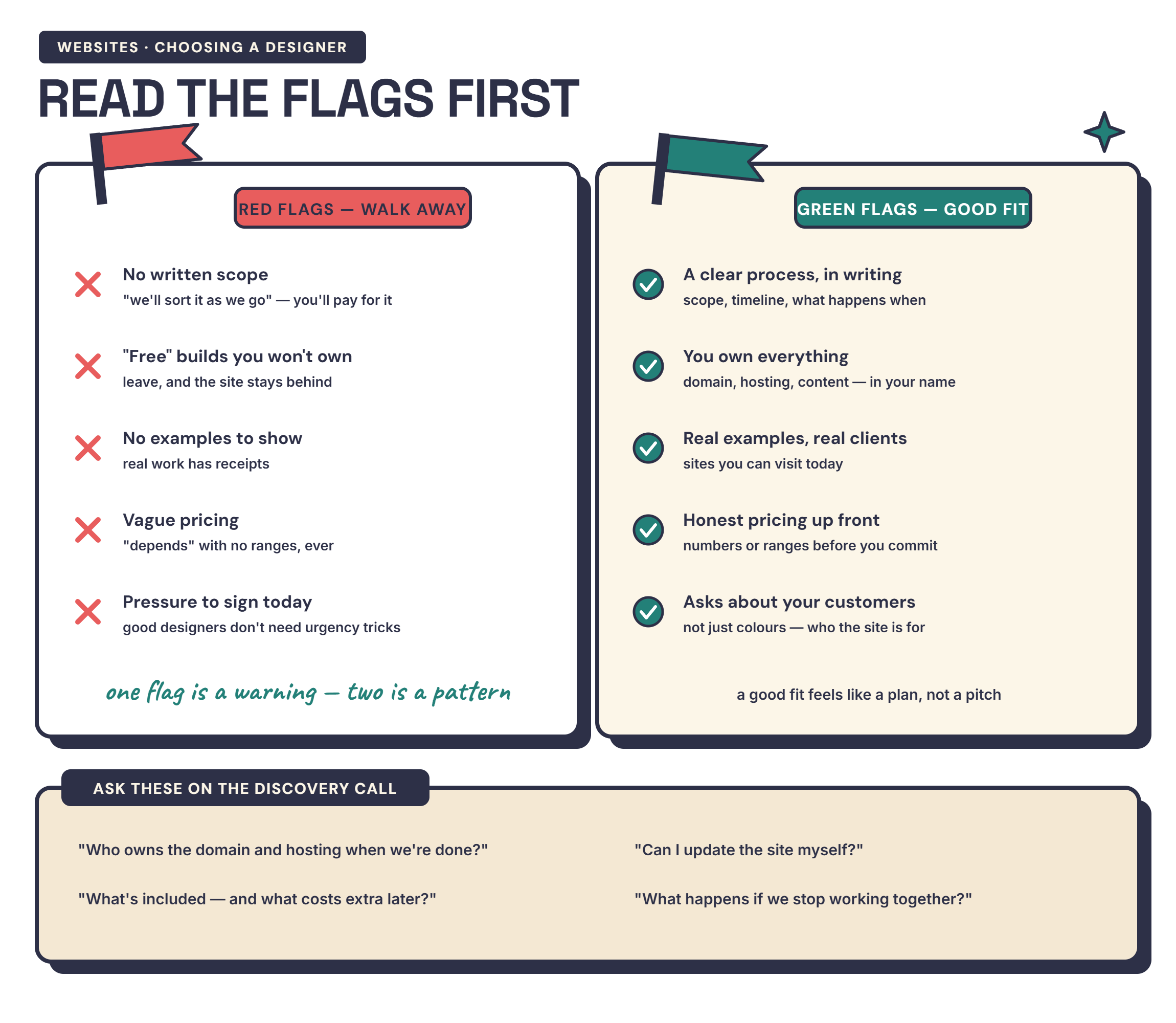
Check five things before you commit to any web designer: they publish their pricing (or at least give you a clear ballpark), they have a portfolio of live sites you can actually visit, they confirm in writing that you’ll own your domain and website files, they provide a written proposal that spells out exactly what’s included, and there’s no lock-in contract. If all five check out, you’re in a much safer position than most. If you’re still deciding between building it yourself or hiring someone, start there first.
Before you even get on a call
You can learn a lot about a web designer from their own website — before you’ve spoken a single word.
Do they show their prices? Research from Nielsen Norman Group found that pricing is the number one piece of information people look for on any website. When they can’t find it, they go to a competitor who does. From what I’ve seen, around 60% of web designers in Australia don’t publish pricing at all. That doesn’t automatically mean they’re dodgy — but it does mean you’ll need to sit through a sales call just to find out if you’re in the right ballpark. A designer who publishes pricing is telling you something about how they operate. I’ve also published a Perth-specific pricing comparison if you want local context.
Do they have a portfolio of live websites? Not screenshots — actual links you can click and visit. Check whether the sites load quickly on your phone. Click around. Do the forms work? Does it look like someone put genuine thought into it? If a designer can’t show you real examples of their work, that’s worth noting.
What do their Google reviews say? Not just the star rating — read the actual reviews. Are they from real businesses you could verify? Do they mention specific things about the experience, or are they generic one-liners? Trustpilot removed 4.5 million fake reviews in 2024, so a healthy scepticism about online reviews is fair. But a designer with detailed, specific reviews from identifiable businesses is a good sign.
Do they explain how they work? A good designer’s website will tell you what to expect — their process, their timeline, what’s included. If the website is all sizzle and no substance — flashy design but no clear information about what you actually get — that’s the experience you’ll probably have as a client too.
What to ask on the discovery call
A discovery call should feel like a conversation, not a pitch. If someone is trying to close you on a contract before they’ve asked about your business, that tells you everything you need to know.
Here are the questions that matter most (I keep the full list — with what good and bad answers sound like — in 10 questions to ask before hiring a web designer):
“Who actually does the work?” Some agencies present a senior person on the sales call, then hand the project to a junior team member you’ve never met. There’s nothing wrong with agencies having teams — but you should know upfront who you’ll be working with day to day.
“Do I own the website when it’s done?” This is the big one. You’re asking about three specific things: domain ownership (is it registered in your name?), website files (can you take them to another developer?), and admin access (can you log into your own site?). If the answer to any of these is unclear or conditional — that’s a red flag. I’ve written more about website ownership and how to check you’re in control of your own domain, files, and admin access.
“What exactly is included in the price?” Does the quote cover copywriting? SEO setup? Mobile responsiveness? Training? Hosting? Post-launch support? The most common source of surprise costs is things the client assumed were included but weren’t. Get it in writing.
“What happens if I want to leave?” A confident designer will have a clear answer. Your files come with you, your domain stays in your name, and there’s a reasonable notice period for any ongoing services. If the answer involves hefty exit fees, proprietary platforms, or vague language about “transition costs” — walk away.
“What does your process look like?” A designer who takes time to understand your business before quoting is fundamentally different from one who sends a price within an hour of your first email. A good process includes some form of discovery — a conversation about your business, your customers, your goals — before any proposal is written. If they’re quoting you without asking questions first, the price isn’t based on your needs. It’s based on their template.
Red flags that should make you walk away
I’ve written a separate post covering seven specific marketing tactics to watch for in the web design industry. But here’s the quick version — if you spot any of these, be very cautious:
No discovery process. They quote you a price without asking a single question about your business. That’s not a custom quote — it’s a product being sold, regardless of whether it fits.
They want to manage your domain. Your domain name is your business identity online. It should be registered in your name, under your login, at a registrar you control. If a designer insists on handling this for you and won’t give you direct access — that creates a dependency you don’t want.
Lock-in contracts. 12 or 24-month contracts with automatic rollover clauses and steep cancellation fees. Worth knowing: since November 2023, unfair contract terms in standard form contracts can attract penalties under Australian Consumer Law. Terms like automatic rollovers, excessive exit fees, and one-sided variation clauses may now be unlawful.
Pressure to sign quickly. “This price is only available until Friday.” “I’ve only got two spots left this month.” If the urgency feels manufactured, it probably is. A good designer will give you time to think without punishing you for it.
Guarantees that sound too good. “We’ll get you to page one of Google.” Nobody can guarantee that — and anyone who does either doesn’t understand how search works or is telling you what you want to hear to close the sale. The AWIA’s Web Industry Guidelines specifically prohibit members from guaranteeing improvements in search rankings.
No documentation or handover. If previous clients can’t tell you what was done, what platform the site is on, or what logins they have — that’s a pattern of keeping clients dependent rather than empowered.
Green flags that indicate a good fit
Not everything is about avoiding bad designers. Here’s what a good experience actually looks like:
They ask more questions than you do. A designer who spends the first conversation trying to understand your business, your customers, and what problems you’re trying to solve — before they talk about their services — is a designer who’s going to build something that actually fits.
They’re honest about what you don’t need. If someone tells you “actually, you probably don’t need that right now” or “there’s a cheaper way to do this” — pay attention. A designer who recommends against their own services when it’s not the right fit is showing you how they operate.
They explain things in plain English. If you walk out of a conversation feeling confused and slightly intimidated, that’s not a knowledge gap on your part. It’s a communication failure on theirs. Your designer should be able to explain what they’re doing and why without resorting to jargon.
They provide a written proposal with a clear scope. Before any work starts, you should have a document that lists exactly what you’re getting, what it costs, what’s not included, and what the timeline looks like. No ambiguity.
They’re flexible with how they work. Some clients prefer Zoom. Some prefer meeting in person. Some need more hand-holding, others want to be left alone until it’s done. A good designer adapts to you — not the other way around.
What does a fair web design process actually look like?
Every designer works slightly differently, but here’s roughly what a good process involves:
First contact. You reach out — email, form, phone. The designer responds within a business day with either a few initial questions or a time to chat. No hard sell.
Discovery. A conversation — 30 to 60 minutes — where the designer asks about your business, your goals, your customers, what’s working and what’s not. This might happen over Zoom, over coffee, or over the phone. The point is: they’re listening before they’re proposing.
Proposal. A written document with a clear scope, timeline, and price. You should understand exactly what you’re getting and what happens after launch. If ongoing services are offered, they should be optional — not bundled in as a condition.
Build and review. The designer builds the site and checks in with you at key milestones. You see progress, give feedback, and approve before it goes live. This should be collaborative, not a black box where you hand over money and hope for the best.
Launch and handover. The site goes live. You receive documentation of what’s been done, all your login credentials, and training on how to manage your site. If something breaks in the first few weeks, there’s a support period included.
Ongoing support (optional). Some designers offer monthly maintenance plans. These should always be optional, month-to-month, and clearly explain what’s included. If you don’t want ongoing support, everything you need to manage the site independently should be provided at handover.
How do the numbers stack up?
A 2024 study by the ASBFEO and the University of the Sunshine Coast found that nearly 70% of small businesses end their relationship with a digital marketing provider within 12 months, and one in three of those relationships end in a dispute. The lead researcher, Dr Karen Sutherland, said the most common reason for disputes was a lack of clear and honest communication between small businesses and their providers.
That’s a lot of broken relationships. And most of them could have been avoided by doing the kind of vetting this post describes — before any money changed hands.
Key takeaways
- Check a designer’s pricing, portfolio, reviews, and process before you speak to them
- Ask who does the work, whether you own the site, what’s included, what happens if you leave, and what their process looks like
- Walk away from lock-in contracts, missing portfolios, pressure tactics, and guarantees about Google rankings
- A good designer asks questions before they quote, explains things clearly, and puts everything in writing
- The ASBFEO found that one in three small business–provider relationships end in a dispute — proper vetting upfront is your best protection
If you’re looking for a web designer and want to see what transparent pricing, no lock-in contracts, and a proper discovery process actually looks like — have a look at how I work, or book a 15-minute chat. No pitch, no pressure. Just a straight conversation about what you need.
Frequently asked questions
What questions should I ask a web designer before hiring them?
Ask who will actually be doing the work, whether you'll own the domain and website files, what's included in the quoted price, what happens if you want to leave, and whether they offer a written proposal with a clear scope. A good designer will also ask you questions — about your business, your customers, and your goals — before they quote anything.
How much should a web designer cost in Australia?
In Australia, a professional small business website typically costs $800–$3,000 from a solo developer and $3,000–$8,000 or more from an agency. Be cautious of quotes under $300 — they often exclude essentials like mobile responsiveness, SEO, and copywriting. Always compare what's included, not just the total price.
What are the biggest red flags when hiring a web designer?
The biggest red flags include no published pricing or portfolio, registering the domain in their name instead of yours, lock-in contracts with hefty exit fees, pressure to sign quickly, no discovery process, and a quote that arrives before they've asked about your business.
Got a question? Need some advice?
Book a free 15-minute call. No pitch — just straight answers. Most people walk away with a clear next step or a blocker sorted.
Book a Free Call →