Updated April 2026: Pricing updated to reflect my new simplified pricing — $500 one-page / $1,000 full site, with 12 months hosting included.
The honest answer is: it depends. But that’s a frustrating answer when you’re trying to set a budget, so let me give you the real numbers.
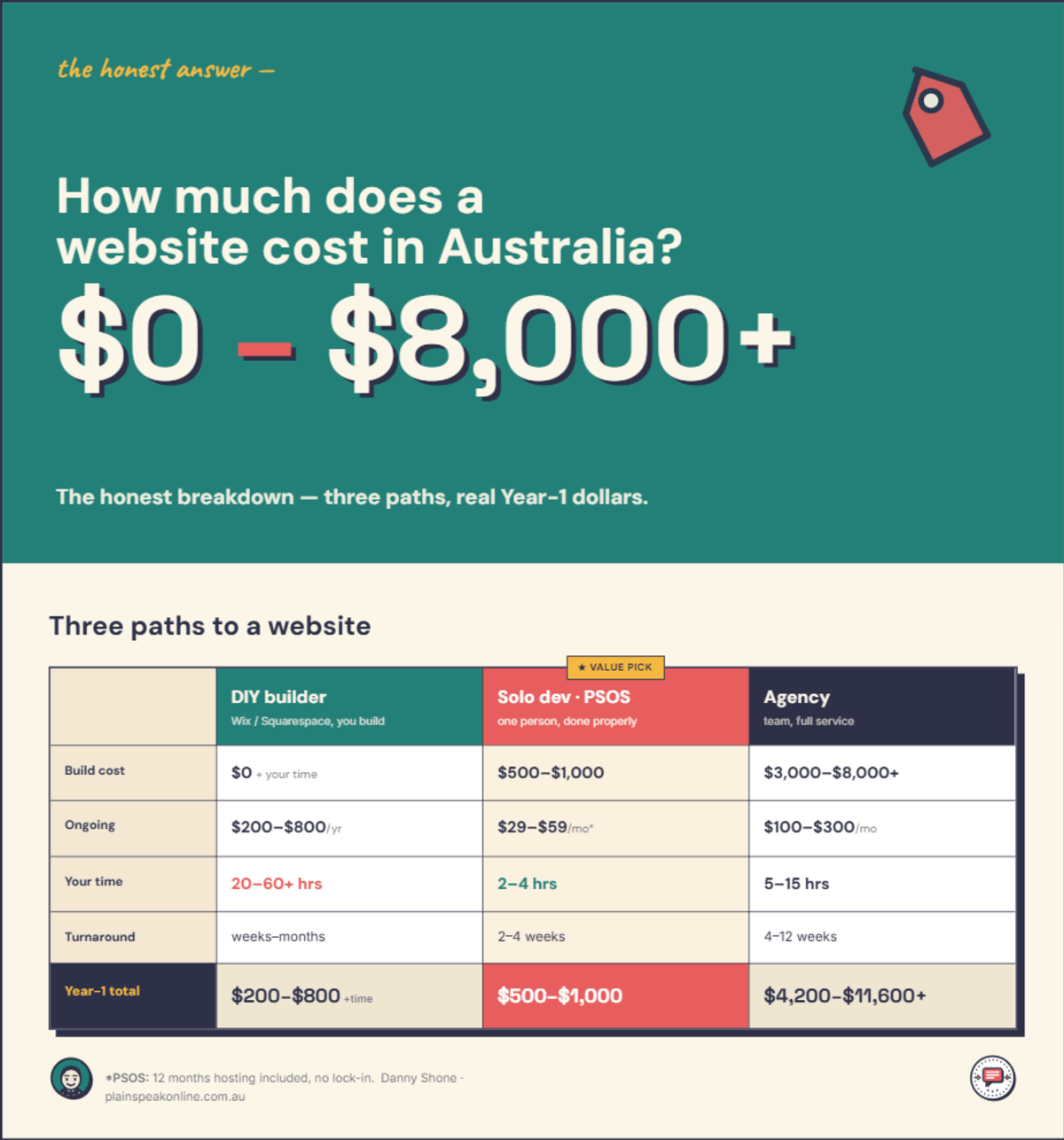
A DIY website on a platform like Squarespace or Wix costs $200–$800 per year in platform fees — but doesn’t account for your time. A professional custom website from someone like me costs $500–$1,000. An agency will typically charge $3,000–$8,000 for a standard small business site, and I’ve seen quotes go well into five figures.
That’s a massive range. And the reason it’s so hard to compare is that every provider packages things differently, uses different terminology, and includes different things in the price. For a non-technical person, it can feel like comparing apples to oranges to something that might not even be fruit.
What’s the short version?
Most Australian small businesses can get a professional, well-built website for $800–$3,000. If you’re being quoted more than that for a standard 5–10 page business site, it’s worth asking what exactly you’re paying for — and whether you could achieve the same goals for less and put the difference into actually getting visitors to the site.
The three paths (and what they really cost)
There are basically three ways to get a website for your small business. Here’s an honest look at what each one actually costs — not just the sticker price, but the full picture.
| DIY builder | Solo developer (like PSOS) | Agency | |
|---|---|---|---|
| Build cost | $0 (your time) | $500–$1,000 | $3,000–$8,000+ |
| Ongoing fees | $200–$800/year (platform + domain) | $29–$59/month (12 months hosting included, then optional plans) | $100–$300/month (hosting + maintenance) |
| Your time investment | 20–60+ hours | 2–4 hours (initial chat + feedback) | 5–15 hours (briefing, meetings, reviews) |
| Turnaround | Weeks to months | 2–4 weeks | 4–12 weeks |
| What you get | Template-based site, you do everything | Custom site, all copywriting, SEO built in, training, 90-day settle-in period | Bespoke design, project management, possibly a team |
| Realistic Year 1 cost | $200–$800 + your time | $500–$1,000 + 2–4 hours of your time (hosting included) | $4,200–$11,600+ |
The cost of your time
This is the one that catches most people. A website builder might cost $20 a month, but building a site yourself means learning the platform, writing the copy, choosing fonts and colours, making it work on mobile, setting up forms, configuring SEO, connecting Google Analytics, and a dozen other things you didn’t know existed until you started.
If your time is worth $50 an hour and you spend 40 hours building a DIY site, that’s $2,000 in your time — on top of the platform fees. For a lot of business owners, hiring someone actually works out cheaper when you account for what your time is worth. And you end up with a better result, faster. I’ve written a full comparison of DIY vs hiring a web designer if you’re weighing up these paths.
What actually affects the price?
Number of pages. A 5-page business site costs less than a 20-page site. More pages, more design, more content, more time.
Custom design vs template. A site built from a template is faster and cheaper. A fully custom design costs more because it’s built specifically for your business. For most small businesses, a clean template customised to your brand does the job perfectly. I’ve compared custom websites vs website builders in more detail if you’re deciding between the two.
Copywriting. Some providers include writing your page content. Others hand you a blank site and say “fill it in.” If you’ve ever stared at an empty About page wondering what to write on each page, you’ll understand why copywriting adds value.
E-commerce. Selling products online adds significant complexity and cost. I’ll cover this in detail in a separate post on online store costs.
Integrations. Booking systems, payment gateways, CRM connections, live chat — each one adds time and cost. Some are straightforward, others require custom work.
SEO setup. Some builds include basic search engine optimisation. Others charge it as an add-on. Every site I build includes SEO foundations as standard — page titles, meta descriptions, schema markup, site speed, and mobile responsiveness — because a website nobody can find isn’t doing its job.
The pricing traps worth watching for
“Free” websites with expensive hosting. Some agencies offer a “free” website build but lock you into monthly hosting fees of $150–$300. Over two or three years, you’ve paid more than a proper build would have cost — and you usually don’t own the site. If you stop paying, it disappears.
“Starting from” prices. A quote that says “websites from $500” often means “the absolute bare minimum, and everything you actually need is extra.” Ask for a full scope and total cost before committing. For a full guide on vetting designers and avoiding these traps, see how to choose a web designer.
The missing extras. Does the quote include your domain? Hosting? SSL? Email setup? Copywriting? SEO? If the proposal doesn’t explicitly list what’s included, ask. The best way to avoid surprise costs is to get everything in writing upfront.
Five-figure quotes for simple sites. I’ll be straight with you — unless you’re a large, complex business with genuinely unique requirements, I can’t personally see the justification for a five-figure price tag on a small business website in 2026. I’ve seen $10,000+ websites that shouldn’t have been more than a grand. The tools, platforms, and workflows available today mean a skilled developer can deliver a professional, fast, well-built site for a fraction of what agencies charged five years ago.
The $199 Facebook ad problem. If you’ve been researching website pricing, you’ve probably seen Facebook ads offering websites for $199 or similar. I’ve been looking into these myself, and here’s what I’ve found.
Some claim to be Australian-based but multiple indicators suggest they’re not — offshore operations using Australian branding to build trust they haven’t earned. Others genuinely are charging $199, but that’s a starter package with inclusions so limited that you’ll absolutely need to upgrade or pay for add-ons to get anything functional. The price gets you in the door. The real cost comes after.
At the lowest end, what you’re typically getting is a template where you fill in a basic form — your business name, your colours, a few lines of text — and out comes a site that looks like a thousand other businesses. Nobody has taken the time to understand what your business actually does, who your customers are, or what makes you different.
That’s not how I work. I spend time with every client — usually over Zoom — understanding their business, their goals, and their customers before I design anything. I don’t use templates. The result is a website that actually reflects the business and the person behind it, not a cookie-cutter page with your logo swapped in.
A $199 website and an $800 website aren’t the same product with different price tags. They’re fundamentally different things.
What does PSOS charge?
For $500–$1,000, you get a custom-designed website (as many pages as you need), all the copywriting, mobile-responsive design, SEO built in, Google Analytics, contact forms, a training video, a live walkthrough, a 90-day settle-in period, and 12 months hosting included. You can see the full details on my website design service page. You own the site outright — no lock-in, no leasing, no “you lose everything if you leave.” If you’re wondering whether to put your own prices on your website, I’ve written about why I think you should.
After the settle-in period, your hosting continues — it’s included for 12 months. If you want ongoing edits and SEO attention, you can add Hosting + Support for $59/month. After 12 months, hosting continues at $29/month. Both plans are month-to-month, cancel anytime. If you’d prefer to pay only when something needs doing, hourly website help is also available at $100/hour — no plan required.
These plans aren’t making me rich. They’re priced the way they are because I think the ongoing stuff — maintenance, updates, SEO, monitoring — is necessary for a website to actually succeed. Not an optional add-on. For a full breakdown of what those ongoing costs look like year by year, see The Real Ongoing Costs of a Website in Australia.
The ROI question nobody asks
If someone tells me they’ve got $8,000 to spend on a website, my first question isn’t “what pages do you want?” It’s “what are you trying to achieve?”
Because an $8,000 website that nobody visits isn’t worth $8,000. Could we build something that achieves the same goals for $2,000–$3,000, and put the remaining $5,000 into Google Ads, local SEO, or content that actually drives traffic? For most small businesses, that split delivers a far better return.
I’ve run the numbers on how long it takes for a website to pay for itself — for most small businesses, it’s faster than you’d expect.
If you’ve been quoted something that feels high, send me the proposal. I’ll review it honestly, tell you what I think, and if it makes sense I’ll put together an alternative — no pressure, no sales pitch. Just a second opinion from someone who does this every day.
What about no upfront cost websites?
You might have seen ads for pay-monthly website plans — instead of paying $500–$2,000 upfront, you pay $50–$150 per month and the provider builds and hosts your site as part of the subscription. It sounds appealing, especially when you’re just getting started and cash flow is tight.
The upside is obvious: low barrier to entry. You’re not outlaying a big chunk upfront, and you get a site live quickly. For testing a business idea before you commit, that can make sense.
The downside? You usually don’t own the site. Stop paying, and it disappears. Over two or three years, the total cost often ends up higher than paying upfront for a site you actually own. And customisation tends to be limited — you’re working within whatever the provider’s system allows.
My honest take: if you’re genuinely just testing an idea and want something live fast, a subscription model is fine for that. But if you’re building a real business, you’re better off owning your site outright. It’s yours, you control it, and you’re not renting your online presence from someone who can change the terms whenever they like.
Are website costs tax deductible?
Good news — yes, in most cases. A website is a business asset, and in Australia, small businesses can claim it under the instant asset write-off. As of 2026, the threshold is $20,000 per asset for businesses with an aggregated turnover under $10 million. That means your website build, and potentially your hosting and domain costs, can be claimed as a business expense. The ATO has specific guidance on website costs covering when they can be deducted immediately versus depreciated.
This applies whether you pay upfront or spread the cost. It’s one of the reasons I always encourage businesses to invest in a proper site rather than cobbling something together for free — if the ATO is effectively subsidising part of the cost, you might as well get something that actually works for your business.
I’m not an accountant, though, so check with yours before claiming anything. Every business situation is different, and the rules can change. But it’s definitely worth asking about.
Key takeaways
- Most small businesses can get a professional website for $800–$3,000 in Australia
- DIY builders are cheap on paper but expensive in your time — factor that in
- Always ask what’s included in a quote: domain, hosting, SSL, copywriting, SEO, ongoing support
- Watch for “free build” models that lock you into expensive monthly fees
- The best website investment isn’t always the website itself — it’s the combination of a good site plus a plan to get people to it
- If you’re based in Perth, I’ve also written about what websites cost in Perth with local agency pricing
- For a quick overview, see my Perth web design pricing guide
Frequently asked questions
What is the average cost of website design for a small business in Australia?
The average cost ranges from $500 to $3,000 for a solo developer or small studio, and $3,000 to $8,000+ for an agency. DIY platforms cost $200–$800 per year in fees plus your time to build and maintain.
Are website costs tax deductible in Australia?
Yes. Ongoing costs like hosting and domains are claimed in the year you pay them. Website builds over $300 are typically depreciated as a business asset. Check with your accountant for your specific situation.
How much should it cost to build a small business website?
For a standard 5–10 page business website in Australia, $500–$3,000 is a realistic range when hiring a solo developer. If you're being quoted more than that, ask what you're getting that justifies the extra cost.
What are the ongoing costs of a website?
Expect to pay $300–$1,500 per year for domain renewal, hosting, SSL, and maintenance. Most small business owners budget $30–$80 per month. I've written a full breakdown of ongoing website costs in Australia.
Got a question? Need some advice?
Book a free 15-minute call. No pitch — just straight answers. Most people walk away with a clear next step or a blocker sorted.
Book a Free Call →