Every new seller hits this question early: do I build my own online store, or just list on eBay, Etsy or Amazon and skip the website altogether?
The short answer I give clients: both — in the right order. But the long answer got more interesting this year, because eBay Australia made selling free for smaller sellers, and that’s genuinely changed the maths. Just not the conclusion.
What’s actually different between the two?
A marketplace hands you traffic and trust on day one. Millions of Australians already shop there, their payment details are saved, and a brand-new seller borrows all of that credibility instantly. That’s real value — don’t let anyone tell you otherwise.
What you give up is control. On a marketplace you’re a listing in someone else’s shop, in their layout, under their rules. The customer belongs to the platform, not to you — you often can’t email them, retarget them, or even see who they are beyond the order. Fees change when the platform decides. Your “shop” can be suspended by an algorithm. And every competitor is one thumb-scroll away.
Your own store flips all of that. Your branding, your customer list, your rules — and every product page is a chance to show up in Google searches, which compounds over years. The trade-off is that you start with zero traffic and the trust is yours to earn.
Australia Post’s latest eCommerce report has Australians spending $82.6 billion online last year, with marketplaces taking $18.9 billion of it — a big slice, but most online spending still happens on retailers’ own sites. Both channels are real. The question is which one you build your business on.
What do marketplaces cost in 2026?
Rough shapes, current at the time of writing — always check the platform’s own fee page before deciding:
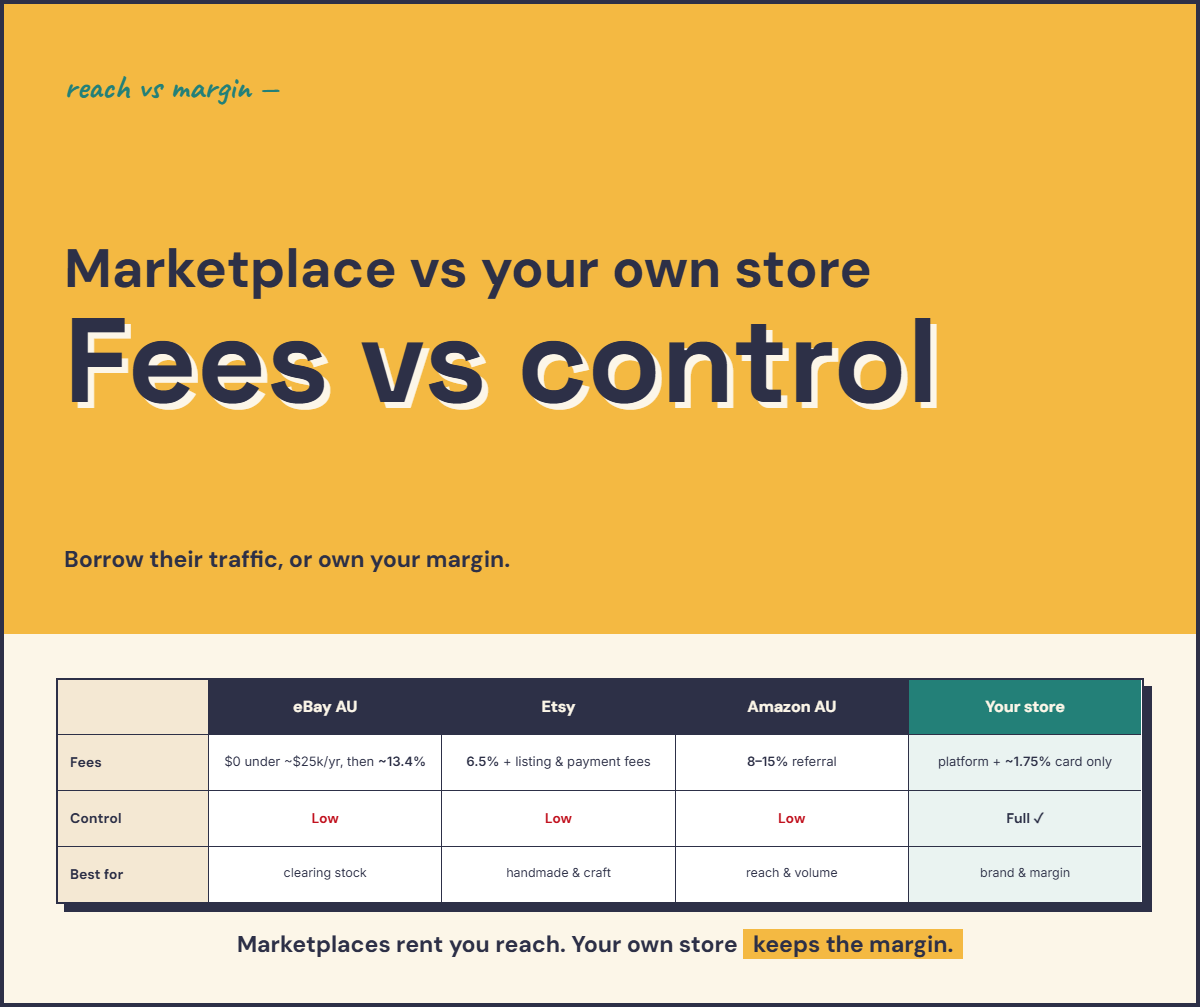
| Channel | What it costs | What you control |
|---|---|---|
| eBay AU | $0 transaction fees for sellers under ~$25k/year (from May 2026). Beyond that, roughly 13.4% on the first $4,000 of a sale, then 2.5%. International sales add 3% | Your listing, within eBay’s format |
| Etsy | Small listing fee per item, 6.5% transaction fee, payment processing around 3%, and 12–15% when an Offsite Ad brings the sale | Your listing and shop page |
| Amazon AU | Referral fees typically 8–15% depending on category, plus fulfilment costs if you use FBA | Very little — it’s Amazon’s world |
| Your own store | Build cost plus platform or processing fees — the full breakdown is in my online store cost guide | Everything |
Notice the pattern: marketplace fees scale with your success forever. Your own store’s biggest cost is mostly up-front.
Doesn’t eBay’s free selling change everything?
It changes something. Since 12 May, Australian sellers under $25,000 a year pay no transaction fees on sales to Australian buyers — which makes eBay a genuinely cheap place to test whether anyone wants your product. For decluttering, side-hustles, and validating demand, that’s hard to argue with.
But read the fine print before calling it free: it only covers domestic sales, casual sellers generally have to buy their postage labels through eBay, Pro-plan features sit outside the free tier, and the international sales fee rose to 3% at the same time. Free has edges, and they’re worth knowing before you build on them.
And none of it changes the ownership question. Here’s the test I give clients — think about your own shopping habits. You see a social media ad for a new product from a small brand. You click it. It lands on an eBay listing instead of their own website. What’s your first thought?
Exactly. That instinct — the little dip in confidence — is what you’re outsourcing when a marketplace is your only home. That reaction is usually enough to settle the conversation.
What about selling on Instagram or Facebook?
Worth clearing up, because the ground moved here too. Meta has wound back in-app checkout — in Australia, Facebook and Instagram Shops now work as discovery: people find and browse your products there, but the purchase completes on your own website.
Which means “I’ll just sell on Instagram” quietly became “I need a website for Instagram to send people to.” Social is the shop window, not the shop. I’ve written more on that split in website vs Instagram vs booking platforms.
So which should you choose?
My honest advice, the same one I give paying clients: your own store is home base, and a marketplace is a secondary listing where your audience genuinely shops. In practice that looks like this.
If you’re testing an idea, list it cheaply — eBay’s free tier or an Etsy shop — and treat the fees as tuition. If it sells, build your own store while the marketplace keeps ticking along as a second channel. If you’re already established, the marketplace listing is optional: useful for categories where buyers default to those platforms, unnecessary where they don’t. Different businesses, different stages, different answers.
What I’d steer you away from is the middle path that looks safest: building your entire business on a platform you don’t control, for years, because it worked well enough to never leave. That’s not a channel strategy — it’s renting your whole business from a landlord who can change the terms whenever they like.
Not sure where your product sits? Tell me what you sell and who buys it — a free 15-minute chat usually settles it. And if the answer is “your own store,” it starts smaller than you think — I build single-product stores for exactly this stage.
Frequently asked questions
Is it free to sell on eBay Australia now?
For smaller sellers, mostly yes — from May 2026, Australian sellers under about $25,000 in annual sales pay no transaction fees on standard listings. There's fine print around payouts, listing features and international sales, so check eBay's current fee page before building a business on it.
Can I sell on a marketplace and my own store at the same time?
Yes, and for many small sellers that's the strongest setup. Your own store is the home base you control; the marketplace listing is a secondary channel that borrows the platform's trust and traffic. Just keep pricing consistent and point your marketing at your own site.
Do I need a website if I sell on Etsy?
You can trade without one, but you're building on borrowed ground — Etsy owns the customer relationship, sets the fees, and can change the rules. A simple site of your own, even one page, gives you somewhere to send people that belongs to you.
Got a question? Need some advice?
Book a free 15-minute call. No pitch — just straight answers. Most people walk away with a clear next step or a blocker sorted.
Book a Free Call →