
You paid for a website. It looks professional. It says what you do. And yet — nothing. No calls, no form submissions, no emails from new prospects. Just silence.
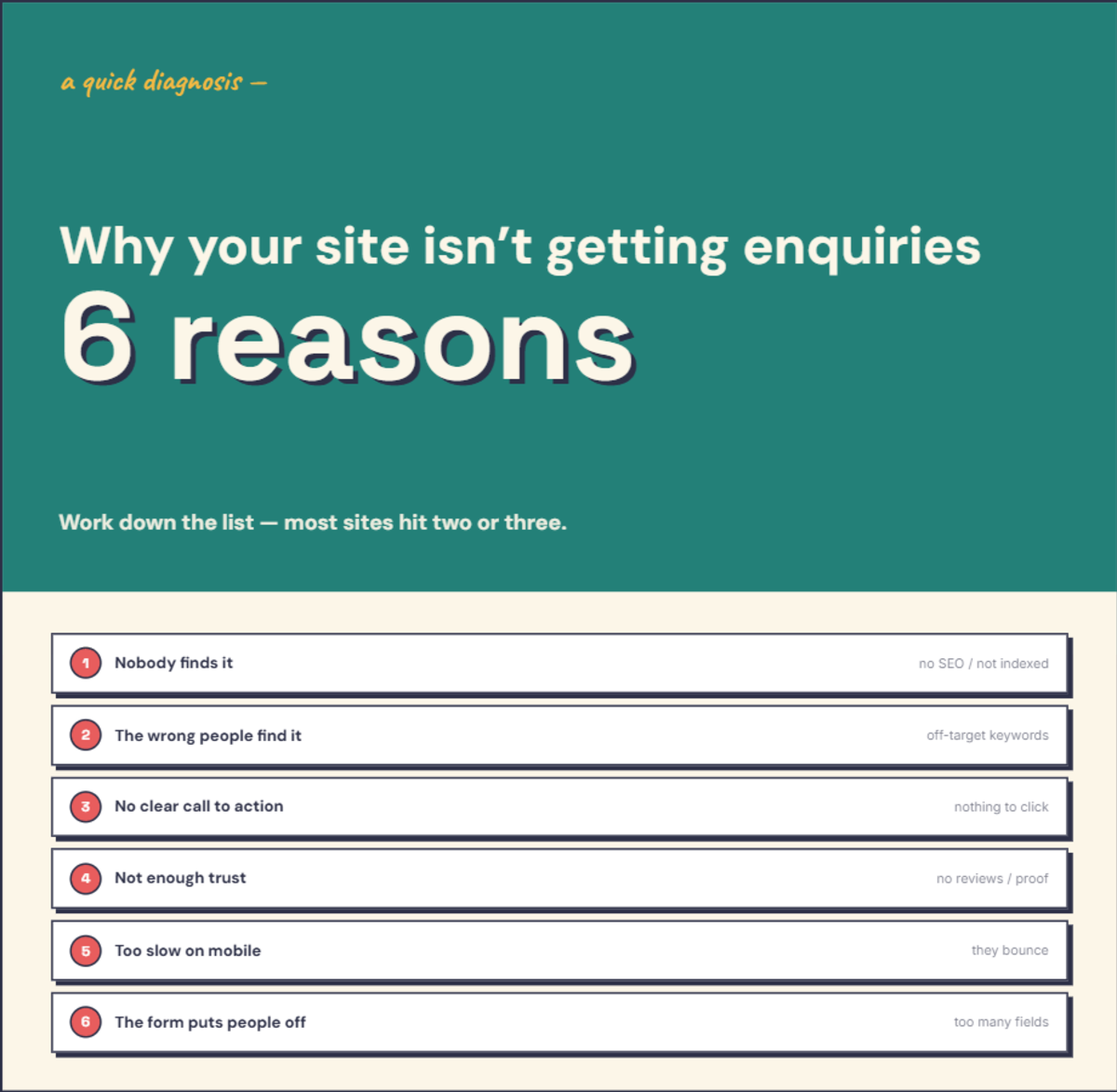
This is one of the most frustrating situations a business owner can be in, because the website looks like it should be working. The problem is almost always one of six things — and they’re not all the same kind of problem. Some are about getting found. Others are about what happens after someone arrives. (For the arrival side, the sibling post covers eight things that drive customers away once they land.)
How to tell which problem you have
Before working through the list, a quick diagnostic. Open Google Search Console (it’s free — if you haven’t set it up, that’s worth doing first). Look at your Performance report for the last 3 months.
Low impressions (under a few hundred) means Google isn’t showing your pages much. That’s a visibility problem — reasons #1 and #2 below.
Decent impressions but low clicks means your listings aren’t compelling. Your titles and descriptions need work.
Clicks but no enquiries means people are finding you and visiting — but your website isn’t converting them. That’s reasons #3 through #6.
This distinction matters because the fix is completely different depending on which problem you have.
1. Nobody can find it
The most common reason a website generates no enquiries is that nobody’s seeing it. It’s not ranking for relevant searches, it’s not linked to a Google Business Profile, and it’s not being shared anywhere.
A website without SEO is a shopfront in a laneway with no signage. It might be brilliant inside, but nobody knows it’s there.
What to check: Search Google for the main thing you do plus your location — “physiotherapist Scarborough” or “bookkeeper Perth.” Can you see your website anywhere in the first two pages? If not, that’s the problem. I’ve written a plain-English guide to SEO and a separate post on local SEO specifically.
2. The wrong people are finding it
Sometimes the traffic is there but the enquiries aren’t — because the people visiting your site aren’t the people you can help. This happens when your content targets keywords that attract the wrong audience, or when your site doesn’t clearly communicate who you serve.
A coach who helps executive women might rank for “life coach Australia” and attract students looking for career advice. A web designer targeting small businesses might rank for “web developer jobs” and attract job seekers. The traffic looks good in the analytics. The phone doesn’t ring.
What to check: In Search Console, look at the actual search queries driving clicks to your site. Are they the kind of searches your ideal customer would make? If they’re off-target, your content strategy needs adjusting.
3. There’s no clear call to action
This is the most fixable problem on the list — and the most common. Someone arrives at your site, reads about your services, thinks “this could work” — and then can’t figure out what to do next.
Specific, personal calls to action consistently outperform generic ones. “Get a free quote for your Perth business” outperforms “Submit.” “Book a 15-minute chat — no obligation” outperforms “Contact us.”
What to fix: Every service page and your homepage should have a visible, specific CTA above the fold. Not just in the navigation. A button, a form, a phone number with a “call now” link on mobile — something that makes the next step obvious and easy.
4. The site doesn’t build enough trust
This is the invisible killer. Your site might look professional, but if it doesn’t include anything that proves other people have had a good experience working with you, visitors don’t have enough confidence to get in touch.
BrightLocal’s 2026 consumer research found 97% of consumers read reviews — yet plenty of small business websites offer them nothing to read. People want reviews, case studies, real photos (not stock images), credentials where relevant, and evidence that you’re a real person running a real business.
What to fix: Add at least 2–3 genuine testimonials to your homepage. Include full names and businesses where possible (with permission). Link to your Google reviews. If you have case studies or before-and-after examples, use them. Real photos of you, your work, and your space make a significant difference. My post on whether you should put prices on your website covers why transparency itself is a trust signal.
5. It’s too slow — especially on mobile
A huge share of your visitors are on phones — and if your site takes more than a few seconds to load on one, many of them leave before they see anything.
A page loading in under 2.5 seconds is what Google considers “good” — and it’s a ranking factor as well as a user experience issue.
What to check: Test your site at PageSpeed Insights. Look at the mobile score specifically. If LCP (Largest Contentful Paint) is above 4 seconds, your site has a speed problem that’s costing you enquiries. My post on how websites actually work explains the technical side in plain English.
6. Your contact form is putting people off
If the only way to get in touch is a form that asks for your name, email, phone number, company name, website URL, budget range, project timeline, and a 200-word description of your needs — you’ve just created an assignment, not a conversation.
Form-analytics studies consistently show most people have abandoned a web form at some point, that long forms convert far worse than short ones — and that a required phone-number field is one of the fastest ways to lose someone.
What to fix: Strip your contact form back to the essentials. Name, email, and a message field. If you need a phone number, make it optional. You can always ask for more details once the conversation starts. Offer alternatives too — a visible phone number, an email address, or a booking link for a quick call.
If you can only do one thing
Work out whether you have a visibility problem or a conversion problem (the diagnostic at the top of this post). Everything else follows from that. There’s no point optimising your CTA if nobody can find your site — and there’s no point investing in SEO if your site isn’t converting the visitors you already get.
Got 15 minutes? Let’s have a quick chat about what would actually make a difference for your website — no pitch, just straight answers.
Frequently asked questions
What's a normal number of enquiries from a website?
For a service-based small business website, converting 1–3% of visitors into enquiries is typical. If you're getting 500 visitors a month and zero enquiries, something specific is wrong. If you're getting 50 visitors and zero enquiries, the problem might simply be traffic — not enough people are seeing it in the first place.
How can I tell if my website has a traffic problem or a conversion problem?
Check Google Search Console (free). If you're getting fewer than 100 impressions per month for your target keywords, it's a visibility problem — Google isn't showing your site. If you're getting impressions and clicks but no enquiries, it's a conversion problem — people are arriving but not taking action.
Got a question? Need some advice?
Book a free 15-minute call. No pitch — just straight answers. Most people walk away with a clear next step or a blocker sorted.
Book a Free Call →