I spent 11 years working inside a national not-for-profit before I started building websites. It was Lifeblood — the organisation that processes blood and blood products for the Australian health system. My role was in the laboratories, not IT. But I learned things in that time that I couldn’t have learned anywhere else.
I learned what it’s like to operate when every dollar is accountable. When your budget comes from the public purse and there’s no room for waste. When the people around you aren’t there for the salary — they’re there because they genuinely believe in what the organisation does.
That experience is a big part of why I offer discounts for NFPs, why I contribute 1% of revenue to the Stripe Climate program, and why I’m working toward B Corp certification. But more practically, it’s why I think most NFP websites are overpriced and overbuilt for what the organisation actually needs.
What does the ACNC actually require on your website?
The short version: almost nothing specific to websites.
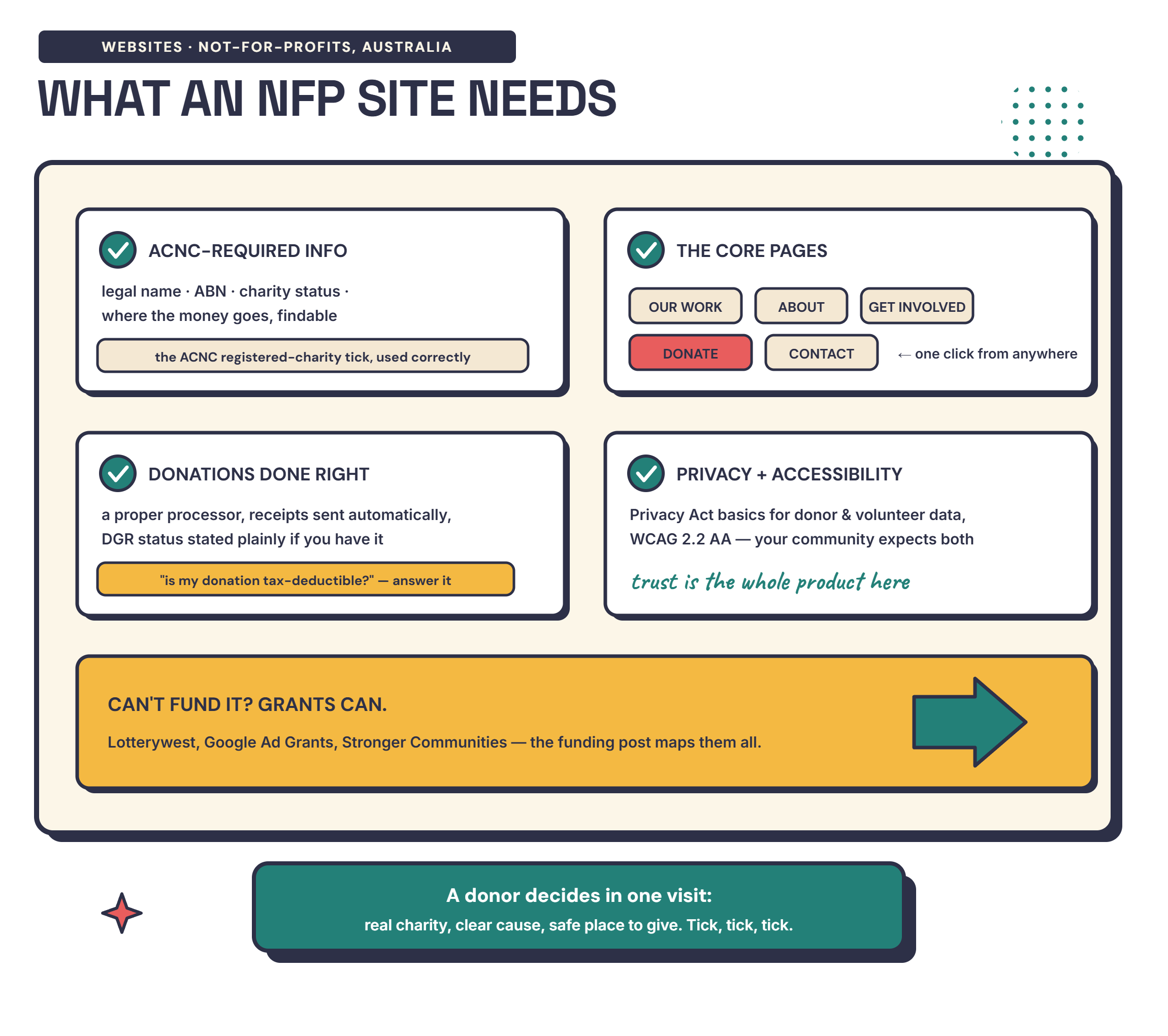
The ACNC Governance Standards require charities to demonstrate their charitable purposes and provide information to the public — but a website is listed as one option alongside social media and annual reports. There’s no rule that says “you must have a website” or “your website must include X.”
What is required more broadly: you need an active ABN for ACNC registration, and the ACNC recommends displaying it on your website along with the statement that your organisation is registered with the ACNC. If you have Deductible Gift Recipient (DGR) status, your donation receipts must include your ABN and fund name — but that’s a receipt requirement, not a website one. Practically though, donors need to see your DGR status before they give, so putting it on the site is common sense.
The ACNC also provides a free Registered Charity Tick that you can display on your website. If you use it digitally, it should link to your listing on the ACNC register. It’s optional, but it builds trust — and it’s free.
Everything else — the donation pages, the volunteer forms, the impact reports — is best practice. Still worth doing well. But nobody should be telling you it’s a regulatory requirement and adding zeros to the invoice.
What pages does an NFP website actually need?
This depends entirely on what your organisation does and who you’re trying to reach. A walk-and-talk networking group for business founders needs something very different from a homelessness support service. I recently built a one-pager for Heart First Founders, a walk-and-talk community for values-driven business owners — and their needs were straightforward. A clear explanation of what the group is about, a way to register for upcoming walks, information for first-timers, and a newsletter signup.
That’s a very different build from a charity running multiple programs across multiple locations with online donation processing and volunteer management.
But here’s a general starting point for most small to mid-size NFPs:
A homepage that answers three questions in the first few seconds: what do you do, who do you help, and how can someone get involved? Most NFP homepages try to do too much. Pick one primary action — donate, volunteer, learn more — and make that the focus.
An about page that tells your story honestly. Not a corporate mission statement that reads like it was written by committee — even if it was. Who started this, why, and what’s actually changed because of the work you do. Real photos of real people if you can.
What you do — whether that’s services, programs, events, or advocacy. Separate pages if you have distinct programs. One page with clear sections if you don’t.
A get involved page covering donations, volunteering, membership, events — whatever applies to your organisation. Make each pathway obvious and easy to follow.
A contact page with real names and response expectations where possible. If your organisation is volunteer-run and emails get checked twice a week, say so. People would rather know than wonder why nobody got back to them.
And a privacy policy — even if you’re currently exempt from the Privacy Act. More on that below.
Donations: what you need to know about payment processing
If your website accepts donations, the payment gateway you choose matters more than you might think — because the fees come directly off what your donors give.
GiveNow, run by Our Community in Melbourne, has historically been one of the lowest-cost donation platforms in Australia. Their transaction fees for Visa and Mastercard start at 0.26% for DGR-endorsed organisations — but since August 2024, they also charge a platform fee starting at 1.5% on their Starter plan, bringing the effective minimum to around 1.76%. GiveNow reports that 90% of donors opt to cover the platform fee when prompted, which helps. Even with the platform fee, it’s still competitive compared to standard payment gateways charging 2–3%. Worth comparing the plans before defaulting to whatever your website platform suggests.
For WordPress sites, GiveWP and WP Charitable are the most established donation plugins. WP Charitable has a free tier that covers the basics, with paid plans from $69 a year for recurring donations and more advanced features.
If you have DGR status, make sure it’s clearly visible on your donation page — and that your automated receipts include your ABN and fund name. Donors need that information for their tax return, and making it easy for them makes it more likely they’ll give again.
One thing that’s often overlooked: a recurring donation option. Even a small monthly contribution adds up over a year, and most donors are willing to set it up if you make it simple. Don’t bury it three clicks deep.
Does the Privacy Act apply to your NFP?
This is one of those areas where the answer is “probably not right now, but likely soon.”
Most NFPs with annual turnover under $3 million are currently exempt from the Privacy Act 1988 and the Australian Privacy Principles. Turnover means all income from all sources — not just commercial revenue.
But there are exceptions even now. If your NFP is contracted to deliver Australian Government services, provides health services, or sells or purchases personal information, you’re already covered regardless of turnover.
The bigger picture: the OAIC has recommended removing the small business and NFP exemption entirely, and that’s being actively considered. The Privacy Legislation Amendment (Enforcement and Other Measures) Act 2022 increased maximum penalties to $50 million or 30% of adjusted turnover — and a new statutory tort for serious privacy invasions took effect from 10 June 2025. Further reforms are being progressed, including a potential removal of the small business exemption, though no timeline has been confirmed.
My advice — and I’m not a lawyer, so take this as a web designer’s practical recommendation, not legal guidance — is to have a privacy policy on your website regardless of whether you’re technically required to. It builds trust, it prepares you for likely changes, and it takes a few hours to set up properly. It’s also worth knowing that the Spam Act and Do Not Call Register Act apply to your marketing regardless of your Privacy Act status.
Grants that can fund your website
This is one of the most useful things I can tell you, because a lot of NFPs don’t know these options exist.
The Stronger Communities Programme (federal) has previously offered grants of $2,500 to $20,000 for small capital projects — explicitly listing website upgrades as eligible expenditure. Round 9 closed in 2025, and no Round 10 has been announced at the time of writing. It’s worth monitoring business.gov.au for future rounds, and building a relationship with your local MP’s office, since nominations go through them.
Google for Nonprofits is available to ACNC-registered charities — you apply directly through Google and get verified by Goodstack (Google’s third-party verification partner for Australian nonprofits). It provides free Google Workspace, YouTube Nonprofit Program access, and — this is the big one — Google Ad Grants giving you up to USD$10,000 per month in free Google Ads. That’s roughly $120,000 a year in free advertising. Most small NFPs don’t know this exists.
In WA specifically, Lotterywest is a major funder for community organisations. Their Grassroots Community-Led grants are open year-round, and their priorities include bridging the digital divide. One Tree Community Services received over $1.1 million from Lotterywest for a digital transformation project. You’re not going to get that kind of funding for a brochure website — but if your digital presence is genuinely tied to your mission delivery, Lotterywest is worth talking to.
Other programs worth knowing about: Microsoft 365 for Nonprofits offers free and discounted licences. Canva for Nonprofits provides free Canva Pro access (apply directly through Canva). Connecting Up (connectingup.org), Australia’s TechSoup partner, provides access to discounted technology from Microsoft, Adobe, Cisco, and others for ACNC-registered charities.
How much does an NFP website actually cost?
The range I see across the industry is roughly $3,000 to $5,000 for a basic NFP site, and $15,000 to $50,000 or more for complex builds with donation systems, CRM integration, member portals, and multilingual content. Some agencies that specialise in NFPs advertise reduced rates — typically 10–25% off standard pricing.
I charge $500 for a one-page website and $1,000 for a full site. That includes design, development, mobile optimisation, SEO, accessibility compliance, copywriting assistance, and 12 months of hosting. I offer discounts for NFPs on a case-by-case basis — because I’d rather do good work for a community organisation at a fair price than watch them struggle with a DIY site that doesn’t serve them.
I don’t change my prices based on who you are or what industry you’re in. The same site costs the same whether it’s for a café, a tradie, or a charity. If your requirements are complex — say, a custom donation portal with recurring payments and CRM integration — I’ll quote that separately. But a functional, secure, accessible website shouldn’t cost a community organisation five figures.
Accessibility matters here too
Everything in my plain-English accessibility guide applies to NFPs as well — and so does the compliance context in my NDIS provider website guide. The Disability Discrimination Act doesn’t distinguish between for-profit and not-for-profit — if your website is inaccessible, you’re potentially discriminating against the one in five Australians living with a disability.
For NFPs that receive government funding, accessibility expectations are often higher. Grant bodies increasingly look for evidence that funded projects are inclusive. And from a purely practical standpoint — if your organisation exists to serve the community, your website should be usable by the whole community.
Accessibility isn’t a premium feature. It’s built into every site I deliver.
The common mistakes I see on NFP websites
The biggest one is “set and forget.” Someone builds the site — or a volunteer builds it — and then nobody touches it for two years. Event listings from 2024 are still on the homepage. The annual report link goes to a 2022 PDF. The “News” section hasn’t had a new post in 18 months. That doesn’t just look bad — it actively undermines trust. If a potential donor or grant assessor visits and the site looks abandoned, they’re going to question whether the organisation is still active.
The second is designing for your internal team instead of your audience. Your website isn’t an internal document — it’s for donors, volunteers, beneficiaries, partners, and grant bodies. Write for them. Not for your board minutes.
Third: too many WordPress plugins. I see this constantly with volunteer-managed sites. Every new feature gets a new plugin, until the site has 30 of them — half of which haven’t been updated in a year. That’s a security risk, a performance issue, and a maintenance headache. Fewer plugins, properly maintained, is always better.
And fourth: no clear purpose. Before you build anything, decide what your website is primarily for. Is it fundraising? Awareness? Service delivery? Volunteer recruitment? Event promotion? It can do more than one, but one should be the priority — and your homepage should reflect that. Trying to do everything equally means nothing gets done well.
Where to from here?
If you’re running a not-for-profit in Australia and you need a website — or you’ve got one that’s gathering dust — I’m happy to chat about it. I’ll give you an honest assessment of what you need, what it’ll cost, and whether there are grants that could help fund it.
I work with community organisations because I want to, not because it’s the most profitable part of my business. I spent 11 years inside a national NFP. I know what tight budgets feel like. And I know that a good website can make a real difference for a small organisation trying to do good work.
Book a 15-minute chat — no pitch, just straight answers. Or start with my dedicated page on websites for NDIS providers and not-for-profits.
Frequently asked questions
Does the ACNC require charities to have a website?
No. The ACNC lists a website as one way to communicate with the public, alongside social media and annual reports. It's not mandatory. But practically, a website is often the first place donors, volunteers, grant bodies, and potential partners look — so not having one limits your reach.
How much does a not-for-profit website cost in Australia?
A basic NFP website can cost anywhere from $500 to $5,000, depending on what you need. A simple informational site with event bookings might be $500–$1,000. Add donation processing, volunteer forms, and a member portal, and you're looking at $2,000–$5,000. I charge $500 for a one-pager and $1,000 for a full site — and I offer case-by-case discounts for NFPs.
Can we use grant funding to build a website?
Yes. The federal Stronger Communities Programme has previously listed website upgrades as eligible expenditure, with grants of $2,500–$20,000 (Round 9 is now closed; monitor business.gov.au for future rounds). In WA, Lotterywest funds digital projects for community organisations year-round. Google for Nonprofits provides free Google Workspace and up to $10,000 USD per month in free Google Ads through their Ad Grants program — apply directly through Google.
Does the Privacy Act apply to not-for-profits?
Most small NFPs with annual turnover under $3 million are currently exempt from the Privacy Act. But this exemption is under active review — the OAIC has recommended removing it entirely. Even if you're exempt, having a clear privacy policy builds trust and prepares you for likely changes ahead.
Got a question? Need some advice?
Book a free 15-minute call. No pitch — just straight answers. Most people walk away with a clear next step or a blocker sorted.
Book a Free Call →