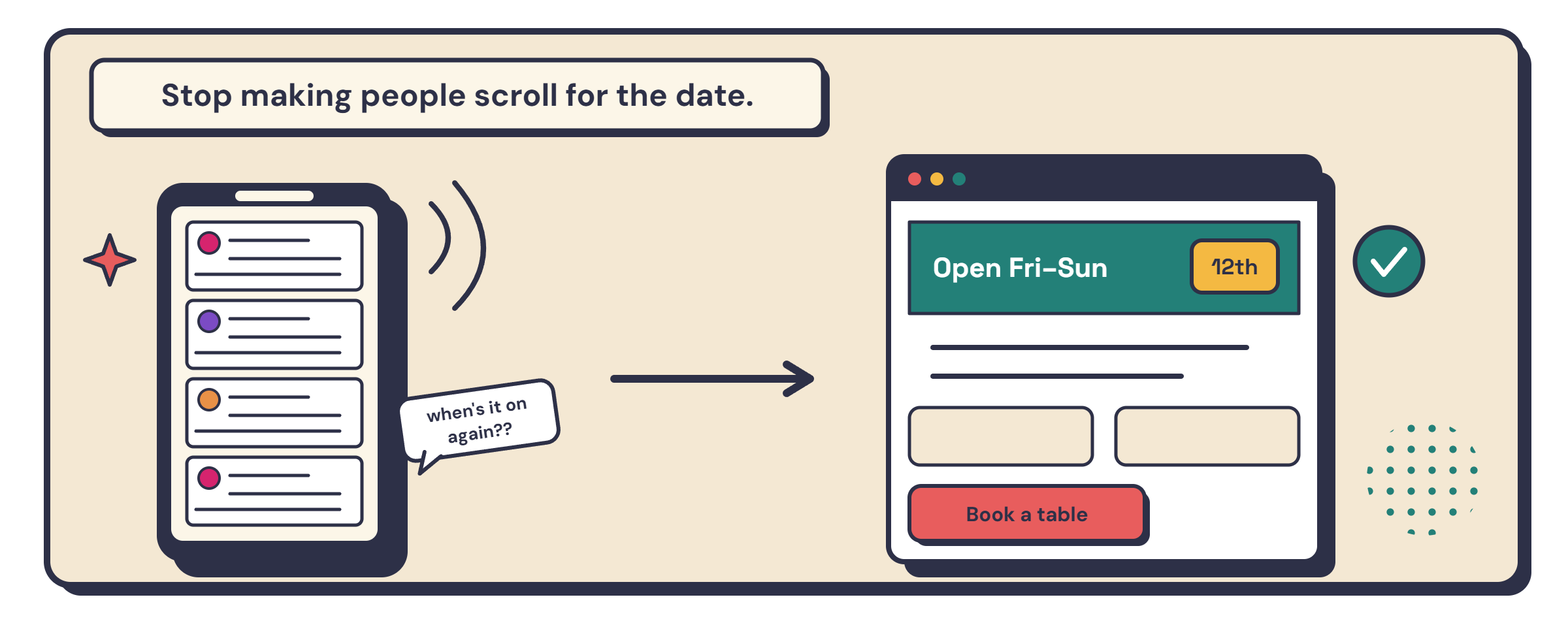
Here’s a problem I watched play out recently. A growing community group ran everything through Instagram — and it worked, right up until someone new wanted to join a monthly event. The date changes every month. So they’d scroll. And scroll. Hunting through weeks of posts for the one that said when and where.
That’s the gap a one-page website fills. Not a replacement for social media — a stable home base beside it. One link that always has the answer.
I’ve written before about landing pages versus full websites. This is different. A landing page exists for one campaign and one action. A one-pager is a permanent home — just a small one. And there’s a stubborn myth that a “real” website means five pages minimum. Let’s test that.
What actually fits on one page?
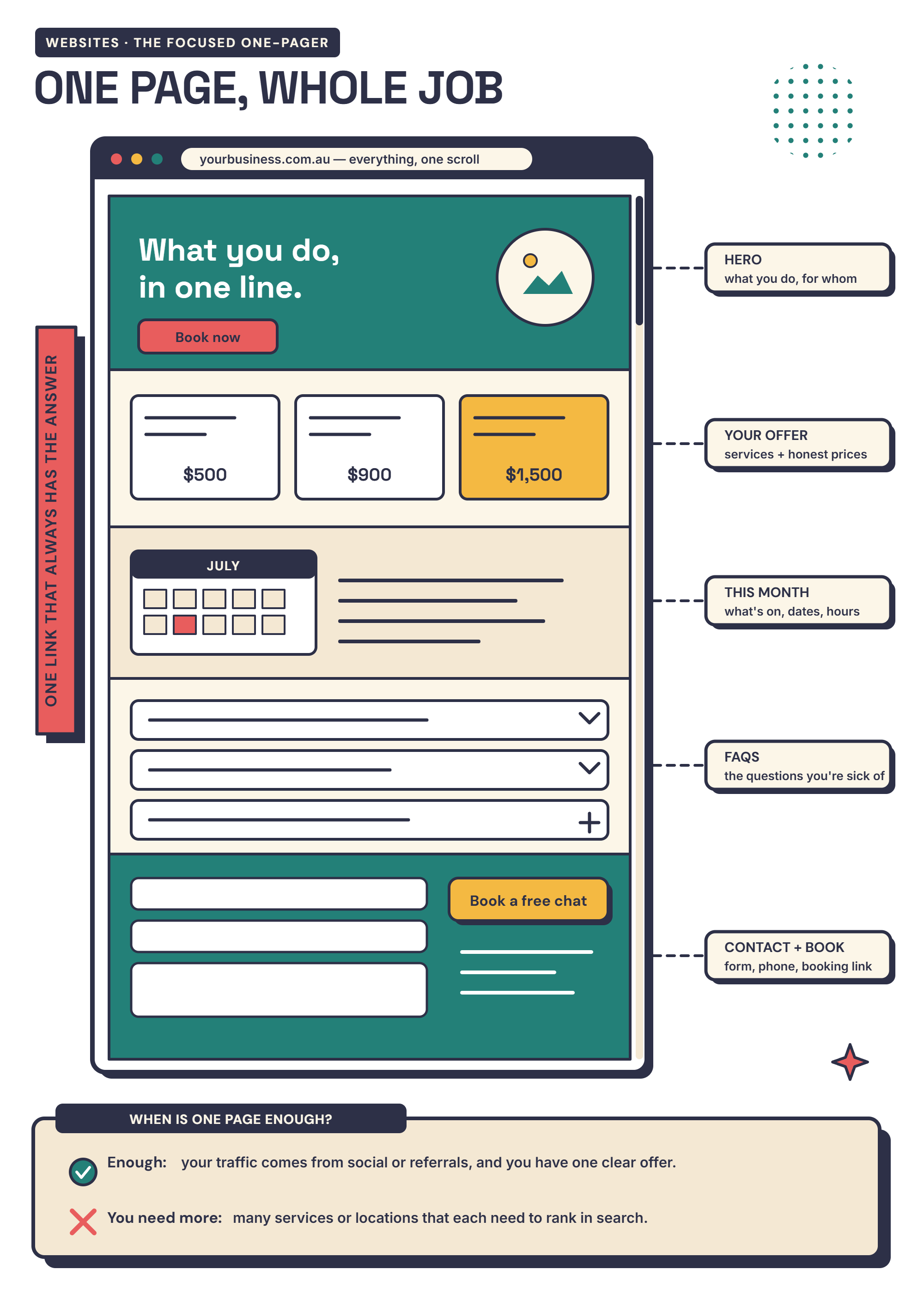
More than most people expect. The site I built for Heart First Founders — a walk-and-talk community for business owners in Perth and Melbourne — carries their story, why the group exists, this month’s walks in both cities, FAQs, contact details for each city’s host, and a newsletter signup. One page. Nobody scrolls Instagram for a date anymore.
Swap the details for your business and the shape holds. Who you are. What you offer, with prices if you’re brave enough to publish them (I think you should be). The one action you want people to take — book, call, order, sign up. A few honest FAQs. Done.
The structure works because visitors don’t actually want to explore your website. They want an answer, then they want to leave. A good one-pager respects that.
Can one page do the clever stuff?
This is the part that surprises people. That newsletter form on the Heart First site asks one extra question — which city are you in? Every signup lands in a CRM tagged Perth or Melbourne, sorted into ready-made lists. Each city’s host can email her own walkers without blasting the other side of the country. Tiny form, real capability.
The site also doesn’t try to do everything itself. Event registrations still run through Humanitix, because that was already set up, already working, and free. The newsletter still sends from the tool the founders already know. My rule: if something’s already working and costing you little or nothing, integrate around it. If you’re starting from scratch, consolidate into fewer tools. Both are valid — the mistake is rebuilding working things for the sake of tidiness.
One more admission. Part of that setup runs on a manual step — I send across the new signups weekly rather than automating the sync. On purpose. The volume doesn’t justify the plumbing yet. Automation should earn its place, even on a site I built.
When is one page the wrong choice?
Time for the honest bit, because a one-pager has a real ceiling — and it’s search.
Every page on a website is a chance to answer a different Google search. My own site has separate pages for websites, online stores, and automation because each one targets what different people actually type. A one-pager can’t do that. It can rank for your business name and maybe one core phrase. That’s roughly it.
So if your customers find you by searching — “electrician Joondalup”, “bookkeeper for tradies” — you’ll likely outgrow one page quickly, and something like five well-chosen pages earns its keep. Same if you’re selling a range of products, or planning to publish articles.
But if your people come from social media, referrals, or a link you hand them directly — one page is often the exact right size. Heart First Founders grows on Instagram. The website’s job was never to be found by strangers. Its job was to catch the people already looking.
How do you know which size you need?
Start with the smallest thing that solves the actual problem. Not the website you think a real business is supposed to have — the one that answers the question your customers keep asking.
For some businesses that’s five pages and a blog. For plenty of others, it’s one well-built page with a form that quietly does something clever. And a good one-pager isn’t a dead end — sections become pages when growth demands it. Nothing about starting small locks you in.
I build one-page websites for $500, hosting included for the first year — the details are on my website services page. If you’re not sure which size fits, book a free 15-minute chat and describe the question your customers keep asking you. The right answer is usually obvious within about five minutes — even if the answer is “smaller than you thought.”
Frequently asked questions
Is a one-page website good for SEO?
It's honest to say: limited. Each page on a website can target its own search queries, so a one-pager naturally has a smaller search footprint. If your customers come from social media, referrals, or a link you share directly, that trade-off often doesn't matter.
How much does a one-page website cost in Australia?
Anywhere from free-and-DIY to a few thousand dollars through an agency. I build custom one-page sites for $500, including hosting for the first 12 months and a 90-day settle-in period.
Can a one-page website grow into a full site later?
Yes. A well-built one-pager is a foundation, not a dead end. Sections can become pages as the business grows — nothing about starting small locks you in.
Got a question? Need some advice?
Book a free 15-minute call. No pitch — just straight answers. Most people walk away with a clear next step or a blocker sorted.
Book a Free Call →