
I’ve seen NDIS provider website quotes ranging from $500 to $15,000 — for sites that, functionally, do the same thing. The difference usually isn’t the quality of the work. It’s the assumptions being made about your budget.
There’s a pricing pattern in the NDIS space that reminds me of the wedding tax. You know how a cake or a dress suddenly costs three times more the moment someone mentions the word “wedding”? The same thing happens with NDIS. Some agencies hear “NDIS provider” and assume there’s a pot of government money behind it. The quote goes up accordingly.
The reality is most small NDIS providers are sole operators or tiny teams running on tight margins. The NDIS pricing framework doesn’t leave a lot of room for five-figure website projects — especially when your days are spent actually delivering support, not sitting in marketing meetings.
So here’s what an NDIS provider website actually costs in 2026, broken down honestly. (The full NDIS website guide covers what should be on the site — this one’s just about the money. My general website cost guide covers the broader market.)
The short version
Most small NDIS providers need a website in the $500–$2,000 range. That should get you a professional, mobile-friendly, accessible site with clear service descriptions, a referral form, your registration details, and basic SEO. Anything above that should be justified by specific features you actually need — not by the word “NDIS” appearing in the brief.
What does the range look like?
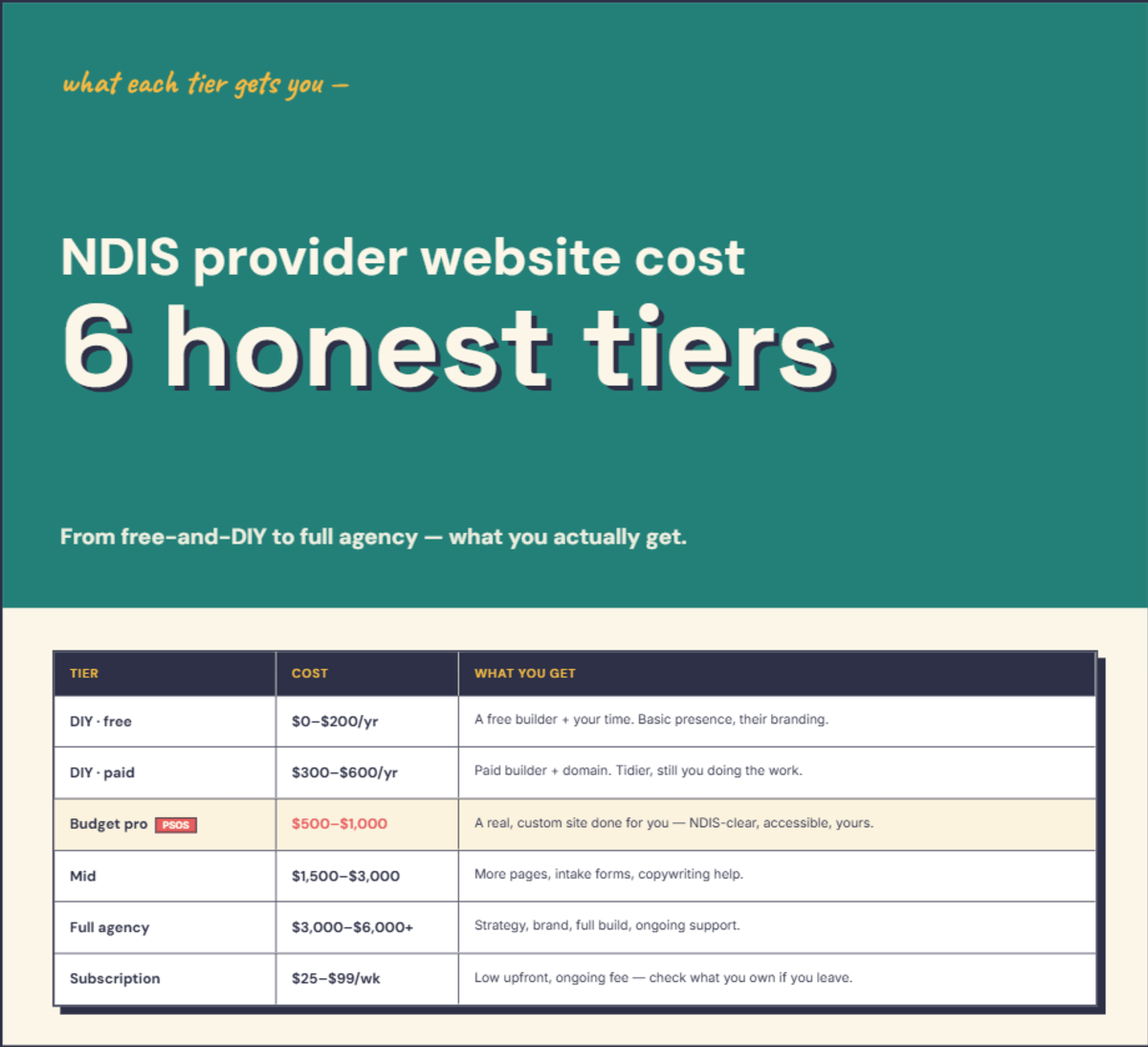
| Approach | Cost | What You Get | Best For |
|---|---|---|---|
| DIY (free tools) | $0–$200/year | Google Sites, Carrd, or free WordPress.com. Basic pages, limited design, no custom domain on free tiers | Providers testing the waters who want something online quickly |
| DIY (paid platform) | $300–$600/year | Squarespace, Wix, or paid WordPress.com. Better design, custom domain, some accessibility features | Providers comfortable with technology who have time to learn |
| Budget professional | $500–$1,000 | Custom design, mobile optimisation, SEO, accessibility compliance, referral form, 12 months hosting | Sole operators and small teams who need it done properly without overpaying |
| Mid-range professional | $1,500–$3,000 | Everything above plus booking system integration, CRM connection, multiple service pages, content writing | Growing providers with multiple service types and staff |
| Full-service agency | $3,000–$6,000+ | Custom design, complex integrations (ShiftCare, Lumary, Brevity), multilingual content, member portals, extensive content | Larger providers with complex requirements |
| Subscription model | $25–$99/week | Some NDIS-specialist agencies offer weekly payment plans. Total cost over a year: $1,300–$5,148 | Providers who prefer spreading costs but should check total cost and lock-in terms |
What should be included as standard?
This is where the quotes start to diverge — and where you need to pay attention.
Accessibility compliance should be included in every build. If a web designer is listing WCAG compliance as a separate line item — especially for an NDIS provider — I’d ask why. Building accessible from the start adds almost nothing to the development time. It only gets expensive when someone builds without it and has to retrofit. I’ve written about this in detail in my accessibility guide.
Mobile optimisation is the same. Around half of all web traffic is mobile. A site that doesn’t work on a phone isn’t finished. This isn’t an extra.
Basic SEO — title tags, meta descriptions, heading structure, alt text, a sitemap — takes an hour to set up during the build. It’s not a premium service. It’s part of building a website that can actually be found.
An SSL certificate (the padlock in the browser that means your site is secure) is free through Let’s Encrypt and included by every reputable hosting provider. If someone is charging you for this, something’s off.
If any of these appear as separate line items on a quote, ask why. They should be part of what you’re paying for — not extras that push the total up.
What might genuinely cost more?
Some features do require additional work and it’s fair to charge for them. The difference is whether the cost is justified by complexity or inflated by assumptions.
A booking or scheduling system — connecting Calendly, Acuity, or a platform-specific booking tool to your site. Depending on the integration, this adds $200–$500 to a build, plus the platform’s own monthly fee ($0–$30/month for most).
CRM integration — connecting your website to ShiftCare, Lumary, Brevity, SupportAbility, or another NDIS management system. This varies significantly depending on the platform and what data needs to flow between them. Could be simple (a Zapier connection for referral forms) or complex (real-time scheduling sync). Ask for specifics.
Multilingual content — if you serve participants who speak languages other than English, having key pages available in those languages is genuinely valuable. This requires translation (not just Google Translate) and adds to both the build and ongoing maintenance.
Custom donation or payment processing — relevant for providers who also operate as NFPs or accept self-managed participant payments directly. Payment gateway setup adds complexity.
Content writing — if you need someone to write all your service descriptions, about page, and supporting content from scratch, that’s additional work. I include copywriting assistance in my builds, but some designers charge separately.
The ongoing costs people forget
The website build is a one-off cost. But there are annual costs that keep it running:
Hosting: $50–$200 per year depending on the provider. I include 12 months free with every build.
Domain name: $15–$50 per year for a .com.au. You should own this yourself — not have it registered under your web designer’s account.
Platform fees (if applicable): Squarespace runs $27–$49/month ($324–$588/year). Wix is similar. WordPress.com ranges from free to $45/month. Self-hosted WordPress hosting is typically $50–$150/year.
Booking system: $0–$30/month depending on the tool and plan.
Email marketing: $0–$30/month. MailerLite’s free tier covers most small providers.
Total ongoing costs for a small provider: Roughly $200–$600 per year once the site is built. That’s $4–$12 a week. Less than a coffee a day.
What I charge
I charge $500 for a one-page website and $1,000 for a full site. That includes design, development, mobile optimisation, SEO, accessibility compliance, copywriting assistance, and 12 months of hosting.
My price is the same regardless of your industry. I don’t charge more because you’re an NDIS provider, and I don’t charge less because you’re a sole operator with a small budget — the price is already built around making professional websites affordable for small businesses and community organisations.
For not-for-profits, I offer discounts on a case-by-case basis. If your requirements go beyond a standard build, I’ll quote the additional work separately and explain exactly what you’re paying for and why.
I publish my pricing because I think you should know what something costs before you decide whether to contact someone. If you want to see the full breakdown, it’s on my pricing page.
How to compare quotes
If you’re getting multiple quotes — which I’d encourage — here are the things to check:
What’s included? Specifically ask about accessibility, mobile optimisation, SEO, SSL, and hosting. If any of these are missing or listed as extras, factor that into the comparison.
What’s the total cost over 12 months? A $500 build with $50/month hosting costs $1,100 in year one. A $2,000 build with hosting included costs $2,000. The headline number doesn’t tell the full story.
Who owns the domain? Make sure the domain is registered in your name, not the designer’s. My guide to domains and web hosting covers how to check.
Is there a lock-in contract? Some agencies — especially subscription-model ones — require 12 or 24-month commitments. Check the terms, check the total cost, and check what happens if you want to leave.
Can you update the site yourself? Or do you have to pay them every time you want to change a phone number? A good website build includes training on how to make basic updates.
If you want a straight conversation about what your provider website needs and what it’ll cost, book a 15-minute chat — no pitch, just honest numbers.
Frequently asked questions
Why do some NDIS website quotes cost $5,000 or more?
Some agencies charge a premium the moment they hear 'NDIS' — like a wedding tax, where the same product costs more because of the occasion. Others genuinely build complex sites with CRM integrations, multilingual content, and custom portals. The difference matters. A sole-operator support worker doesn't need a $5,000 website. Ask exactly what you're getting and compare it to what you actually need.
What are the ongoing costs of an NDIS provider website?
Hosting typically runs $50–$100 per year with most providers (I include 12 months free). A domain name costs $15–$50 per year for a .com.au. SSL certificates are usually free through providers like Let's Encrypt. Beyond that, you might pay for a booking system ($0–$30/month), email marketing ($0–$30/month), or a CRM if you need one. Total ongoing costs for a small provider are typically $200–$600 per year.
Can I build an NDIS provider website myself?
You can. Platforms like Squarespace ($27–$49/month) and WordPress.com ($0–$45/month) let you build a site without coding knowledge. The trade-off is your time, the learning curve, and the risk of missing NDIS-specific requirements like accessibility compliance and correct branding. For a sole operator whose time is better spent delivering support, a professional build often makes more sense financially.
Got a question? Need some advice?
Book a free 15-minute call. No pitch — just straight answers. Most people walk away with a clear next step or a blocker sorted.
Book a Free Call →