
There are words and phrases that NDIS providers use on their websites every day — often in good faith — that can result in fines of tens of thousands of dollars. Some have led to Federal Court proceedings.
The rules come from three different places: the NDIS Code of Conduct, the NDIA’s trademark and branding guidelines, and Australian Consumer Law. They overlap in places, contradict each other in tone, and aren’t written in a way that makes them easy for a sole-operator support worker to follow. So here’s my attempt at a plain-English version.
I’m not a lawyer. This isn’t legal advice. But these are the rules as they currently stand, drawn from the official NDIS Commission and ACCC sources — and they directly affect what goes on your website.
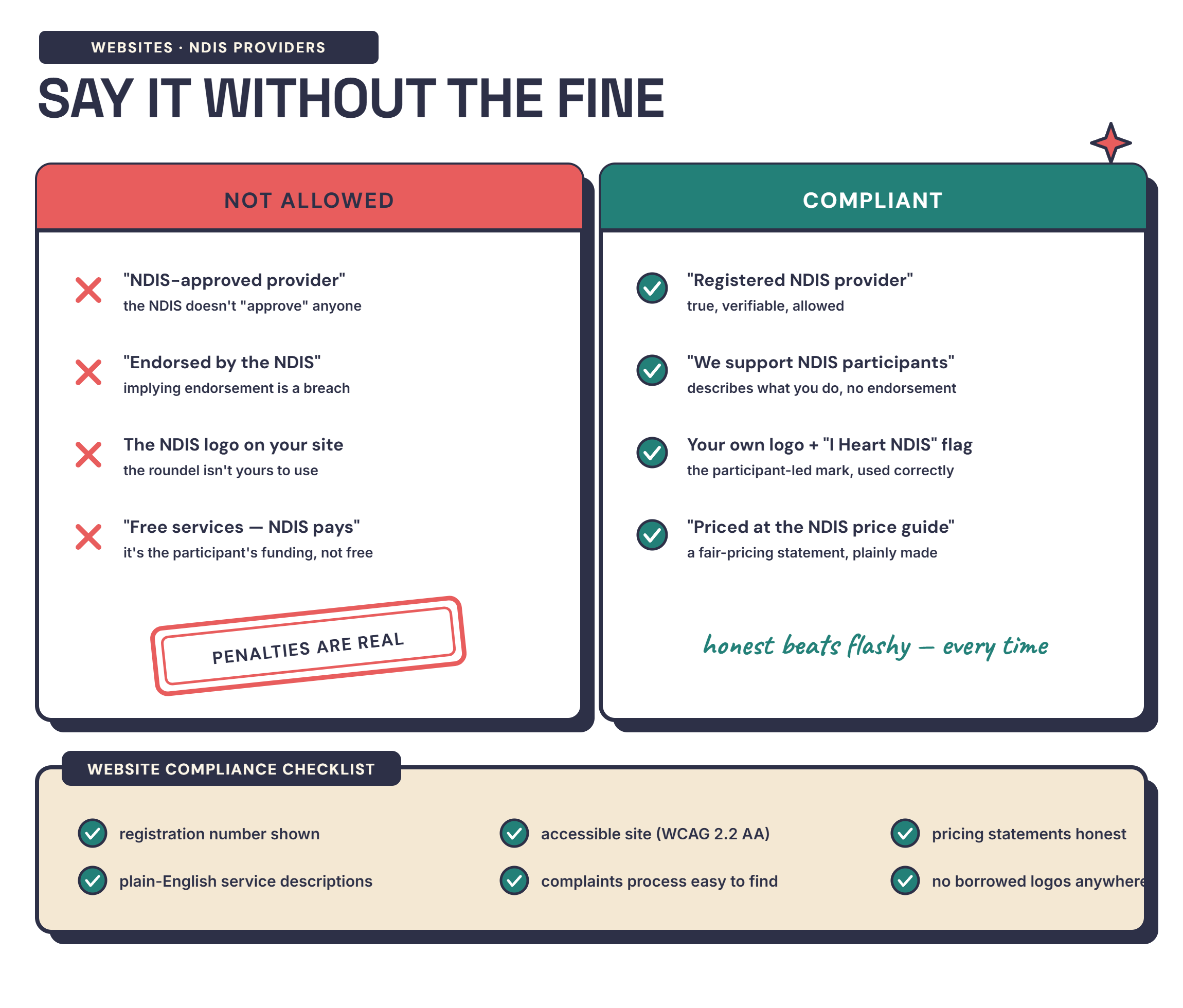
Phrases you can’t use
This is where most providers trip up, because the language feels natural and harmless. But the NDIS has a specific position on each of these — and the ACCC enforces it.
“NDIS approved” — The NDIS doesn’t approve individual providers or services. Registration means you’ve met the Practice Standards and passed an audit. It doesn’t mean the NDIS has reviewed your specific service and given it a tick.
“NDIS endorsed” — Same problem. The NDIS doesn’t endorse providers. Using this implies a level of official backing that doesn’t exist.
“100% NDIS funded” — This suggests the NDIS automatically pays for your service, which isn’t how it works. Whether a participant can use their plan to access your service depends on their individual plan, their funding categories, and how their plan is managed.
“Official NDIS provider” — There’s no such thing. You’re either registered or you’re not. “Official” implies a status that doesn’t exist in the NDIS framework.
What you can say: “NDIS registered provider.” “Our services can be funded through the NDIS.” “We work with NDIS participants.” These are factual statements. The line is between describing what you are and implying something you’re not.
If you’re not a registered provider, you can still provide services to self-managed and plan-managed participants — but you need to be clear about your registration status on your website. Claiming or implying registration when you’re not registered is a breach of the Code of Conduct.
The NDIS logo rules
The NDIS name and logo are registered trademarks owned by the NDIA. You can’t use them without permission, and you can’t use “NDIS” in your business name in a way that implies affiliation with the scheme.
If you’re a registered provider, you can use the “I ♥ NDIS” or “We ♥ NDIS” logos — but there are conditions. The logo must include the “Registered Provider” tagline. You can’t change the colours. You can’t alter the size ratios. You can’t modify the design. You can’t remove or obscure the tagline.
If you’re not registered, you can’t use these logos at all.
The main NDIS logo — the one you see on ndis.gov.au — requires written NDIA consent. Most small providers don’t need it and shouldn’t use it.
This sounds straightforward, but I’ve seen plenty of provider websites with recoloured logos, stretched logos, logos without the tagline, and even logos that look like they were screenshot from the NDIS website and pasted into a header. Each of those is technically a breach.
The fair pricing rule
This one is newer and has real teeth.
Since December 2023, the NDIS Code of Conduct has included a fair pricing provision. The rule: you can’t charge NDIS participants more than non-NDIS customers for the same goods or services without reasonable justification.
A Fair Pricing Taskforce chaired by the ACCC — alongside the NDIS Commission and the NDIA — specifically monitors NDIS pricing. In December 2024, the ACCC brought Federal Court proceedings against Ausnew Home Care over alleged misleading pricing practices, including “was/now” pricing that inflated the apparent discount NDIS participants were receiving.
This matters for your website because if you display pricing — which I think you should, for transparency — your NDIS rates and your non-NDIS rates need to make sense together. Charging $150 an hour for a service to the general public and the full NDIS price-limit rate for exactly the same service to an NDIS participant is the kind of thing the taskforce is looking at.
The NDIS Pricing Arrangements and Price Limits set maximum prices, not recommended prices. If your actual cost of delivering a service is $120 an hour, charging NDIS participants the maximum just because that’s the cap is exactly the pattern the ACCC is targeting.
My own approach is to publish one set of prices for everyone. I don’t change what I charge based on who’s asking or what industry they’re in. That keeps it simple — and it keeps it fair.
The penalties are real
This isn’t a theoretical risk. Enforcement is active and the amounts are significant.
Thermomix paid $79,200 in penalties over misleading NDIS claims. Bedshed paid $39,600. The ACCC’s proceedings against Ausnew Home Care Services are ongoing in Federal Court. The NDIA actively monitors the marketplace and issues cease-and-desist letters for trademark misuse.
The NDIS Amendment (Integrity and Safeguarding) Act 2026, which commenced in April 2026, introduced maximum civil penalties reaching $16.5 million for serious contraventions. Under Australian Consumer Law, penalties can reach $50 million or three times the benefit obtained.
For a sole-operator provider, even a smaller fine can be devastating. The simplest way to avoid it is to be accurate about what you are, honest about what you charge, and careful about how you use the NDIS name.
A practical checklist for your website
Here’s what I’d check if I were reviewing an NDIS provider website right now:
Registration claims: Does your website accurately state your registration status? If you say you’re registered, are you? If your registration lapses, will you remember to update the site?
Logo usage: If you’re using the “I ♥ NDIS” logo, does it include the “Registered Provider” tagline? Are the colours unaltered? If you’re not registered, is there an NDIS logo anywhere on the site that shouldn’t be there?
Language: Do any pages use “NDIS approved,” “NDIS endorsed,” “100% NDIS funded,” or “official NDIS provider”? Search your site for these phrases — they might be in places you’ve forgotten about, like a footer or an old blog post.
Pricing: If you display prices, are your NDIS rates consistent with what you charge non-NDIS customers? If they’re different, do you have a reasonable justification documented?
Service descriptions: Do any pages imply that the NDIS will definitely fund a particular service? Funding depends on individual participant plans — your site should make that clear.
Business name: Does your business name or trading name use “NDIS” in a way that could imply affiliation with the scheme?
If you’re not sure about any of these, it’s worth getting a second pair of eyes on your site. I offer a free website audit that covers content, accessibility, and compliance basics — and I’ll flag anything that looks like it could be a problem.
The rules are changing — keep your site current
The NDIS is in the middle of its biggest reform since it started. The Getting the NDIS Back on Track legislation from October 2024 introduced stronger marketing and advertising provisions. The Integrity and Safeguarding Act, which commenced in April 2026, brings higher penalties and new criminal offences for serious breaches — including misleading advertising.
From 1 July 2026, registration is mandatory for SIL and platform providers. That means thousands of providers who’ve been operating without registration will need to update their marketing materials — including their websites — to accurately reflect their new registration status.
If you’re affected by these changes, your website needs to be updated at the same time your registration takes effect. Not three months later.
I’ve written a broader guide covering everything NDIS providers need from a website — including accessibility requirements, the pricing framework, and what pages to include. The marketing rules in this post are one piece of a bigger picture.
Frequently asked questions
Can I use the NDIS logo on my website?
Only if you're a registered provider. You can use the 'I heart NDIS' or 'We heart NDIS' registered provider logos — but only with the 'Registered Provider' tagline, and you can't change the colours, size, or design. The main NDIS logo is a registered trademark and requires written NDIA consent to use.
Can I say 'NDIS approved' on my website?
No. The NDIS does not approve or endorse individual providers or their services. Phrases like 'NDIS approved,' 'NDIS endorsed,' '100% NDIS funded,' and 'official NDIS provider' are all prohibited. You can say you're an NDIS registered provider if you are one, or that your services can be funded through the NDIS.
What happens if I break the NDIS marketing rules?
The ACCC and NDIS Quality and Safeguards Commission actively enforce these rules. Thermomix was fined $79,200 and Bedshed $39,600 for misleading NDIS advertising. The ACCC took Ausnew Home Care Services to Federal Court in December 2024. Maximum penalties now exceed $16.5 million under the NDIS Integrity and Safeguarding Act 2026, and $50 million under Australian Consumer Law.
Got a question? Need some advice?
Book a free 15-minute call. No pitch — just straight answers. Most people walk away with a clear next step or a blocker sorted.
Book a Free Call →