
Not every website needs a rebuild. Sometimes a few targeted fixes — updating content, improving speed, adding a proper CTA — can turn things around. I’d rather save you money than sell you a new site you don’t need.
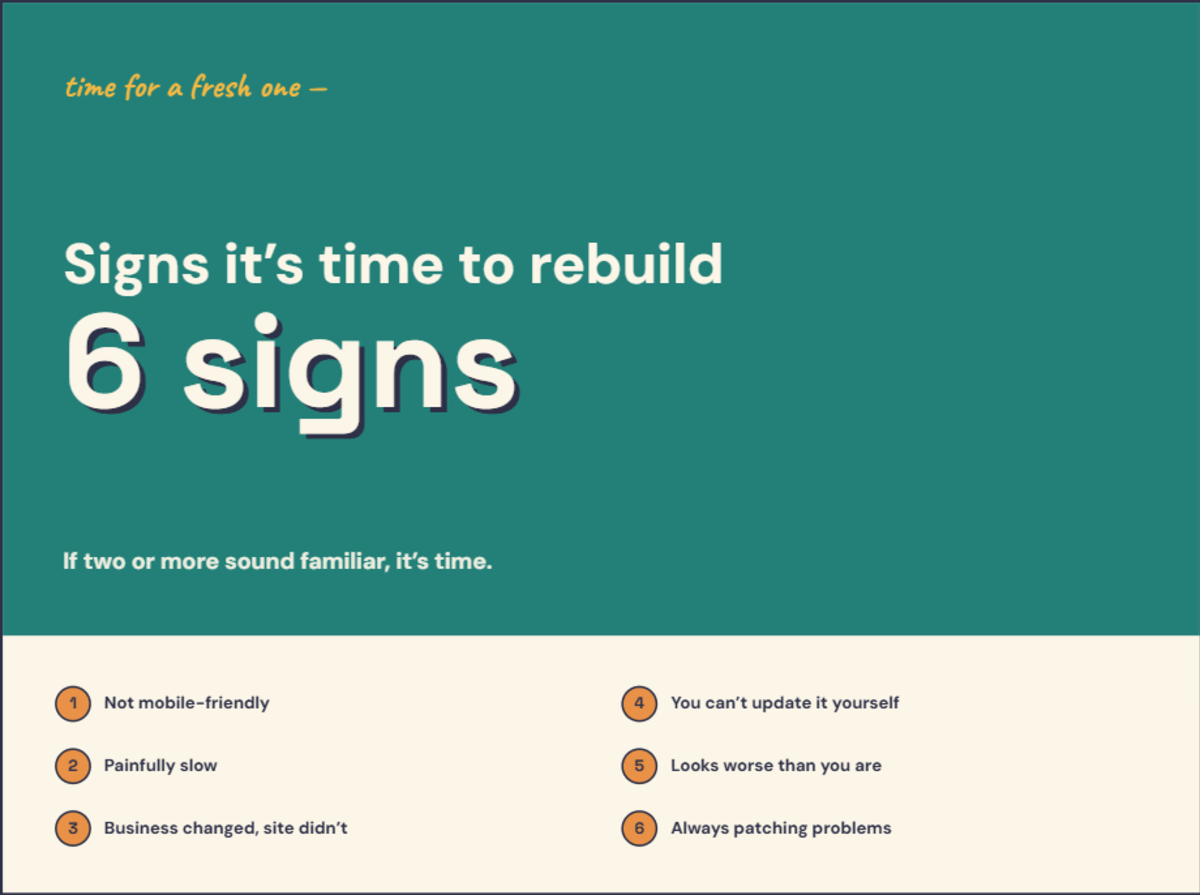
But there’s a point where patching stops making sense. Where the cost and effort of fixing what’s broken approaches — or exceeds — the cost of starting fresh on solid foundations. Here are the six signs that point crosses.
How long does a website actually last?
The average lifespan of a small business website sits somewhere between 2 and 5 years, depending on who you ask. Orbit Media’s long-running lifespan study puts the average at about 2 years and 7 months — though actively maintained sites routinely run far longer.
The honest answer: a website lasts as long as it continues to do its job. A well-built, well-maintained site can run for 5+ years. A site built on a platform that’s no longer supported might need replacing after 2.
1. It’s not mobile-friendly
Statcounter puts mobile at roughly four in ten Australian page views — and Google indexes the mobile version of your site first, meaning if your mobile experience is poor, your rankings suffer regardless of how your site looks on a desktop.
If your website was built before 2018 and hasn’t been substantially updated since, there’s a real chance it’s not genuinely mobile-responsive. Test it: open your site on your phone and navigate through every page. If you’re pinching to zoom, scrolling horizontally, or struggling to tap buttons — that’s not a tweak. That’s a structural problem that usually means a rebuild.
2. It’s painfully slow
Google’s current benchmark is a Largest Contentful Paint (LCP) score under 2.5 seconds. If your site is above 4 seconds, Google considers that “poor” — and your visitors left before the page finished loading.
Speed problems can sometimes be fixed: compressing images, removing unnecessary plugins, upgrading hosting. But if your site is built on an older CMS version with years of accumulated plugins, or if the theme itself is the bottleneck, optimisation hits a ceiling. You can spend $2,000 trying to speed up a site that was never going to be fast — or put that money toward a clean, fast build.
How to check: PageSpeed Insights — test your homepage on mobile. If LCP is red (above 4 seconds), note whether the recommendations are simple fixes or fundamental architecture issues.
3. Your business has changed — but the site hasn’t
This is the most common trigger I see. You’ve added new services. You’ve dropped old ones. Your pricing has changed. Your target audience has shifted. You’ve rebranded, or your old branding no longer reflects who you are. But the website still says what you did three years ago.
A website that describes a different version of your business is worse than no website at all. It creates confusion, sends the wrong people your way, and makes existing clients wonder if you’re still operating.
If the changes are minor — updating text and swapping a few images — that’s not a rebuild. If your services, positioning, and audience have fundamentally shifted, it usually is.
4. You can’t update it yourself
If you need to email your web designer every time you want to change a phone number, update your hours, or add a blog post — and especially if they charge you each time — that’s a dependency problem.
Some designers build sites on proprietary platforms where only they have access. Others build on standard platforms but never gave the client login credentials. Either way, if you can’t make basic updates to your own website, the relationship is backwards.
A rebuild on an accessible platform — with proper training and your own login — puts you back in control. My post on DIY vs hiring a web designer covers when each approach makes sense.
5. It makes your business look worse than it is
Research consistently shows people form an opinion about a website within 50 milliseconds — and that opinion directly affects whether they trust the business. If your website looks dated, it makes your business look dated. Even if your actual service is excellent.
This isn’t about following design trends for the sake of it. It’s about whether your site accurately represents the quality of what you do. If you’re embarrassed to send people to your website — if you find yourself saying “don’t judge us by the website, it’s old” — that’s a sign.
Design ages faster than you’d think. A site that looked contemporary in 2022 often looks noticeably dated by 2025. My post on how much a website costs in Australia and Perth-specific pricing cover what a rebuild actually costs.
6. You’re patching problems that keep coming back
Security warnings. Broken plugins. Formatting that randomly breaks. Pages that load differently each time. If you’re spending time and money fixing recurring issues rather than running your business, the site has become a liability.
WordPress powers about 41.5% of all websites — and outdated core versions, themes, and plugins are consistently how WordPress sites get hacked. If your CMS, plugins, or PHP version are out of date and updating them risks breaking the site, that’s a rebuild signal.
The rule of thumb: if the estimated cost to fix your existing site exceeds 50–60% of what a fresh build would cost, the rebuild wins. You get a clean, fast, secure foundation instead of a patched-together compromise.
If three or more of these apply
A rebuild is almost certainly better value than continuing to fix. Not because there’s anything wrong with fixing — but because the compounding cost of ongoing patches, the time you spend worrying about it, and the business you’re losing to a site that doesn’t represent you adds up.
Want to know where your site stands? Get a free website audit — I’ll tell you honestly whether it needs a few fixes or a fresh start. No obligation either way.
Frequently asked questions
How often should a small business rebuild its website?
The average website lifespan is roughly 2–5 years before it starts showing its age. Simple brochure sites can last 5–7 years with regular content updates. But lifespan depends more on whether the site still does its job than on any fixed timeline. If it's mobile-friendly, loads quickly, reflects your current business, and generates enquiries — it doesn't need rebuilding just because it's 4 years old.
Is it cheaper to fix my old website or start fresh?
It depends on the specific problems. If the issues are content and design, updating can work. If the problems are structural — wrong platform, not mobile-responsive, no CMS access, outdated code — retrofitting often costs as much as rebuilding, and you end up with a compromised result. A good rule of thumb: if the estimated cost to fix exceeds 50–60% of a fresh build, rebuild.
Want to know how your current website stacks up?
Get a free, plain-English audit.
Get Your Free Audit →